

從試點到驗證 – 健康醫療AI的真實世界評估與漂移監測
本文探討了健康醫療領域AI系統進行真實世界評估與漂移監測的關鍵性,強調AI與傳統軟體不同,其運作具有機率性,需要持續理解並適應變化的情境。



From Pilot to Proof — Real‑World Evaluation & Drift Monitoring for Health AI
Article summary
Healthcare is picking up AI quickly, but the expectations around it sometimes feel out of sync with how these systems actually behave. There’s still an assumption that AI should act like traditional software: steady, predictable, and consistent. So, say someone asks, “If I run the same problem twice, will I get the same result?” That’s a question we hear all the time in early AI pilots. What they’re really asking for is confidence that the system won’t surprise them. But intelligence—human or artificial—doesn’t work that way.
Building AI That Improves Care in Healthcare
Doctors reviewing the same chart don’t always agree. Two clinicians can look at identical symptoms and still recommend different next steps. Even lab results show slight variation when run more than once. Beyond individual variation, the world around these systems shifts: workflows change, populations change, and the context an AI operates in today won’t look exactly the same tomorrow. AI systems, which operate probabilistically, reflect that same kind of variation. The goal isn’t to eliminate it. It’s to understand it, measure it, monitor it, and design an adaptable system that accounts for when things start to drift. In other words: acknowledging the friction and designing for it.
This shift is happening at the regulatory level, too. In 2025, the FDA formally asked for public feedback on how AI‑enabled medical devices should be measured in real‑world conditions [1]—a signal that evaluation and drift monitoring are no longer optional. That’s the gap this paper addresses. If healthcare leaders want AI they can trust, they need pilots that generate real evidence—not anecdotes, not one‑off demos, but reproducible results grounded in experiment design and UX research methods. But the transition from early experimentation to broader adoption has stalled largely because clear evaluation standards don’t yet exist.
This paper outlines practical methods and frameworks Atomic Object is already applying on real projects to help close that gap and make AI safer to adopt. Taken together, these ideas lay a roadmap for how organizations can move from a promising prototype to something dependable enough for clinical and operational use. In the best‑case scenarios, this approach can even reduce some of the natural human variability we see across clinical settings—creating more trust in the systems meant to support care.
The Core Problem: Why Healthcare AI Pilots Break Down
Many healthcare AI pilots fall apart long before they reach real adoption—not because the ideas are bad, but because the way they’re tested and evaluated just isn’t enough. MIT found that 95% of GenAI pilots fail [2], often because teams focus on the wrong metrics or rely too much on feel‑good “time saved” stories. And some of the issues don’t show up until an AI system leaves the test environment and hits the messiness of the real world:
Data that doesn’t match what the model was trained on.
Models might look great in testing, but once they hit real‑world data—messier, inconsistent, and full of surprises—they can stumble. It’s one of the quickest ways drift shows up.
Unusable or inconsistent data structures.
As The Economist highlights, many teams discover too late that their data isn’t in a format an AI system can actually work with, making it difficult to produce reliable outputs [3].
Privacy and regulatory hurdles.
Strict rules around medical data—and the slow, complex process of validating AI systems—make it difficult to iterate, test, and refine models in real clinical settings.
The “black box” problem.
Clinicians hesitate to trust systems when they can’t easily explain or validate how an AI reached a decision. This is increasingly a compliance risk, as new transparency rules like the ONC’s HTI-1 require developers to provide clear explanations of the logic behind predictive decision support [11].
Starting with an AI idea instead of a real problem.
When teams jump to a solution too quickly, it often leads to misalignment—and the end product doesn’t actually solve anything meaningful for users.
Drift sits at the center of many of these issues: an AI system might perform beautifully in testing, then begin to fail when it encounters new inputs, new workflows, or new populations. Drift is not a failure—it is an expected property of AI systems operating in dynamic environments.
Model drift refers to the gradual decline in a model’s performance as the real‑world data it encounters changes over time. Even a well‑trained model can start producing inconsistent or incorrect results when the patterns, inputs, or relationships it learned from no longer match what it sees in practice. Drift is normal and expected—but without monitoring, it can quietly undermine decision‑making and trust in the system [5].
Without monitoring and regular evaluation, failures can go unnoticed until trust erodes and the pilot loses momentum fast.
The Taxonomy of Change: Categorizing Drift by Origin
To manage AI effectively, we must move beyond treating “drift” as a simple technical failure. For a healthcare executive, the goal is to identify where the change originates so they can hold the right team accountable for the fix.
1. Data & Pipeline Drift: When the “Fuel” Changes
AI is fueled by data. If the plumbing of your hospital changes—due to an EHR update, a new lab vendor, or a change in how nurses document symptoms—the AI receives “low-quality fuel.” This is often a silent failure that occurs before the AI even makes a decision.
2. World & Clinical Reality Drift: When “Truth” Changes
Sometimes the data is fine, but the medical world has moved on. If your AI was trained to detect a disease using 2022 guidelines, it might provide “incorrect” advice in 2025 because medical standards have evolved.
3. Human & Workflow Drift: When “Behavior” Changes
This is often the most overlooked risk. It occurs when staff adapt their behavior in response to the AI. If the tool is frustrating or slow, clinicians will find “workarounds” that break the system’s logic.
4. Outcome-Level Drift: When the “Bottom Line” Changes
This is the “check engine light” of the AI system. It tells you the system is failing, but not why. By the time this drift is visible, you are already losing ROI or risking patient safety.
Governance & Accountability Matrix
Effective AI management requires a cross-functional approach. While executive leadership owns the risk, the delivery team (Engineers and Designers) provides the instrumentation and agility needed to manage it.
The Solution: Designing AI Pilots Like Regulated Experiments
At this point, one thing should be clear: success with healthcare AI is less about choosing the “right” model and more about adopting the right process. This is an emerging and fast-moving problem space. As models, tools, and regulations evolve, teams that succeed are the ones who treat AI projects as learning systems—designed to generate evidence, surface risk early, and adapt as reality changes.
“Success with healthcare AI is less about choosing the ‘right’ model and more about adopting the right process.”
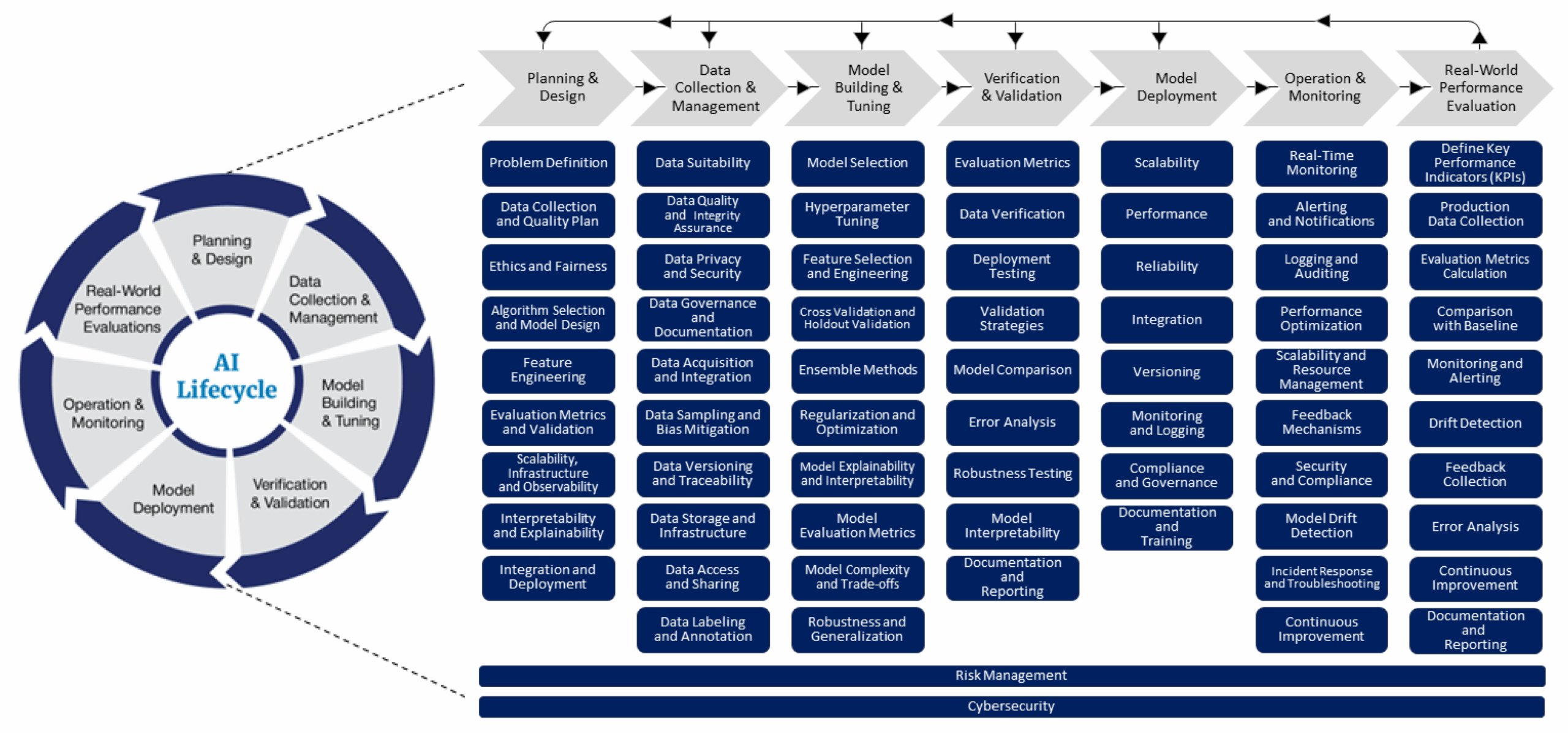
At Atomic Object, we approach AI work the same way regulators increasingly expect it to be managed: as a lifecycle, not a launch. This aligns with the FDA’s shift toward a Total Product Life Cycle (TPLC) approach, where safety and effectiveness are managed through continuous monitoring and predetermined change protocols [9]. Pilots are not disposable proofs of concept; they are structured experiments that produce governance-ready evidence.
Scope note: This post is about evidence and operational risk—how you prove performance, detect drift, and decide when to expand deployment. It is not a guide to determining whether a feature is SaMD or non-device CDS; treat that as a separate, earlier scoping decision.
A Lifecycle-Driven Process for AI Projects
Each phase of the lifecycle answers a different governance question, but the connective tissue across all of them is design. Not visual design, and not interface polish—but experiment design, service design, and systems design: the practice of anticipating how systems behave over time, how people actually use them under pressure, and how those interactions shape risk, performance, and trust.
Figure 1: The FDA’s lifecycle management approach toward delivering safe and effective AI-enabled health care. Source: FDA Digital Health Center of Excellence.
A Design‑Led, Experiment‑Driven AI Process
We approach AI projects as a series of structured experiments embedded within real services. Each phase is deliberately designed to answer specific questions about behavior, risk, and readiness—before automation increases.
AI development begins with the scientific method, not model selection. Teams pre‑declare hypotheses, success criteria, failure thresholds, and stop conditions before exposure to real users. Evaluation datasets, cohorts, and time windows are chosen deliberately so outcomes are reproducible, comparable, and defensible—not anecdotal.
UX research is how teams surface risk early. By studying real workflows, edge cases, and decision‑making under pressure, designers identify where AI inputs and outputs may be misunderstood, ignored, over‑trusted, or repurposed.
Rather than jumping straight to high-impact deployment, pilots move through a deliberate progression of system impact—offline evaluation → shadow mode → supervised deployment → constrained automation. Each transition is gated by evidence, not optimism.
From day one, systems are instrumented to observe change across the full service: input mix, output distribution, subgroup performance, and human interaction patterns.
Human oversight is intentionally designed, not bolted on. Review workflows capture structured feedback, annotated errors, and escalation signals that feed quality assurance and learning.
The outcome of a pilot is not a demo—it’s evidence. One‑page reports summarize acceptance criteria, results (with uncertainty), error taxonomies, and a clear decision narrative: continue, revise, or stop.
ROI in healthcare AI is less about time saved and more about decision confidence. While early hype focused on immediate efficiency, industry experience suggests that the “real” ROI is often slower to materialize and rooted in clinical durability and clinician well-being rather than immediate administrative cost-cutting [10].
In Practice
In practice, this work comes together as a repeatable system for designing, governing, and improving AI over time. The techniques below are applied together, not in isolation:
Health AI: From Pilot to Proof
Healthcare AI does not fail because it changes—it fails when teams assume it won’t. Moving from pilot to proof requires treating AI systems less like traditional software and more like living participants in complex clinical and operational environments.
By combining rigorous evaluation methods with UX research, human‑in‑the‑loop design, and real‑world monitoring, organizations can generate the kind of evidence regulators, clinicians, and leaders are increasingly asking for. The goal is not perfect consistency, but understood variability—systems whose behavior is observable, explainable, and responsive to change.
References

Related Posts
The Joys of Working on a Large Software Development Team
Why My Team Started Running Weekly Dev Syncs
Use Cursor as a BI Tool for Fast, Actionable Delivery Insights
Keep up with our latest posts.
We’ll send our latest tips, learnings, and case studies from the Atomic braintrust on a monthly basis.
Join the conversation Cancel reply
Your email address will not be published. Required fields are marked *
Comment *
Name *
Email *
Save my name, email, and website in this browser for the next time I comment.
Δdocument.getElementById( "ak_js_1" ).setAttribute( "value", ( new Date() ).getTime() );
Project & Team Management Category
The Joys of Working on a Large Software Development Team
Why My Team Started Running Weekly Dev Syncs
Use Cursor as a BI Tool for Fast, Actionable Delivery Insights
Tell Us About Your Project
We’d love to talk with you about your next great software project. Fill out this form and we’ll get back to you within two business days.
Atomic is a software design + development consultancy.


相關文章