


解鎖健康洞察:利用智慧手錶估計進階步行指標
Google Research 發布的研究結果顯示,智慧手錶能夠可靠地估計進階的時空步態指標,例如步行速度和步長,為健康洞察開闢了新途徑。
Defining the technology of today and tomorrow.
Philosophy
We strive to create an environment conducive to many different types of research across many different time scales and levels of risk.
People
Our researchers drive advancements in computer science through both fundamental and applied research.
Research areas
Foundational ML & Algorithms
Computing Systems & Quantum AI
Science, AI & Society
Projects
We regularly open-source projects with the broader research community and apply our developments to Google products.
Publications
Publishing our work allows us to share ideas and work collaboratively to advance the field of computer science.
Resources
We make products, tools, and datasets available to everyone with the goal of building a more collaborative ecosystem.
Shaping the future, together.
Student programs
Supporting the next generation of researchers through a wide range of programming.
Faculty programs
Participating in the academic research community through meaningful engagement with university faculty.
Conferences & events
Connecting with the broader research community through events is essential for creating progress in every aspect of our work.
Unlocking health insights: Estimating advanced walking metrics with smartwatches
January 15, 2026
Amir Farjadian, Research Scientist, and Ming-Zher Poh, Staff Research Scientist, Google
We verified that smartwatches serve as a highly reliable platform for estimating spatio-temporal gait metrics through a large-scale validation study.
Quick links
Gait metrics — measures like walking speed, step length, and double support time (i.e., the proportion of gait cycle when both feet are on the ground) — are known to be vital biomarkers for assessing a person’s overall health, risk of falling, and progression of neurological or musculoskeletal conditions. Analyzing how a person walks, known as gait analysis, offers valuable, non-invasive insights into general well-being, injuries, and health concerns.
Historically, measuring gait required expensive, specialized laboratory equipment, making continuous tracking impractical. While smartphones now offer a portable alternative using their embedded inertial measurement units (IMUs), they demand precise placement — such as a thigh pocket or belt — for the most accurate results. In contrast, smartwatches are worn on the wrist in a fixed location. This provides a much more practical and consistent platform for continuous tracking, even expanding the tracking window to phone-less scenarios like walking around the house.
Despite this crucial logistical advantage, smartwatches have historically lagged behind smartphones in comprehensive gait metric evaluation. In our work, "Smartwatch-Based Walking Metrics Estimation", we sought to bridge this gap. We demonstrated that consumer smartwatches are a highly viable, accurate, and reliable platform for estimating a comprehensive suite of spatio-temporal gait metrics, with performance comparable to smartphone-based methods.
A deep learning approach for the wrist
To achieve this, we developed a multi-output (i.e., multi-head) deep learning model built on a temporal convolutional network (TCN) architecture identical for both smartwatch and smartphone data. This multi-head model is a key differentiator from prior TCN-based approaches, which often only provide temporal events (like contact points) that require drift-prone integration for spatial metrics like step length and gait speed. Our model, in contrast, directly estimates all spatio-temporal gait metrics.
Our model takes two key inputs, user height (a single scalar demographic input) and raw IMU signals, which include 3-axis accelerometer and 3-axis gyroscope data from a single on-wrist Pixel Watch at 50 Hz sampling frequency. The model architecture extracts embeddings from the IMU sensor input, which are then concatenated with the demographic data before the final prediction layers. The multi-head model output then directly estimates a comprehensive suite of measures, including bilateral metrics, one head each for gait speed and double support time, and unilateral metrics, two heads each (one for left and one for right foot) for step length, swing time, and stance time. Definitions for each of these metrics are defined as:
For data segmentation, we used 5-second windows with a 1-second overlap. We utilized mean absolute percentage error (MAPE) for the loss function, which uniquely optimizes for the relative accuracy across all multi-unit outputs (e.g., step length in cm, double support time in ms).
Rigorous validation in a large-scale study
To rigorously evaluate the model, we conducted a large-scale validation study featuring a large cohort of 246 participants and approximately 70,000 walking segments. Participants were screened to be over 18, not using assistive devices, and without balance- or gait-affecting conditions. Data was collected from two international cohorts: Google in Mountain View, California and Kyoto University in Japan.
For the reference (ground truth) measurements, we used a lab-grade Zeno Gait Walkway system. Participants were outfitted with a Pixel Watch 1 on each wrist and four Pixel 6 phones placed in the front pocket, back pocket, backpack, and a cross-body bag.
The study protocol included a diverse range of walking patterns to ensure comprehensive evaluation:
The smartwatch model was trained using data from both wrist-worn devices, while the smartphone model's testing phases exclusively utilized data from front and back pocket phone placements, given their expected prevalence and highest accuracy. We employed a five-fold cross-validation strategy to maximize the test cohort and prevent data leakage by assigning all data from a single participant to a single split.
Key findings
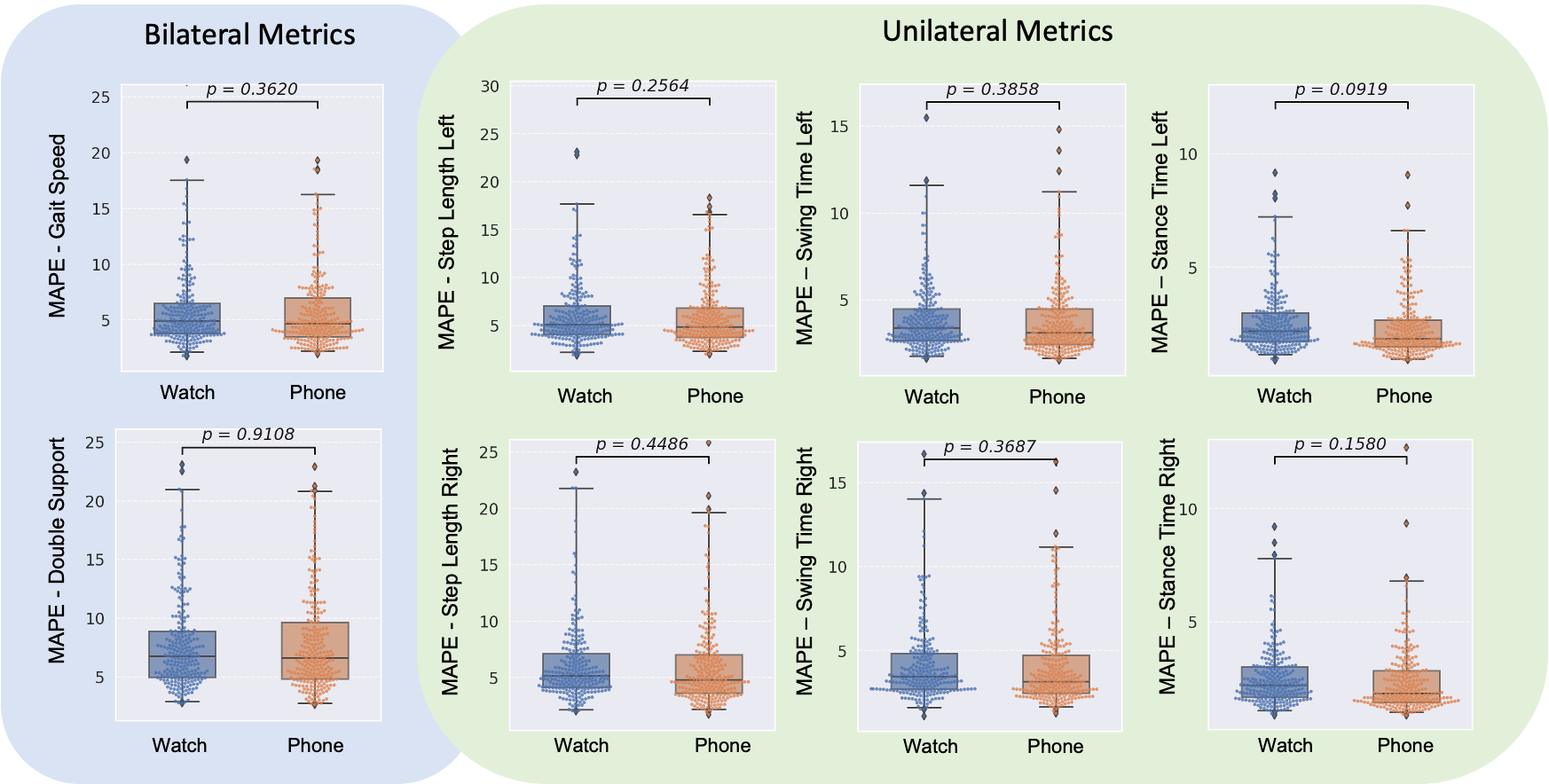
The results collectively demonstrated the accuracy, correlation, and reliability of the smartwatch-based method, showing comparable performance to smartphone estimates, despite the smartphone model being trained with approximately two times more data segments.
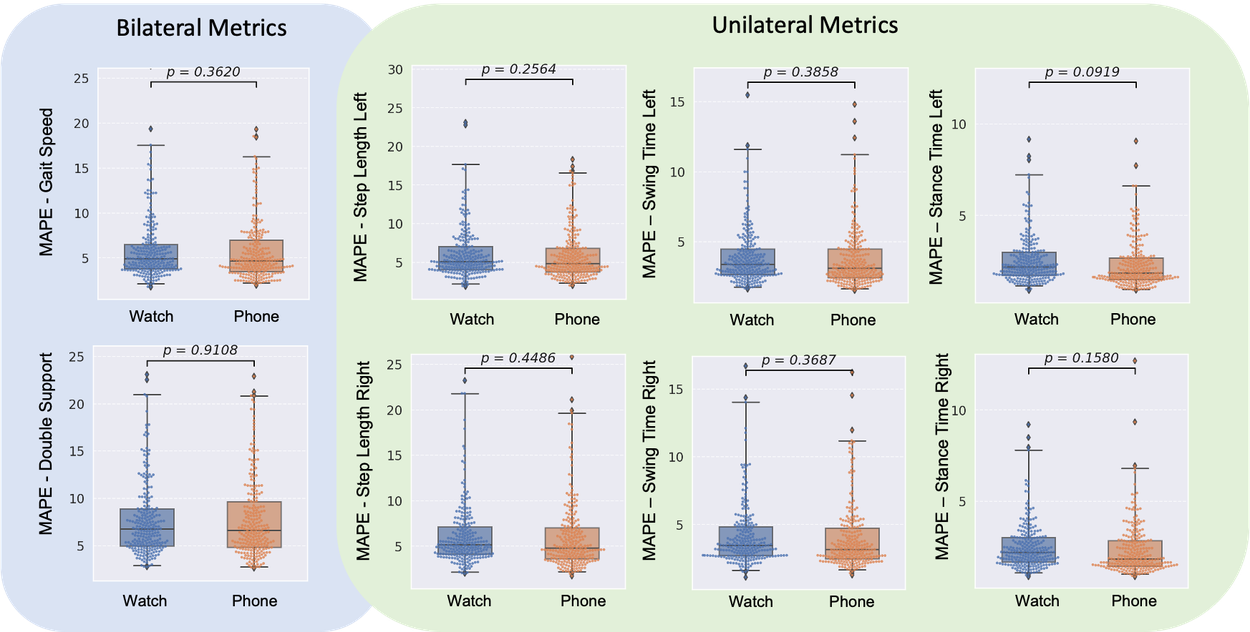
Gait parameter accuracy reflecting the mean absolute percentage error (MAPE) for Pixel Smartwatch (Watch) and Pixel Smartphone (Phone) (N=246 participants). Boxes indicate the interquartile range (Q1–Q3), whiskers show 1st–99th percentiles.
Impact and future directions
These findings are a major step in establishing the ubiquitous on-wrist smartwatch as a foundational technology for accurate and reliable gait-based health tracking. By bringing comprehensive gait analysis out of the lab and onto the wrist, we can enable:
The smartwatch offers a practical and consistent platform for health tracking that overcomes the placement issues associated with smartphones. Our continued work will explore refining and expanding the suite of metrics to maximize the utility of smartwatches in proactive health tracking and recommendations.
Acknowledgements
The following researchers contributed to this work: Amir B. Farjadian, Shun Liao[e3e428], Alicia Y. Kokoszka, Kyle DeHolton, Jonathan Hsu, Jonathan Wang, Lawrence Cai, Mark Malhotra, Shwetak Patel, Anupam Pathak, Ming-Zher Poh.
Work done while at Google.
Quick links
Other posts of interest

January 13, 2026

December 12, 2025

November 18, 2025
Follow us
相關文章
其他收藏 · 0