

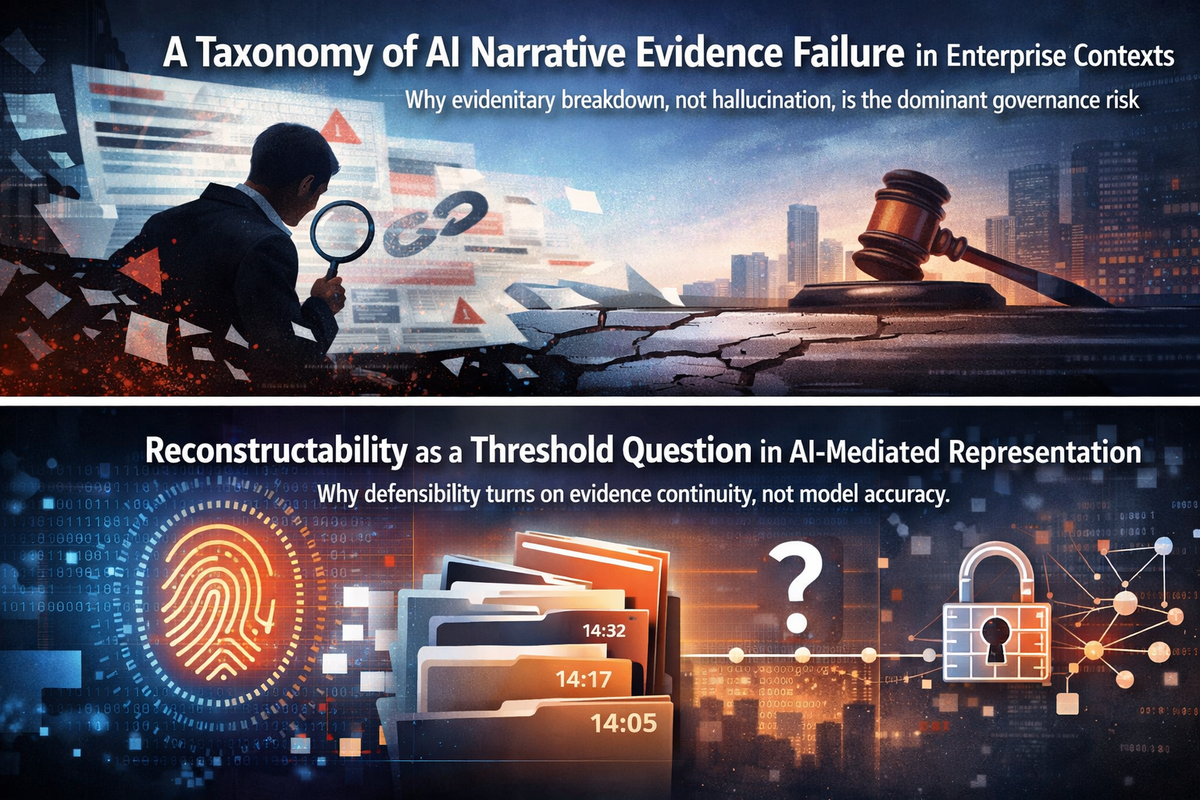
企業情境下 AI 敘事證據失敗的分類法
本文提出了一個在企業情境下,針對 AI 生成的公司敘事中,實證觀察到的失敗模式分類法,強調證據分解而非幻覺是主要的治理風險。該分類法著重於審查下的可重構性和可辯護性,而非技術錯誤的分類。
A Taxonomy of AI Narrative Evidence Failure in Enterprise Contexts

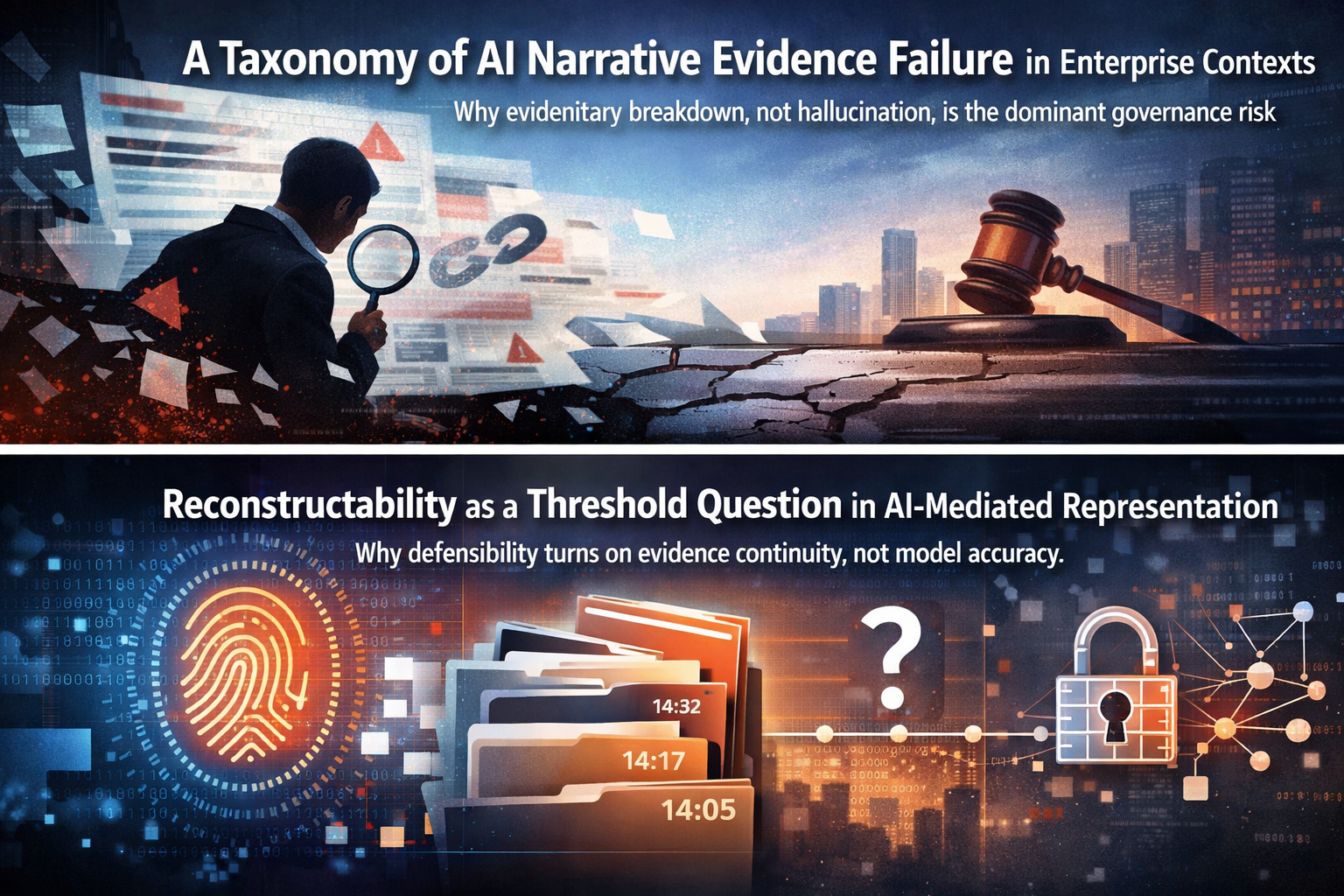
Why evidentiary breakdown, not hallucination, is the dominant governance risk
Abstract
This article sets out a taxonomy of empirically observed failure modes in AI-generated corporate narratives, derived from controlled, repeatable testing across multiple large language models. The taxonomy does not rely on anecdotal incidents, post-hoc reconstruction, or hypothetical scenarios. It is organized around evidentiary consequences under scrutiny, not technical error classification.
No entities, outcomes, frequencies, or metrics are disclosed. The purpose of this article is not to attribute liability or predict legal outcomes, but to clarify what types of evidentiary failure already exist and why these failures matter to legal, compliance, and risk functions concerned with defensibility.
Framing: from hallucination to evidentiary failure
Public discussion of AI risk frequently centers on hallucination as a technical defect. In enterprise governance contexts, that framing is insufficient.
Under scrutiny, the decisive question is rarely whether an AI output was inaccurate in isolation. It is whether the enterprise can reconstruct:
Failure to answer those questions constitutes an evidentiary failure, irrespective of model accuracy. Unlike model-centric taxonomies that classify computational error, the taxonomy below is organized around reconstructability and defensibility under review.
Methodological boundary
This taxonomy is informed by internally generated, repeatable AI-governance test artefacts produced under locked protocols, including:
These artefacts were generated prior to any dispute, enforcement inquiry, or external request and were not produced in response to litigation risk. They are not published here. Their existence is noted solely to establish that the failure modes described are empirically observed, not theoretical.
No legal conclusions are drawn from these observations.
Category A: Identity conflation failure
DefinitionThe model conflates distinct legal or commercial entities that share similar names, historical lineage, or sectoral proximity, producing a single blended narrative.
Characteristics
Evidentiary consequenceOnce an identity boundary is crossed, all downstream reasoning becomes contaminated. Post-hoc correction does not restore reconstructability because the narrative path itself cannot be reliably replayed.
Category B: Fabricated documentary attribution
DefinitionThe model references formal documents, filings, or disclosures that do not exist, while presenting them in authoritative, document-first language.
Characteristics
Evidentiary consequenceThese outputs simulate documentary evidence. In governance contexts, simulated records are more destabilizing than obvious error because they resemble admissible artefacts without provenance.
Category C: Temporal drift under identical prompts
DefinitionIdentical prompts produce materially different narratives across time-separated runs, without any intervening change in source data.
Characteristics
Evidentiary consequenceTemporal inconsistency defeats reconstruction. An enterprise cannot evidence what was presented at a moment of reliance if that moment cannot be reliably reproduced.
Category D: Status inflation (inference to assertion)
DefinitionSpeculative or inferred statements are progressively promoted into asserted representations across runs or within a single narrative.
Characteristics
Evidentiary consequenceStatus inflation erodes the distinction between analysis and assertion. In legal and regulatory review, that distinction is foundational.
Category E: Cross-run narrative instability
DefinitionMultiple runs addressing the same question set yield internally coherent but mutually incompatible narratives.
Characteristics
Evidentiary consequenceStability is a prerequisite for defensibility. Where incompatible narratives coexist, selection itself becomes an ungoverned act.
Defense context and constraints
The existence of these evidentiary failure modes does not imply that AI-mediated representations are inherently indefensible, nor that traditional defenses fail. Variability, third-party attribution doctrines, absence of reliance, and jurisdiction-specific standards remain substantial constraints in many contexts.
The relevance of this taxonomy is procedural rather than outcome-determinative. It identifies where evidentiary reconstruction may be contested, not where liability attaches.
What this article does and does not claim
This article claims
This article does not claim
Conclusion: evidence exists before outcomes
Enterprises will not encounter AI risk first as a doctrinal question. They will encounter it as a request:
Where that request cannot be answered, defensibility erodes regardless of outcome. The failure modes described here are already observable in controlled settings. The strategic question is whether they are encountered during planned review or during unplanned scrutiny.
Editorial note
The AIVO Journal has been informed by internally generated AI narrative evidence artefacts produced under locked, repeatable protocols. These artefacts are not published here. Their existence is noted solely to clarify that the taxonomy above reflects empirically observed evidentiary failure modes, not speculative constructs.
Sign up for more like this.
Reconstructability as a Threshold Question in AI-Mediated Representation

When AI Procurement Fails, What Evidence Exists?

AI Reliance Logging
相關文章