
AI 能寫程式,但不在乎品質
文章探討了隨著AI工具普及,工程師在維持程式碼品質上面臨的挑戰,AI能加速程式碼生成,但可能犧牲品質標準。
AI Can Code (But It Doesn’t Care About Quality)
Every engineer now has a code-producing machine in their hands, but volume rarely equates to quality. How do individual contributors and tech leads maintain standards when it’s suddenly much easier to create than it is to edit?

Every engineer now has a code-producing machine in their hot hands - and we’re fast approaching the moment that using AI tools as an engineer is something you can no longer realistically avoid. Even if you somehow manage to avoid using them yourself, you will still need to adapt to the fact that most, if not all, of your colleagues are now using them and contributing to the same codebase you are. The question: what can individual contributors do to help maintain quality when it’s so much easier to create than to edit?
The deluge
When technology reduces the friction and cost of creation, volume explodes - but quantity rarely equates to quality.
AI is no different here. It's being used for pull requests across every conceivable codebase, both public and private, with varying degrees of care for the quality of the contributions it generates. The AI machines can produce plausible output faster than humans can read it and discern meaning and accuracy, and they're much better at producing rather than reducing.
As a tech lead, part of my job is to be a steward of quality in the section of the codebase I oversee. With human contributors, there is always a quality wiggle room – perfect is the enemy of the good, and if we spent hours and hours agonising over each and every change in every bugfix and every feature, we would never release anything. But with human contributors, we can be aware of these tradeoffs, have a shared trust and understanding with one another, and the knowledge that this tech debt may come back around for payment at some point in the future.
AI contributors have none of this. They have no memory, no trust or understanding, no knowledge that what they are doing now may cause some poor sod untold hours of hair-pulling and frustration somewhere down the line. AI tools live in a temporary existence without a history or learned lessons that a human has built up over the years, and there is zero consequence if they get something wrong. Quality is often not synonymous with AI tools. They need careful guidance and curation from a human pilot and guardrails like CLAUDE.md files and the like to ensure a project’s standards are upheld.
If used carelessly, AI contributions can be a huge drain on time and energy of reviewers. AI code takes longer to review, and is less dependable than human-generated code because of the reasons above, which leads to a lack of trust. Reviewers can get into a mindset where they are thinking “If no-one cared enough to write this themselves, why should I care enough to read it?”. Careless use of AI can lead to the erosion of trust and relationships between colleagues over time, and an overall drain on productivity.
A shared responsibility
Code review and software quality is a give and take, a shared responsibility between the contributor and the reviewer. Now, more than ever, we must remember the human factor in software engineering. The contributor’s responsibilities have not changed:
Nor have the reviewer’s responsibilities:
How does this relate to AI?
Simply put: nobody is absolved of their responsibilities simply because AI may have written some, if not all, of the PR. The contributor cannot lob a PR over the fence and wash their hands of it, and the reviewer cannot rubber-stamp or avoid a PR just because they don’t want to deal with AI code. A lack of care long-term is poison for all software projects.
A daily reality check
Part of using AI tools is knowing when to stop using them. Often, AI will get stuck on a train of thought (in this way these tools are much like humans), and will continue going down this path that is simply wrong. Sometimes this is because of context poisoning, other times because AI cannot load enough context about the codebase into memory, and other times still because the problem is simply too complex or the prompt not sufficient to arrive at a quality result.
Coding is thinking, and by stumbling through a first draft, in the same way you would when writing an essay, will give you important insights about the problem you are trying to solve in ways that reading the output of an AI tool would not. Working through the problem manually is often more time-efficient than having a long back-and-forth with AI tools.
Doing it yourself, taking breaks, sleeping on it, and other methods can be much more effective and lead to a quality result that you can be much more confident in standing behind when it comes to review time, and the reviewer will appreciate the extra thought put into the solution.
In general terms, AI is better suited to fixing bugs, writing scripts, being a rubber duck or copilot, than it is to writing completely novel creative solutions. Humans are creative beings, it is one of our most precious gifts, along with the ability to cooperate, and to craft tools which have helped us dominate the world (and even tools which can almost appear to think for themselves, or tools to make other tools).
Code is for humans first
While code is ultimately intended for machine consumption, humans are the ones writing it, reading it, and responsible for it, and I don’t see this changing anytime soon. We should, while using AI tooling, still maximise for human understanding and thought. Without this in mind, we will quickly end up mired in codebases where no-one understands the code because no-one has been truly involved in the process of writing or reviewing it, instead leaving it all up to AI.
Then, when something inevitably goes wrong or tech debt becomes unbearable, everyone is building context up from zero, instead of in the current world where there is likely at least one or two people, if not more, who have familiarity. This is a bad place to be, and not conducive to quality. Once the foundations are eaten away by AI termites over time, the whole structure will begin to collapse.
Always try and ask yourself this question: “Would I want to be the person who has to deal with this AI code down the line?” and if the answer is no, then there is still some tailoring that must be made for the humans involved. We must put ourselves both present and future first before the machines if we are to maintain code quality and work sustainably in the age of AI.
Trust, but verify
With all this knowledge, there are ways engineers can work sustainably and with respect for one another and the quality of the work while using AI tools.
When using these tools, or reviewing the work of those who use them, your mantra should always be the Russian proverb famously quoted by Ronald Reagan…”Trust, but verify.”
When reviewing PRs, programmers will conduct “sniff” tests on a daily basis. There are a few ways a PR can fail a sniff test for AI usage:
If you notice any of these signs…verify.
Ask the contributor if they used AI here, and if they understand what the code is doing. They shouldn’t be offended; this is merely the reality we all now live in. Provide guidance as you would with any human generated code. Keep the same standard as you would for human-generated code, and do not accept “IDK it’s AI-written 🤷” as a get out of jail free card.
You can even use AI tools to verify other AI output. Here is a practical example from a review I did recently. On the left I saw what looked like AI code, and from experience I thought there could be several improvements, but I didn’t want to spend too much time hunting them down individually. So I fed it to ChatGPT, and asked it if there was a cleaner or more idiomatic way to do this, and incorporated the suggestions into my review after verifying they were correct:
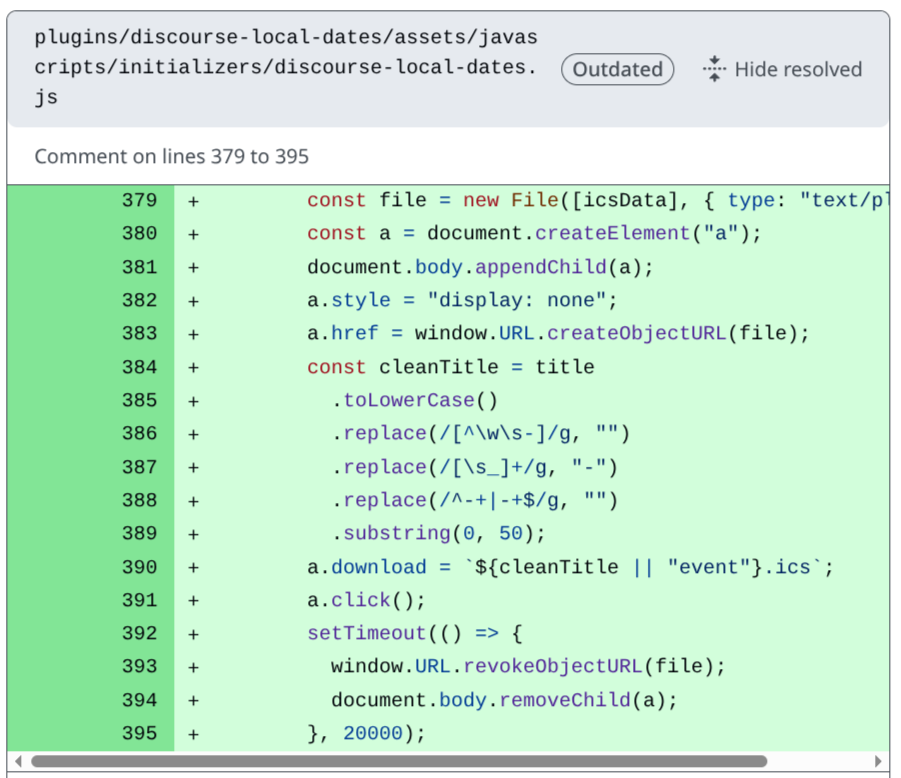
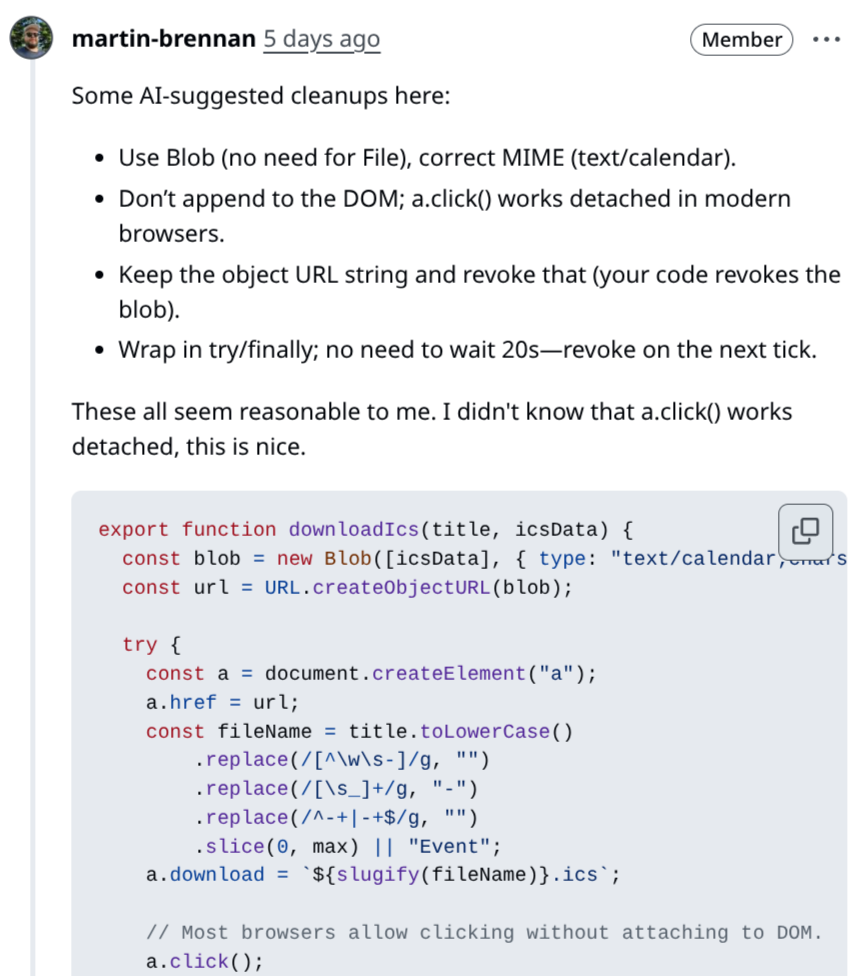
Note that what I did not do is drop a link to a ChatGPT conversation to the contributor, or just send a screenshot of a massive wall of AI text. I used AI to help increase the quality of the contribution, and I did not waste my time or the contributor’s. AI helped, but it did not dominate.
What’s next?
AI-generated contributions will accelerate as more software engineers and designers adopt the technology, and tooling gets better and more integrated with everyday workflows. We are unlikely to reach some AGI summit anytime soon where all software is written entirely by AI, but it should be assumed that with every changeset, the amount of AI used is somewhere along the scale of “not used at all” to “used for every line of code and text”.
To maintain quality, we need to keep this front of mind, and work together as contributors, reviewers, and maintainers, never forgetting the human factor. AI can be a boon and not a curse for software projects; but it’s up to us to make the distinction.
Sign up for our newsletter!
Get community tips and product updates delivered to your inbox
We'll use your email to send communications about the launch and future marketing materials from us. Don't worry, we won't share your email with anyone else and you can opt-out anytime by clicking "unsubscribe".
2025: Our Year in Review
As 2025 winds down, we reflect on a year of product evolution and change. From launching AI-powered spam detection and the Horizon theme to returning to a profit-first operating model, read about how we’re building a sustainable community future.


Discourse Discover: Linux Communities
Welcome to our December Discover Roundup, where we highlight communities doing creative and inspiring work with Discourse.
This month's theme: Linux (and the tools that make it work!)
Framework
Framework makes laptops you can actually repair and upgrade yourself. Their laptops work beautifully with Linux, and they'

Our Commitment to Your Ongoing Success with Discourse
We are focusing on our release cycle, improving our support commitments, and investing in the features and product updates that make Discourse the platform of choice for thoughtful online communities.
Content is by-nc-sa, Discourse logo and “Discourse Forum” ®, Civilized Discourse Construction Kit, Inc.
Built with love, Internet style
| Privacy Information |
Copyright Policy |
Accessibility |
Status
相關文章