

2025 AI 總結:我如何用 100% AI 生成的程式碼完成專案
本文闡述了作者在程式設計中運用 AI 的演變歷程,從最初的聊天機器人進階到能完成複雜程式碼任務的 AI。作者現在能以提出想法的速度來建構原型,讓工程管理人員能夠在不阻礙團隊的情況下,保持技術能力。


2025 AI Wrapped: Evolution of Using AI Every Day
This is Part 1 of 5 of my 2025 AI Wrapped series. This post covers my evolution from “CHOP” programming to integrated CLI/Cursor workflows, why I now build prototypes instead of PowerPoints, and how AI makes it possible for engineering managers to stay technical without impeding their teams.
AI makes programming viable for engineering managers again. I’ve been building with AI this past year, and AI has evolved from a frustratingly limited chat bot (2023), to a useful but context-limited research assistant (2024), to something that actually completes complex programming tasks (2025).
The biggest evolution in my work: I can now validate ideas at the speed I used to pitch them. So instead of theorizing about how something might work, I’m validating that it can work. By building with AI, I’m “showing” proof of work instead of “telling.”
Before AI, if I had an idea I wanted to explore, I would have to either interrupt my fellow engineers, spend hours muddling through a “hello world” setup, or worse, be shut down on StackOverflow. Many ideas died before they could even be evaluated for feasibility.
Now, with AI, I build in the same timeframe I used to spend on PowerPoints and one-pagers. I’m fitting build iterations into gaps between meetings, validating ideas while protecting scarce engineering time. Organizational buy-in still matters, but now I show up to the meeting with working prototypes instead of just a PowerPoint.
Given the choice between building PowerPoints or prototypes, I choose the prototype, every time.
Evolution of AI Tools and my GitHub contributions
This shift didn’t happen overnight. A year ago, I was using chat-based AI alongside my work, primarily brainstorming ideas and writing code using “CHOP”-style programming, i.e., copy/pasting code to/from a web chat agent. Results were so unreliable and inefficient that I would review every proposed changeset as if inspecting each widget coming off an assembly line.
During 2025, AI has gone from “nice to have” to critical for collapsing the learning curve and navigating project domains. My setup is Anthropic Claude Code, OpenAI Codex, and Cursor as an integrated workflow. In 2024, I used one chat window; now I run multiple AI agents concurrently—generating code, brainstorming next steps, and running terminal commands.
With the newest frontier models (GPT 5.1, Claude 4.5), 95 percent1 of AI-generated code compiles and is useful enough to iterate upon. Now, instead of inspecting each unit of generated code, I’ll use GitHub Desktop to review the changeset, use more AI cycles to improve code quality, and finally push it for peer-review.
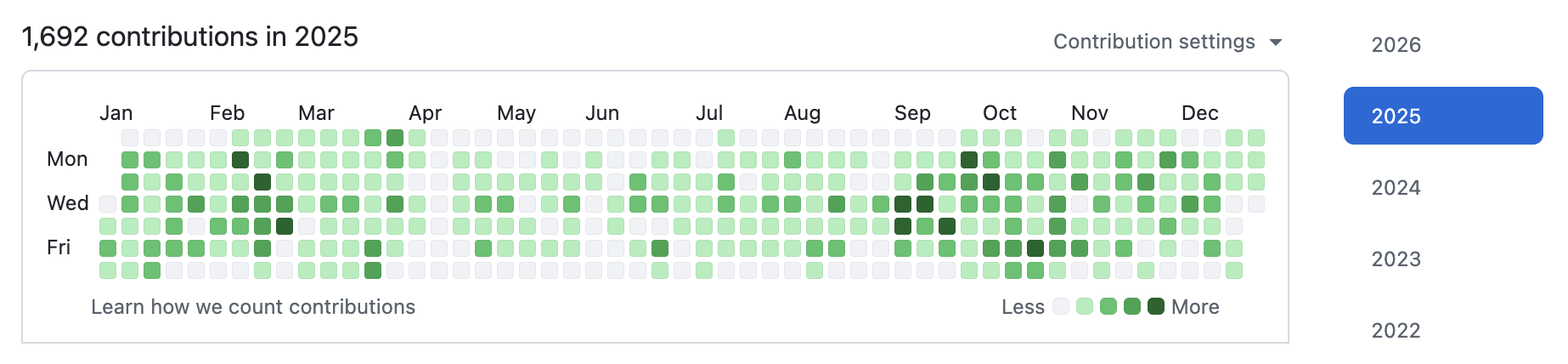
My GitHub activity shows this evolution in three distinct phases.
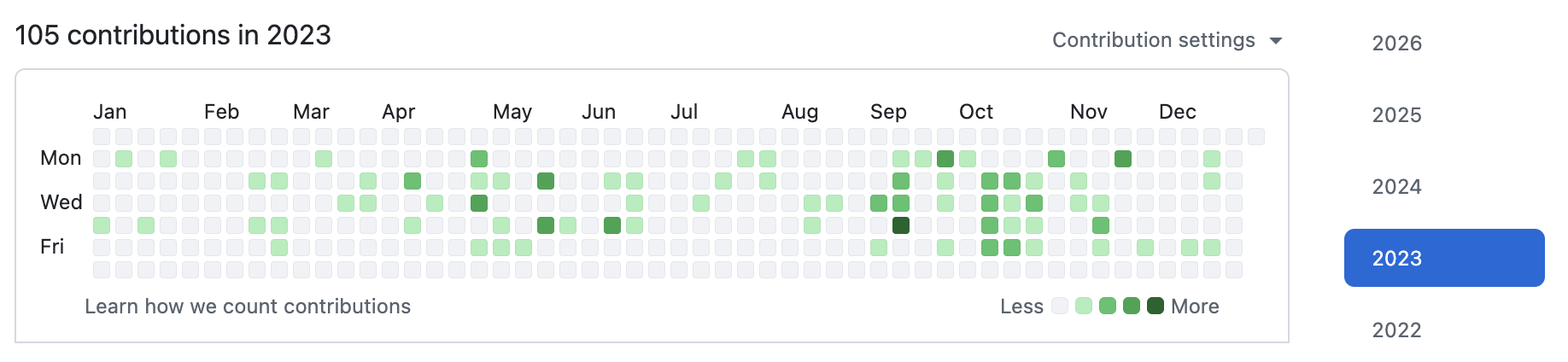
2023: This was the “engineering managers don’t have time to code” phase. I did very little hands-on work, and me trying to code would just burden my team. The below contribution chart reflects the occasional PR review, and some prototype/hackathon work in October. Even with advancing releases of ChatGPT, it just wasn’t efficient to build with. Note: Zero weekend activity on personal projects.
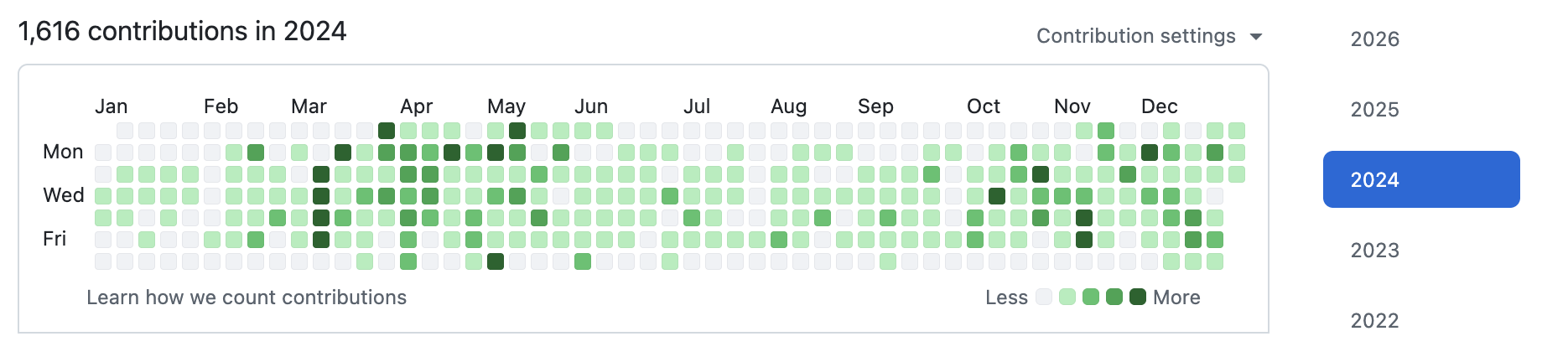
2024: AI would frequently reach context limits and lose the plot when working with long conversations. AI was also unable to iterate on its own changes, often clobbering its previous work; most of these commits are in the CHOP style of programming. See also: Weekend work increasing because AI models are getting good enough to accelerate my personal projects.
2025: By early 2025, I had fully embraced a Cursor/Claude Code/Codex setup. I’m building real solutions and, frankly, loving programming again. AI helps me orient on a project, accomplish tasks, and have meaningful impact with tiny slices of time.
The best engineering managers operate where they can multiply their team’s effectiveness. For years, this meant staying out of the code entirely and slowly losing their relatability with newer technologies. With AI, engineering leaders don’t have to choose between staying technical and staying effective. AI has collapsed the cost of personal experimentation—and in doing so, it’s evolving what the engineering manager role can be.
During 2025, with the help of AI, I’ve shipped 20+ software solutions that span personal projects, prototypes/PoCs, back-office tools, small feature work, and bug fixes. None of this was possible before AI.
Significant Revisions
Footnotes
This hasn’t been perfect. See “What Hasn’t Worked” for the other 5%. ↩

[email protected]
The digital journal of James Rowe. Something between WordPress, LiveJournal and gists.
2026-01-22T02:55:32+00:00 Last build
Copyright © 2010-2025 James Rowe. All thoughts and opinions expressed here are solely my own and do not express the views or opinions of my employer(s) past or present. Built by Wiglaf Software™
Unless otherwise noted, all code posted on this site is licensed under the MIT License and all other content including but not limited to blog posts, articles, and photos is licensed under the Creative Commons Attribution 4.0 International License.
相關文章