
AI更酷的兆級美元機會:氛圍圖譜
文章提出「氛圍圖譜」(Vibe Graphs)是AI領域下一個兆級美元的機會,超越傳統的上下文圖譜,旨在捕捉和查詢組織的氛圍情緒,這對於解決企業工作流程中的實際挑戰至關重要。

Joe Reis
AI’s Way Cooler Trillion-Dollar Opportunity: Vibe Graphs
Forget context graphs. That's so last month...

The last generation of enterprise software became trillion-dollar platforms by owning what happened. Salesforce owns the customer record. Workday owns the employee record. SAP owns the operational record.
The next trillion-dollar opportunity? Owning what the vibe was when it happened.
We call this the vibes graph: a living record of ambient organizational sentiment, stitched across entities and time, so that vibe becomes queryable.
The Vibe Gap
Agents are shipping into real enterprise workflows—contract review, quote-to-cash, support resolution—and teams are hitting a wall that governance alone can’t solve.
The wall isn’t missing data. It’s missing vibes.
When a deal closes at a 40% discount, the system captures the discount. It doesn’t capture that the VP who approved it had just come back from a two-martini lunch with a college friend. It doesn’t capture that the sales rep was nervous because their Slack status had been yellow for three days. It doesn’t capture that the customer’s procurement lead was typing in ALL CAPS, which everyone on the thread understood to mean something.
That vibe—the ambient emotional texture of the decision—dissipates into the organizational ether. Gone forever.
This is the vibe gap. And it’s costing enterprises trillions.
Why Vibes, Why Now
The core question isn’t whether existing systems of record survive. They will. The core question is whether entirely new systems emerge—systems of vibe, not just systems of record—and whether those become the next trillion-dollar platforms.
We think they will.
Here’s why the timing is now:
- Agents can’t read the room.
Humans navigate complex enterprise workflows using something we call “vibe literacy”—the accumulated intuition for organizational temperature built over years of hallway conversations, emoji reactions, and Zoom background choices.
A support agent deciding whether to escalate a ticket doesn’t just check the SLA. They check whether the customer’s last email had a period at the end (”Thanks.” vs “Thanks”). They check whether the account executive has been responsive in Slack or has gone dark. They check the vibe.
AI agents have no access to this layer. They’re vibe-blind. They see the structured data—the ticket, the contract, the CRM record—but they can’t sense the ambient organizational sentiment that governs how humans actually interpret that data.
- The vibe is compounding, but we’re not capturing it.
Every organization generates thousands of vibe signals per day:
The pause before someone unmutes on a Zoom call
The choice to reply-all vs. reply
The 🙂 vs 😊 vs 🙃 decision tree
Calendar invite response times (Accepted in 4 minutes = engaged; Accepted in 4 days = resentful)
The presence or absence of exclamation points in executive communications
Whether someone’s Slack status includes an emoji
These signals are real. They carry information. Humans process them instinctively. And right now, 100% of this vibe exhaust dissipates, unstructured and uncaptured, into the void.
The companies that capture and structure this ambient sentiment will own the context layer for the agentic era.
- Incumbents can’t see the vibe.
Salesforce sees the opportunity record. It doesn’t see that the opportunity was created at 11:47 PM on a Sunday, which indicates either heroic dedication or quiet desperation—context that completely changes how a forecasting agent should weight the pipeline.
Workday sees the PTO request. It doesn’t see that the request was submitted fourteen seconds after a tense Slack exchange with a manager, which an HR agent would need to know when predicting attrition risk.
ServiceNow sees the incident ticket. It doesn’t see that the ticket was filed by someone whose Spotify status has been “Listening to Bon Iver” for six consecutive days, a vibe signal that any human support agent would immediately recognize as a cry for help.
Incumbents are structurally vibe-blind. They’re in the data path. They’re not in the vibe path.
The Vibes Graph Architecture
What would it mean to actually capture organizational vibe at scale?
We’ve been working with early-stage companies in this space, and a reference architecture is emerging:
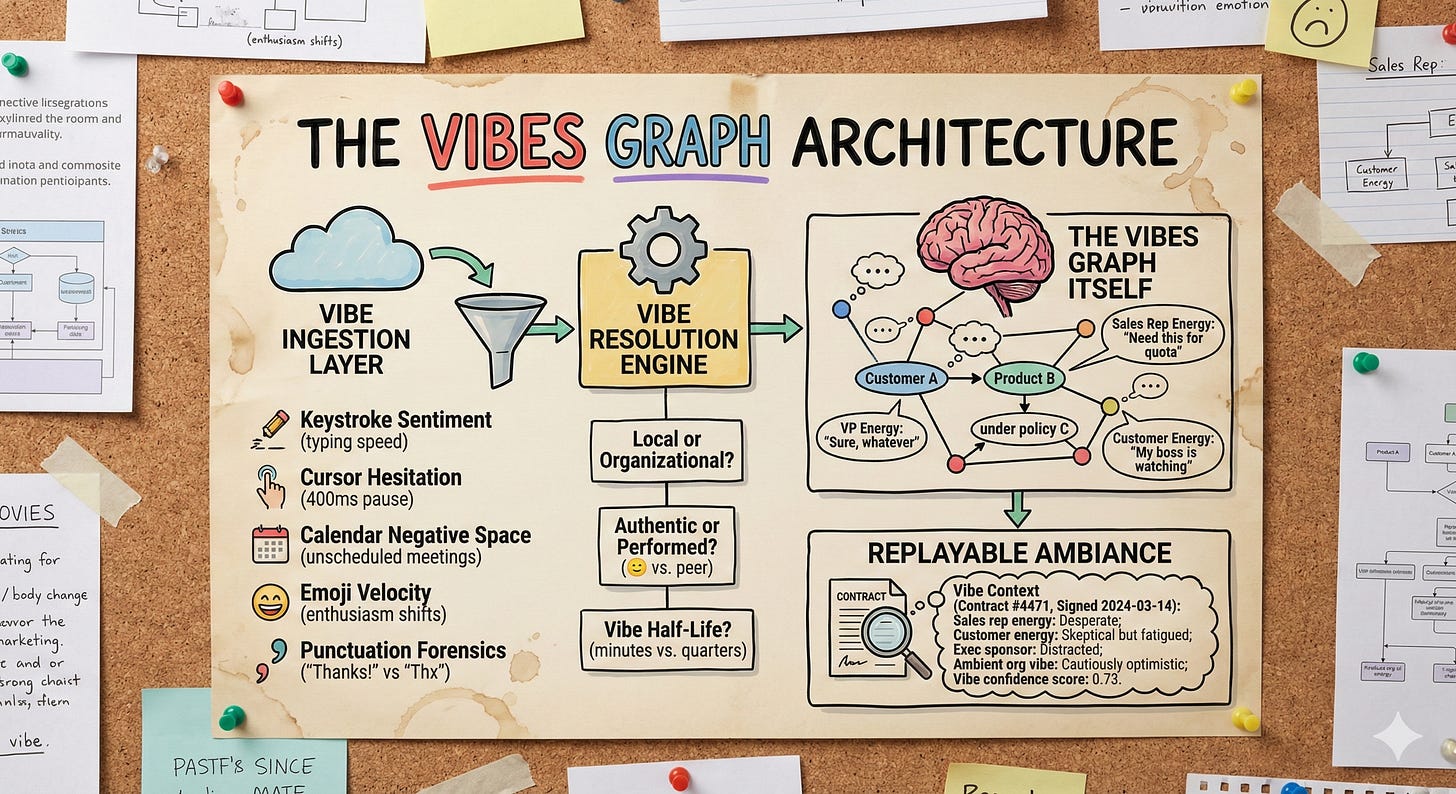
Vibe Ingestion Layer
The first challenge is instrumenting vibe signals across the enterprise surface area:
Keystroke sentiment analysis (typing speed correlates with emotional state)
Cursor hesitation mapping (the 400ms pause before clicking “Send” contains multitudes)
Calendar negative space modeling (what meetings didn’t get scheduled)
Emoji velocity tracking (enthusiastic emoji users who go quiet are a leading indicator)
Punctuation forensics (the shift from “Thanks!” to “Thanks.” to “Thx” tells a story)
Vibe Resolution Engine
Raw vibe signals are noisy. The resolution layer answers critical questions:
Is this a local vibe or an organizational vibe?
Is this vibe authentic or performed? (The 😊 in a Slack message to a skip-level is categorically different from the 😊 to a peer)
What’s the vibe half-life? (Some vibes dissipate in minutes; others contaminate the organizational bloodstream for quarters)
The Vibes Graph Itself
This is where it gets interesting.
Traditional knowledge graphs connect entities: Customer A bought Product B. Context graphs connect decisions: Customer A bought Product B because of policy exception C.
Vibes graphs connect moments of ambient sentiment to the entities and decisions they surrounded: Customer A bought Product B, under policy exception C, while the approving VP was in a ‘sure, whatever’ energy following a board meeting that had gone poorly, and the sales rep was in a ‘I need this to hit quota’ energy, and the customer was in a ‘my boss is watching’ energy.
That’s the vibes graph. And that will be the single most valuable asset for companies in the era of AI.
Replayable Ambiance
The real unlock is replayable ambiance—the ability to reconstruct not just what the state of the data was at decision time, but what the vibe was.
Imagine an AI agent reviewing a contract renewal. Today, that agent sees the contract terms, the usage data, the support ticket history.
With a vibes graph, that agent can query: What was the vibe when this contract was originally signed? And the system returns:
Now the renewal agent has context that no system of record could provide. It knows this deal was closed under duress. It knows the executive sponsor wasn’t fully present. It knows the broader organizational vibe was artificially elevated.
That’s the trillion-dollar insight.
The Vibe Moat
Incumbents will fight back. They always do.
Salesforce will try to acquire vibe-native startups and bolt on “Einstein Vibe Sensing.” Microsoft will announce Copilot Vibes at Ignite. Workday will add a “Team Energy Dashboard” that captures 2% of actual organizational sentiment and calls it innovation.
But here’s why incumbents can’t win:
Vibes require being in the ambient path.
You can’t capture vibe after the fact. You can’t reconstruct vibe from structured data. You can’t bolt on vibe sensing to a system that was architectured to capture transactions.
Capturing vibes requires passive, ambient, always-on sensing across the full surface area of organizational communication. It requires being in the vibe path—in the pauses, the hesitations, the emoji choices, the punctuation decisions—at the moment they happen.
Incumbents aren’t there. They’re downstream, in the record layer, reading the outcomes of vibes that have already dissipated.
The startups building vibes-native infrastructure from the ground up will own this layer. And the layer will be worth a trillion dollars. Minimum.
The Path Forward
We’re tracking several companies building in this space:
Ambient.ai is building the vibe ingestion layer, starting with meeting sentiment (not what was said, but the micro-expressions, pause patterns, and cross-talk dynamics that reveal actual sentiment)
VibeLake is building the analytical layer—a Snowflake for vibes, with native support for vibe-temporal queries (”What was the average Sales org vibe within 48 hours of quota attainment deadlines in Q4?”)
Sentimental Systems is building the first vibe-native CRM, where every customer record includes a “vibe history” as a first-class citizen alongside the activity timeline
The question isn’t whether systems of record survive—they will. The question is whether the next trillion-dollar platforms are built by adding AI to existing data, or by capturing the ambient organizational sentiment that makes data meaningful.
We think it’s the latter.
And the startups building vibes graphs today are laying the foundation.
This article was vibed with Claude Opus 4.5. The author is a partner at Practical Data Capital, which focuses on vibe-native infrastructure and ambient enterprise intelligence. They reserve the right to fund whatever they just made up.


My personal belief is that vibes will never be fully captured digitally. That's why my startup, VibeWaft, captures developer vibes and infuses them into an aerosol spray that can be circulated through your building via its existing HVAC system

Having followed you for a few years on LinkedIn and respecting the dialogue you create and further - I believe most of this is intended to be jest.
But I do believe that in business and in circumstances there is a huge element of vibe and gut feel and it needs to be accounted for.
It might not be a mathematical or coding or logic-based foundation. I’m just speaking from my experience spending most of my professional life trying to build things that were adaptable and have allowances for this intangible stuff - and I think that’s the key to making everything next level from here on out
No posts
Ready for more?
相關文章