


從試點到獲利:調查顯示金融服務業正加倍投入人工智慧投資與開源技術
NVIDIA發布的最新報告顯示,金融服務業正大幅增加對人工智慧(AI)和開源技術的投資,從試點階段邁向實際獲利,並強化了詐欺偵測和風險管理等關鍵業務功能。
Artificial Intelligence Computing Leadership from NVIDIA

From Pilot to Profit: Survey Reveals the Financial Services Industry Is Doubling Down on AI Investment and Open Source
AI has taken center stage in financial services, automating the research and execution behind algorithmic trading and helping banks more accurately detect fraud and money laundering — all while improving risk management practices and expediting document processing.
The sixth annual “NVIDIA State of AI in Financial Services” report, based on a survey of more than 800 industry professionals, found that AI usage in the industry has never been higher.
Organizations are deploying and scaling AI use cases, such as fraud detection, risk management and customer service, to improve critical business functions that create meaningful return on investment. New types of AI — including AI agents — are streamlining processes ranging from back-office operations to investment research as financial institutions embrace the tools needed to build specialized AI, including open source foundation models and software.
Highlights from this year’s report include:
“Open source models are fundamentally changing the competitive dynamics in financial AI,” said Helen Yu, CEO of Tigon Advisory Corp. “The real value capture happens when institutions fine-tune these models on their proprietary transaction data, customer interaction histories and market intelligence, creating AI capabilities that competitors cannot replicate.”
Read more below on some of the report’s key findings.
Building the Foundation of the Future With Open Source
Open source models allow for flexibility and efficiency, enabling organizations to tailor development tools to their unique needs and make them more accurate by incorporating a financial institution’s proprietary data. As a result, 83% percent of respondents said open source is important to their organization’s AI strategy, with 43% saying it is very to extremely important.
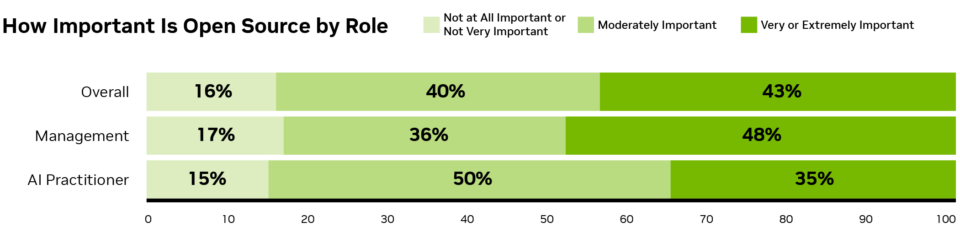
“Open source models can help banks close the gap with early movers, unlock cost efficiencies and safeguard against vendor lock-in, but they’re not without their limitations — proprietary approaches can unlock superior performance for domain-specific tasks,” said Alexandra Mousavizadeh, cofounder and co-CEO of Evident Insights. “Leading banks need to demonstrate proficiency in both approaches — applying the right kind of model to the right problem, in the right context.”
The Return on Investment of AI in Financial Services Is Clear
Financial institutions have moved from piloting AI projects to deploying solutions that create business impact and scaling them across the organization. In turn, companies have begun to see significant return on investment from AI on the top and bottom lines.
As stated above, 89% of survey respondents said AI has helped increase annual revenue and decrease annual costs. For many organizations, the impact has been significant, with 64% of respondents saying AI has helped increase annual revenue by more than 5% — including 29% who said revenue increased more than 10%.
Similarly, 61% said AI had helped decrease annual costs by more than 5%, with 25% saying costs decreased more than 10%.
Respondents cited a long list of AI use cases that have provided return on investment, including document processing and management, customer experience and engagement, algorithmic trading and risk management.
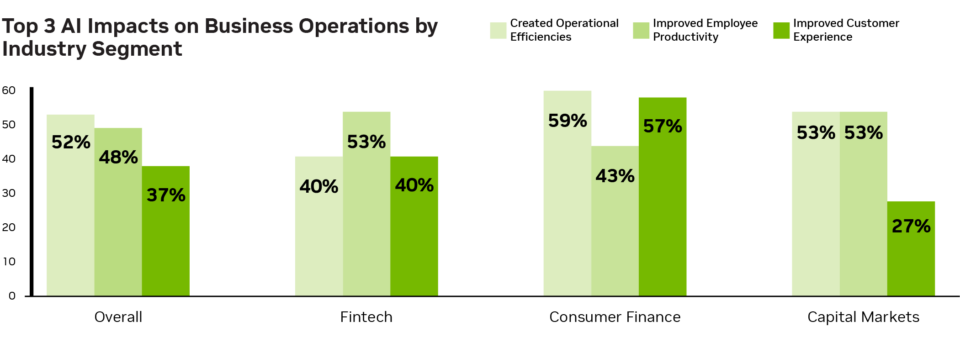
Creating operational efficiencies is the largest improvement AI has made in financial services, according to 52% of respondents. And 48% said employee productivity was among the biggest improvements.
“The most tangible ROI I’m seeing is in payment operations, specifically authorization optimization and intelligent routing,” said Dwayne Gefferie, payments strategist at Gefferie Group. “Agentic AI systems can now autonomously route transactions to the most optimized payment networks, dynamically adjust retry logic based on real-time issuer signals and make routing decisions under 200-millisecond routing that traditional rule-based systems simply can’t match. What makes this compelling is that every basis point improvement in authorization rates translates directly to revenue — there’s no ambiguity in measurement.”
Success Leads to Increasing AI Budgets
Given the shift from running proof of concepts to deploying AI-enabled applications into production, the financial services industry is looking to significantly expand AI budgets. Nearly 100% of respondents said their AI budgets would increase or stay the same in the coming year.
About 41% of respondents said investment would go toward optimizing AI workflows and production, reinvesting in and improving the AI solutions that are already working.
More than a third (34%) said they had an eye toward AI expansion in their organizations, with spending focused on identifying additional use cases. And 30% said that investment would focus on building or providing more access to AI infrastructure, such as on-premises installations or in the cloud.
Investment will also flow to deployment and expansion of AI agents, which are advanced AI systems designed to autonomously reason, plan and execute complex tasks based on high-level goals. About 21% of respondents said AI agents have already been deployed, with another 22% saying AI agents will be deployed within the next year and beyond.
“The institutions winning in AI are treating their proprietary data as a strategic asset for building differentiated AI products,” said Yu.
Download the “State of AI in Financial Services: 2026 Trends” report for in-depth results and insights.
Explore NVIDIA’s AI solutions and enterprise-level AI platforms for financial services.
All NVIDIA News

Flight Controls Are Cleared for Takeoff on GeForce NOW

NVIDIA Named Best Place to Work in Tech and AI by Glassdoor

‘Largest Infrastructure Buildout in Human History’: Jensen Huang on AI’s ‘Five-Layer Cake’ at Davos

Survive the Quarantine Zone and More With Devolver Digital Games on GeForce NOW

AI’s Next Revolution: Multiply Labs Is Scaling Robotics-Driven Cell Therapy Biomanufacturing Labs
Corporate Information
Get Involved
News & Events
Share on Mastodon
Friend's Email Address
Your Name
Your Email Address
Comments
Send Email
相關文章