

當AI會議記錄成為法律證據
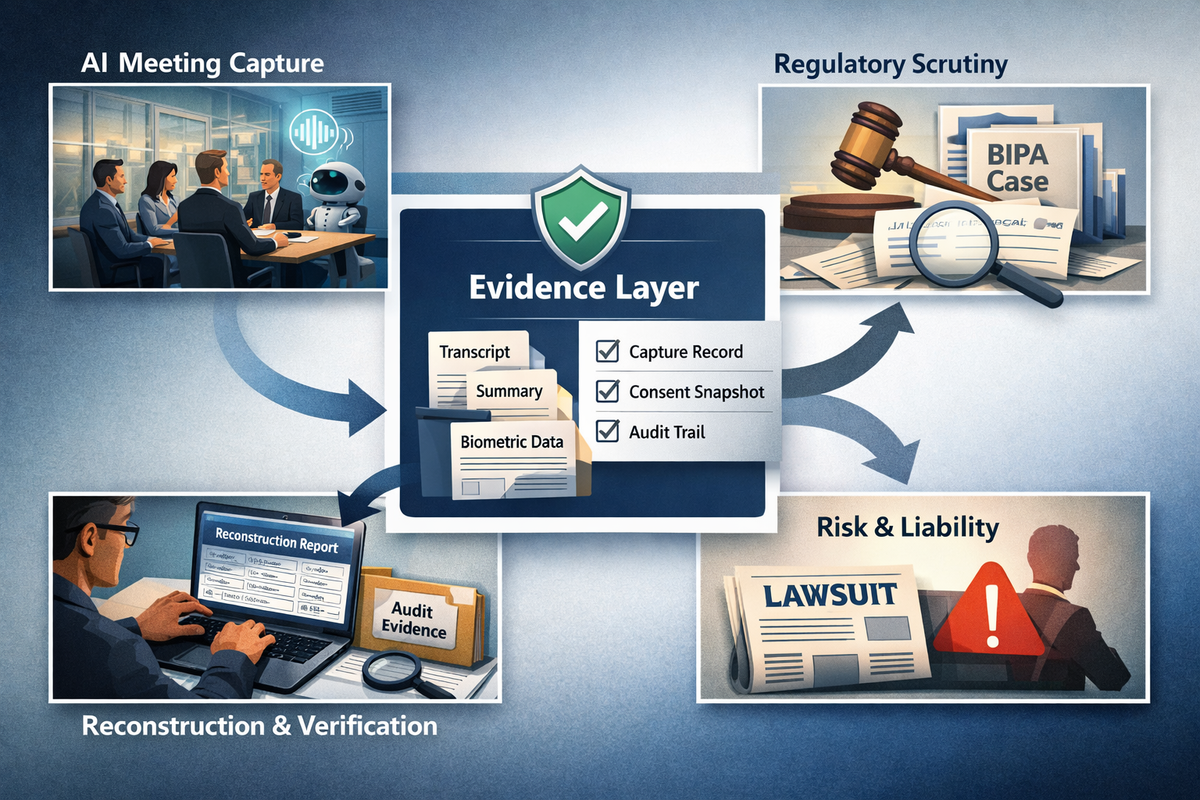
AI會議助理已從生產力工具轉變為潛在的法律證據。近期BIPA風格的訴訟凸顯了「證據缺口」,組織難以從AI生成的記錄中重建事件,焦點從轉錄準確性轉移到可證明的合規執行。
When AI Meeting Notes Become Legal Evidence

Why BIPA-style lawsuits expose an evidence gap, not a transcription problem
The recent Illinois Biometric Information Privacy Act case against Fireflies.AI Corp has largely been framed as a biometric privacy dispute. That framing is legally correct but analytically incomplete. The more consequential issue is not voice recognition accuracy or transcription quality. It is evidence failure in systems that now routinely record, summarize, and store human speech.
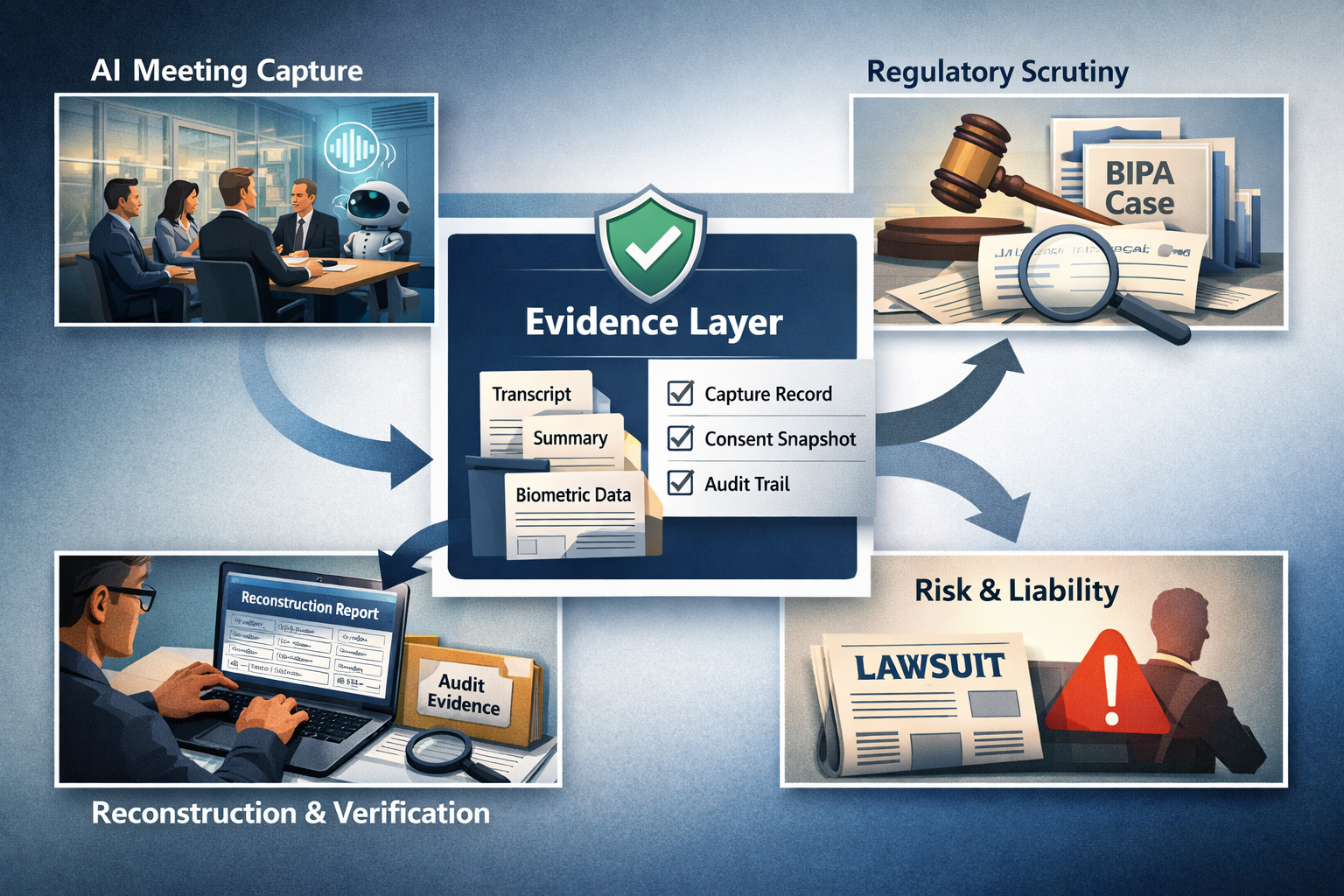
AI meeting assistants have crossed a quiet threshold. Their outputs are no longer disposable productivity aids. In legal, compliance, HR, and audit contexts, transcripts and summaries are increasingly relied upon as records. Once that reliance exists, scrutiny shifts. Regulators and plaintiffs stop asking whether the AI was accurate and start asking whether the organization can reconstruct what actually happened.
Most cannot.
The reliance threshold regulators are probing
The risk does not arise simply because a meeting was recorded. It arises because downstream artifacts are treated as authoritative.
In the Fireflies complaint, the most damaging allegations are not about errors in transcription. They focus on the absence of provable answers to basic questions:
Policies, privacy notices, and vendor assurances do not answer these questions after the fact. Logs alone rarely help either. AI meeting systems are non-deterministic and context dependent. You cannot replay the meeting to prove compliance. By the time a claim surfaces, intent is irrelevant. What matters is whether there is reconstructable evidence of execution.
This is why BIPA-style cases are so destabilizing. They convert silent data exhaust into contested legal evidence.
Similar theories have already been raised against other AI transcription providers, reinforcing that this is a pattern, not a one-off.
Why traditional AI governance fails under litigation pressure
Most enterprise AI governance programs emphasize prevention: model reviews, accuracy testing, consent language, and internal policies. These controls matter, but they fail in adversarial settings for one reason.
They are not evidence.
Courts and regulators do not ask whether an organization had a policy. They ask what happened in a specific interaction. In AI meeting systems, that interaction is the moment of capture and derivation.
Once a transcript or summary is relied upon, the organization must be able to show, credibly and precisely:
Without that, even a technically compliant deployment becomes legally fragile.
Where an evidence layer changes the risk shape
This is where AIVO’s original governance doctrine applies cleanly, without expansion or overreach.
Implemented precisely as a post-incident evidence service, not as a privacy or consent platform, AIVO targets the exact gap exposed by BIPA-like suits.
Its role is narrow by design:
This does not prevent lawsuits. It materially changes what happens when they arrive.
Instead of reconstructing events from fragmented logs and vendor statements, the organization can answer the questions regulators actually ask using its own neutral evidence record. That difference often determines whether an incident becomes a contained legal matter or a reputational escalation.
Why this is viable now
This approach would not have been viable several years ago. It is viable now for three reasons.
First, reliance has surged. AI meeting artifacts now influence decisions, audits, and formal records in regulated environments.
Second, regulatory attention has shifted. Enforcement is moving away from abstract AI safety claims toward inspectable evidence trails and post-event reconstruction.
Third, non-users are implicated. External participants and silent attendees are now legally relevant, even when they never interacted with the tool.
These forces create demand for something most organizations lack: credible proof of what their AI systems captured, derived, and exposed at the moment it mattered.
This pattern will not remain confined to Illinois or to biometric law. Post-market monitoring and record-keeping duties emerging in other regimes are converging on the same evidentiary question.
What this is not
Clarity here is essential.
This is not a full privacy solution.It is not a consent management platform.It does not determine legal compliance or provide safe harbor.It does not replace statutory obligations under biometric or wiretapping laws.
Over-claiming would destroy credibility.
The value is forensic readiness. It is about making AI-generated meeting artifacts defensible once they exist and are relied upon.
Practical adoption guidance
For organizations already using AI meeting assistants, this should be approached as a targeted pilot, not a blanket rollout.
The rational starting point is in high-risk contexts:
These are the settings where transcripts are most likely to become evidence and where the absence of reconstruction capability is most damaging.
Pilots should be scoped explicitly as evidence readiness exercises, not as compliance deployments. The objective is to observe whether the organization can reconstruct events under pressure, not to redesign meeting behavior.
CTA: evidence before exposure
If your organization uses AI meeting tools, the relevant question is no longer whether they improve productivity. It is whether you can prove what they did when it mattered.
AIVO’s evidence layer is designed for that moment.
If you are concerned about BIPA-style exposure or discovery risk from AI meeting artifacts, consider piloting AIVO as a post-incident evidence control in a limited, sensitive scope first. Start where reliance already exists. Expand only if the evidence proves its value.
In governance, credibility compounds quietly. Evidence is where it starts.
Sign up for more like this.
When AI Speaks, Evidence Becomes the Control Surface
When Evidence Retention Becomes Mandatory
Why Most AI Incidents Are Evidence Failures, Not Model Failures
相關文章