

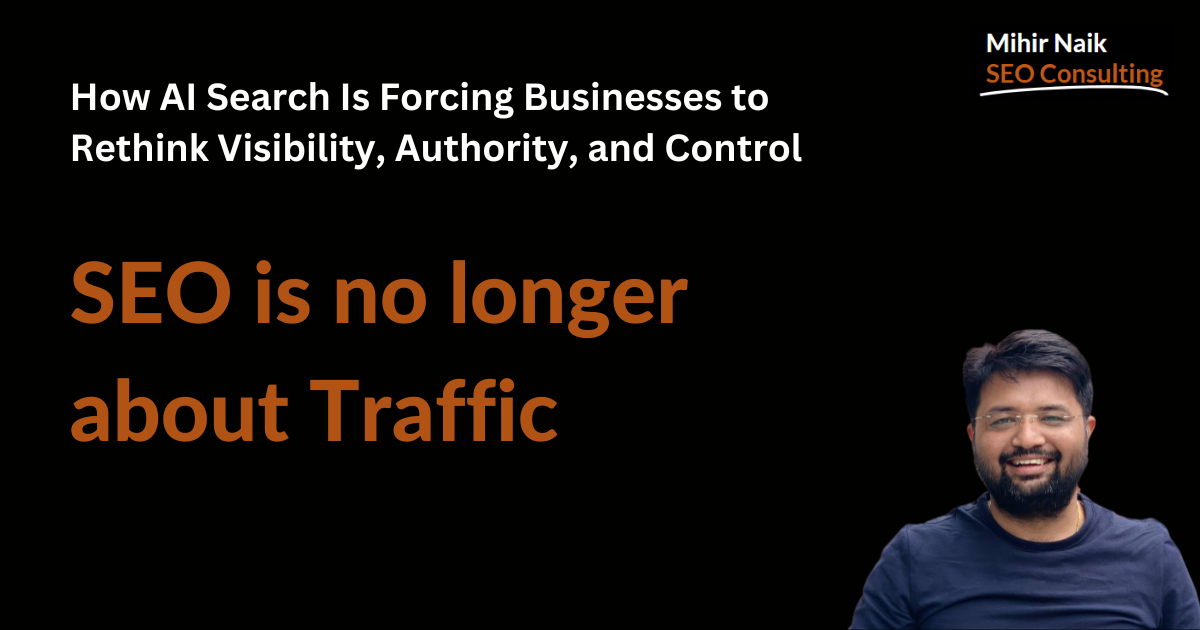
AI搜尋正迫使企業重新思考可見度、權威性和控制權
AI搜尋平台的興起正根本性地改變客戶發現和評估品牌的方式,導致傳統的漏斗頂端流量崩潰,因為答案直接在AI介面中提供。這種轉變要求對SEO在維持企業可見度、權威性和控制權方面的作用進行策略性重新評估。
Mihir Naik
AI SEO Consulting
SEO Is No Longer About Traffic
Introduction: Taking Stock at the End of 2025
Over the last few years, I’ve been very active on LinkedIn, sharing observations from the front lines of enterprise SEO. I’ve spent a large part of my career building and managing SEO programs on the enterprise side where scale, complexity, and cross-functional execution are unavoidable realities.
More recently, I moved to seoClarity, where I’m responsible for building our AI Search Visibility Monitoring and Optimization Platform, ArcAI. That shift from running SEO programs to building tooling for the next generation of search has given me a unique vantage point.
As 2025 comes to a close and we look ahead to 2026 and beyond, I’ve been trying to take stock of a few things:
Where is AI search actually today?
How is it changing how customers discover, evaluate, and choose brands?
What do businesses fundamentally misunderstand about this shift?
And why, despite all the noise, is SEO still the right team to own AI search?
This writeup is an attempt to answer those questions not tactically, but strategically.
The Quiet Collapse of the Top of the Funnel
Let’s start with the uncomfortable truth.
Top-of-funnel traffic is disappearing.
Not because demand is gone but because it’s being resolved before users ever reach a website.
AI search platforms like ChatGPT, Perplexity, Claude, and Google’s AI experiences are increasingly:
Answering questions directly
Comparing options
Explaining trade-offs
Recommending solutions
In many cases, the user completes most of their decision-making inside the AI interface itself.
What does that mean for businesses?
It means:
Fewer visits
Fewer measurable touchpoints
Less visible attribution to Organic Search
And yet higher intent when users finally do arrive
I’ve seen this pattern repeatedly: AI-driven traffic converts better, because users only click when they’re ready to act.
AI didn’t kill the funnel.It compressed it.
The New Content Paradox: Authority Without Traffic
This leads to the first major dilemma businesses will face in 2026:
You still need to produce content even when that content may never generate traffic.
Why?
Because AI search engines don’t rank pages they retrieve knowledge.
If your content:
Builds topical authority
Clearly explains concepts
Defines products, features, and use cases
Answers nuanced questions
…then you have a higher chance of being retrieved, mentioned, cited, and trusted when AI generates an answer.
The business challenge is obvious:
How do you justify content investment without traffic?
How do you measure ROI?
How do you scale content production to the volume AI retrieval requires?
The answer is not “more writers.”
The answer is automation, systems, and a fundamentally new skill set.
Why Traditional Content Workflows Break
The old model looks like this:
Content Brief → Content Outline → Writer → Optimize → Publish
That model does not scale to:
Hundreds of thousands of questions
Multiple personas
Dozens of decision stages
Continuous AI-driven retrieval
Modern content production needs:
A source of truth for the business
Structured knowledge about products, personas, pain points, and use-cases
Human-in-the-loop automation where 80–90% is system-generated and reviewed by experts
Content is no longer a campaign output.It’s infrastructure.
AI Search Still Runs on SEO Foundations
There’s a misconception that AI search makes SEO irrelevant.
In reality, the opposite is true.
While large language models rely on internal knowledge for simple queries, complex queries trigger retrieval workflows often involving:
Query expansion (fan-outs)
External content retrieval
Source evaluation and citation
This is where traditional SEO foundations still matter:
Crawlability
Indexability
Content structure
Internal linking
Authority signals
SEO is the backbone of AI retrieval.
The difference is that the output is no longer a ranking it’s an answer.
The Real Challenge: Query Fan-Outs You Can’t See
One of the hardest problems in optimizing for AI search is this:
You don’t (reliably) know what queries the AI is expanding into.
Most of these queries:
Don’t exist in keyword tools
Will never show up in Search Console(except from Google AI mode, in certain cases)
Are dynamically generated by AI systems
This is why prompt research becomes essential.
Not prompt guessing but structured modelling of:
Customer intent
Business use cases
Decision paths
You cannot track millions of prompts.But you can build a representative sample that reflects how your audience thinks.
That sampling problem is one of the most important new skills in modern SEO(or AEO/GEO if you want to call it that).
Log Files: The Most Underrated AI Search Signal
If I had to point to the most valuable data source for understanding and actioning on AI search today, it wouldn’t be rankings or traffic.
It would be log files.
Log files show you:
Which AI bots are hitting your site
What pages they’re accessing
How frequently
And how that behavior differs from human traffic
In the future, SEO teams will need to:
Identify LLM training bots
Separate retrieval bots from agent bots
Correlate bot activity with downstream visibility and conversions
The companies that win will be the ones that connect:
AI bot interaction → retrieval → citation → business outcome
Optimization in 2026: From Pages to Questions
Optimization workflows are changing in subtle but profound ways.
One of the most important steps almost no one talks about is this:
Generate synthetic questions and validate whether your website actually answers them.
Think about prompt research in layers:
The universe of questions your customers could ask
A large synthetic set to test content coverage
A small, high-impact subset you actively track for AI Search visibility
If your site doesn’t answer a question:
You lose retrieval possibility
You lose narrative control
And AI fills the gap from somewhere else
Sometimes that “somewhere else” is a third-party site which may be acceptable.Other times, it’s inaccurate or misleading which is dangerous.
Accuracy and Sentiment Are the New Brand Risks
Being mentioned by AI is not enough.
Businesses now have to ask:
How are we described?
Are we cited correctly?
Is the sentiment accurate?
Which attributes are emphasized or ignored?
If AI search gets your pricing, positioning, or capabilities wrong, users may never give you a chance to correct it.
This creates an entirely new operational need:
Detect inaccuracies
Identify the source (your site vs third parties)
Correct them through content and influence
SEO becomes narrative governance.
Why SEO Is the Right Team to Own AI Search
This brings me to what I believe is the most important organizational insight.
AI search doesn’t belong to:
Paid media
Brand
PR
Or product alone
It belongs to SEO expanded and evolved.
Modern SEO teams already sit at the intersection of:
Content
Technology
Analytics
User intent
Cross-functional execution
But the charter needs to change.
SEO’s New Responsibilities
SEO teams must evolve to own:
Search visibility (where and when the brand appears)
Citations, Share of Voice
Accuracy and misinformation risk
Sentiment and narrative by intent
Retrieval readiness and accessibility
This often requires new capability lanes:
In practice, this often looks like an SEO-led visibility control tower working across marketing, product, engineering, analytics, and communications.
SEO doesn’t do everything.But it coordinates everything.
Rethinking Metrics and Attribution
Traditional organic KPIs are no longer sufficient.
Traffic alone cannot explain:
Influence
Visibility
Or lost demand
The future measurement stack includes:
AI Search visibility
Brand mentions and citations
Accuracy scores
Sentiment by attribute
Conversion performance of AI-referred traffic
Log-based interaction data
Attribution has always been hard for SEO.Now it’s unavoidable.
Looking Ahead: Preparing for AI-Native Experiences
AI platforms are rapidly adding:
Shopping research
Deep research
Task automation
Agent-based workflows
As these systems learn what users are trying to accomplish, they will build vertical-specific experiences.
To participate in those experiences, brands need:
Deep contextual content
Clear knowledge representation(think OpenAI’s product feeds as a starter)
Accessible and accurate information
AI doesn’t integrate “pages.”It integrates understanding.
A Final Thought for Business Leaders
If there’s one idea I want to leave you with, it’s this:
In the AI era, the brands that win won’t be the ones with the most content but the ones whose businesses are best understood by machines.
SEO is no longer about traffic.
It’s about:
Visibility without clicks
Authority without rankings
Trust without touchpoints
And that makes SEO more strategic not less than it has ever been.

Leave a Reply Cancel reply
Your email address will not be published. Required fields are marked *
Comment *
Name *
Email *
Website
Join My Newsletter!
Learn to automate the parts of your SEO Workflow using GSC API, Customized Python Scripts, GenAI(LLMs) and more!

Know More
Let's Connect
SEO Frameworks
相關文章