
為何C++程式設計師在面對競爭、安全疑慮和AI的同時仍快速成長
儘管面臨競爭、安全疑慮和AI的興起,C++和Rust仍是成長最快的主要程式語言。這種成長主要歸因於解決日益複雜運算問題的持續需求,這項需求不斷超越硬體進步的能力,而AI是最新推動效能優化的催化劑。

Sutter’s Mill
Herb Sutter on software development
Software taketh away faster than hardware giveth: Why C++ programmers keep growing fast despite competition, safety, and AI
2025 was another great year for C++. It shows in the numbers
Before we dive into the data below, let’s put the most important question up front: Why have C++ and Rust been the fastest-growing major programming languages from 2022 to 2025?
Primarily, it’s because throughout the history of computing “software taketh away faster than hardware giveth.” Our demand for solving ever-larger computing problems consistently outstrips our ability to build greater computing capacity, with no end in sight. Every few years, people wonder whether our hardware is just too fast to be useful, until the future’s next big software demand breaks across the industry in a huge wake-up moment of the kind that iOS delivered in 2007 and ChatGPT delivered in November 2022. AI is only the latest source of demand to squeeze the most performance out of available hardware.
The world’s two biggest computing constraints in 2025
Quick quiz: What are the two biggest constraints on computing growth in 2025? What’s in shortest supply?
Take a moment to answer that yourself before reading on…
— — —
If you answered exactly “power and chips,” you’re right — and in the right order.
Chips are only our #2 bottleneck. It’s well known that the hyperscalars are competing hard to get access to chips. That’s why NVIDIA is now the world’s most valuable company, and TSMC is such a behemoth that it’s our entire world’s greatest single point of failure.
But many people don’t realize: Power is the #1 constraint in 2025. Did you notice that all the recent OpenAI deals were expressed in terms of gigawatts? Let’s consider what three C-level executives said on their most recent earnings calls. [1]
Amy Hood, Microsoft CFO (MSFT earnings call, October 29, 2025):
[Microsoft Azure’s constraint is] not actually being short GPUs and CPUs per se, we were short the space or the power, is the language we use, to put them in.
Andy Jassy, Amazon CEO (AMZN earnings call, October 30, 2025):
[AWS added] more than 3.8 gigawatts of power in the past 12 months, more than any other cloud provider. To put that into perspective, we’re now double the power capacity that AWS was in 2022, and we’re on track to double again by 2027.
Jensen Huang, NVIDIA CEO (NVDA earnings call, November 19, 2025):
The most important thing is, in the end, you still only have 1 gigawatt of power. One gigawatt data centers, 1 gigawatt power. … That 1 gigawatt translates directly. Your performance per watt translates directly, absolutely directly, to your revenues.
That’s why the future is enduringly bright for general-purpose languages that are efficient in “performance per watt” and “performance per transistor.” The size of computing problems we want to solve has routinely outstripped our computing supply for the past 80 years; I know of no reason why that would change in the next 80 years. [2]
The list of major portable languages that target those key durable metrics is very short: C, C++, and Rust. [3] And so it’s no surprise to see that in 2025 all three continued experiencing healthy growth, but especially C++ and Rust.
Let’s take a look.
The data in 2025: Programming keeps growing by leaps and bounds, and C++ and Rust are growing fastest
Programming is a hot market, and programmers are in long-term high-growth demand. (AI is not changing this, and will not change it; see Appendix.)
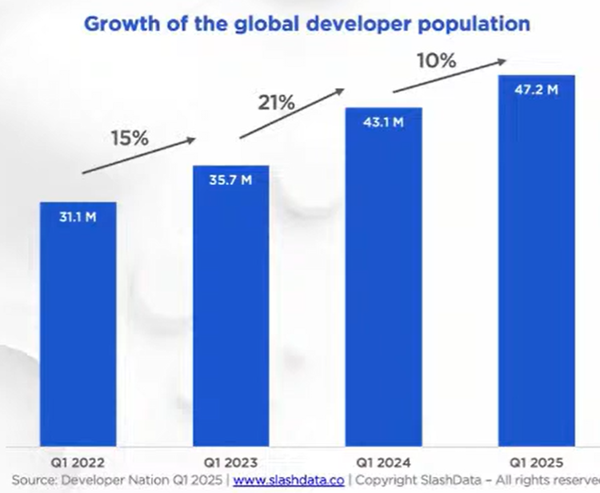
“Global developer population trends 2025” (SlashData, 2025) reports that in the past three years the global developer population grew about 50%, from just over 31 million to just over 47 million. IDC forecasts that this growth will continue, to over 57 million developers by 2028. And which two languages are growing the fastest (highest percentage growth from 2022 to 2025)? Rust, and C++.
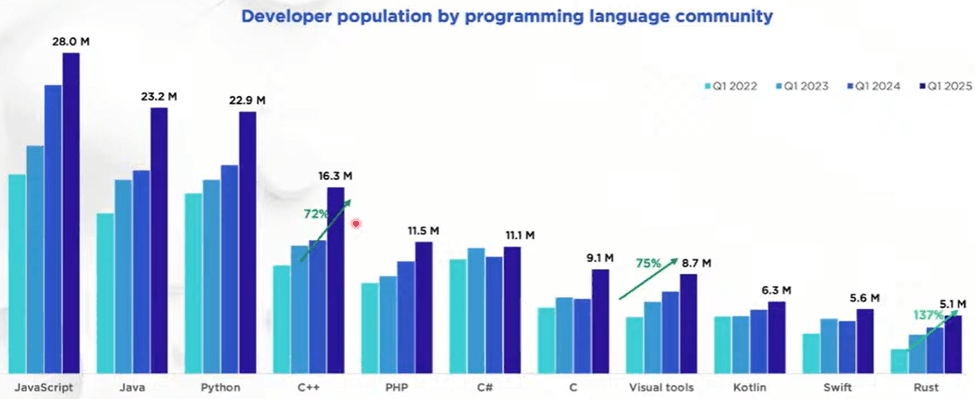
To put C++’s growth in context:
C++ is a living language, continually evolving to stay relevant to the changing landscape of hardware. The new C++26 standard contains additional support for hardware parallelism on the latest CPUs and GPUs, notably adding more support for SIMD types for intra-CPU vector parallelism, and the std::execution Sender/Receiver model for general multi-CPU and GPU concurrency and parallelism.
But wait — how could this growth be happening? Isn’t C++ “too unsafe to use,” according to a spate of popular press releases and tweets by a small number of loud voices over the past few years?
Let’s tackle that next…
Safety (type/memory safety, functional safety) and security
C++’s rate of security vulnerabilities has been far overblown in the press primarily because some reports are counting only programming language vulnerabilities when those are a smaller minority every year, and/or because statistics conflate C and C++. Let’s consider those two things separately.
First, the industry’s security problem is mostly not about programming language insecurity.
Year after year, and again in 2025, in the MITRE “CWE Top 25 Most Dangerous Software Weaknesses” (mitre.org, 2025) only three of the top 10 “most dangerous software weaknesses” are related to language safety properties. Of those three, two (out-of-bounds write and out-of-bounds read) are directly and dramatically improved in C++26’s hardened C++ standard library which does bounds-checking for the most widely used bounded operations (see below). And that list is only about software weaknesses, when more and more exploits bypass software entirely.
Why are vulnerabilities increasingly not about language issues, or even about software at all? Because we have been hardening our software, and so attackers stop pursuing it as much and switch to target the next slowest animal in the herd. For example, “CrowdStrike 2025 Global Threat Report” (CrowdStrike, 2025) reports that “79% of [cybersecurity intrusion] detections were malware-free,” not involving programming language exploits. Instead, there was huge growth not only in non-language exploits, but even in non-software exploits, including a “442% growth in vishing [voice phishing via phone calls and voice messages] operations between the first and second half of 2024.” Why go to the trouble of writing an exploit for a use-after-free bug to infect someone’s computer with malware which is getting harder every year, when it’s easier to do some cross-site scripting that doesn’t depend on a programming language, and it’s easier still to ignore the software entirely and just convince the user to tell you their password on the phone?
Second, for the subset that is about programming language insecurity, the problem child is C, not C++.
A serious problem is that vulnerability statistics almost always conflate C and C++; it’s very hard to find good public sources that distinguish them. The only reputable public study I know of that distinguished between C and C++ is Mend.io’s as reported in “What are the most secure programming languages?” (Mend.io, 2019). Although the data is from 2019, as you can see the results are consistent across years.
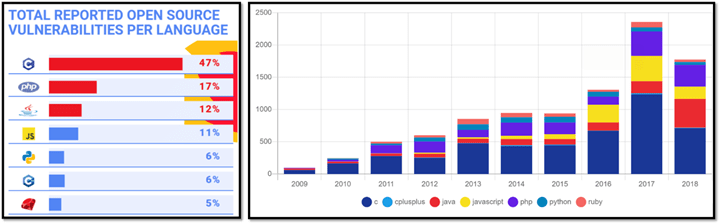
Can’t see the C++ bar? Pinch to zoom. 😉
Although C++’s memory safety has always been much closer to that of other modern popular languages than to that of C, we do have room for improvement and we’re doing even better in the newest C++ standard about to be released, C++26. It delivers two major security improvements, where you can just recompile your code as C++26 and it’s significantly more secure:
Additionally, C++26 adds functional safety via contracts: preconditions, postconditions, and contract assertions in the language, that programmers can use to check that their programs behave as intended well beyond just memory safety.
Beyond C++26, in the next couple of years I expect to see proposals to:
I know of people who’ve been asking for C++ evolution to slow down a little to let compilers and users catch up, something like we did for C++03. But we like all this extra security, too. So, just spitballing here, but hypothetically:
What if we focused C++29, the next release cycle of C++, to only issue-list-level items (bug fixes and polish, not new features) and the above “hardening” list (add more library hardening, remove more language undefined behavior)?
I’m intrigued by this idea, not because security is C++’s #1 burning issue — it isn’t, C++ usage is continuing to grow by leaps and bounds — but because it could address both the “let’s pause to stabilize” and “let’s harden up” motivations. Focus is about saying no.
Conclusion
Programming is growing. C++ is growing fast, and has a long-term future because it’s deeply aligned with the overarching 80-year trend that computing demand always outstrips supply, and C++ is a living language that continually adapts to its environment to track what users need to make the most of hardware.
And it shows in the numbers.
Here’s to C++’s great 2025, and its rosy outlook in 2026! I hope you have an enjoyable rest of the holiday period, and see you again in 2026.
Acknowledgments
Thanks to Saeed Amrollahi Boyouki, Mark Hoemmen and Bjarne Stroustrup for motivating me to write this post and/or providing feedback.
Appendix: AI
Finally, let’s talk about the topic no article can avoid: AI.
C++ is foundational to current AI. If you’re running AI, you’re running CUDA (or TensorFlow or similar) — directly or indirectly — and if you’re running CUDA (or TensorFlow or similar), you’re probably running C++. CUDA is primarily available as a C++ extension. There’s always room for DSLs at the leading edge, but for general-purpose AI all the high-performance deployment and inference is implemented in C++, even if people are writing higher-level code in other languages (e.g., Python).
But more broadly than just C++: What about AI generally? Will it take all our jobs? (Spoiler: No.)
AI is a wonderful and transformational tool that greatly reduces rote work, including problems that have already been solved, where the LLM is trained on the known solutions. But AI cannot understand, and therefore can’t solve, new problems — which is most of the current and long-term growth in our industry.
First, I think that people who think AI isn’t a major game-changer are fooling themselves.
To me, AI is on par with the wheel (back in the mists of time), the calculator (back in the 1970s), and the Internet (back in the 1990s). [5] Each of those has been a game-changing tool to accelerate (not replace) human work, and each led to more (not less) human production and productivity.
I strongly recommend checking out Adam Unikowsky’s “Automating Oral Argument” (Substack, July 7, 2025). Unikowsky took his own actual oral arguments before the United States Supreme Court and showed how well 2025-era Claude can do as a Supreme Court-level lawyer, and with what strengths and weaknesses. (Spoiler quote: “You should listen to the argument all the way through. … Objectively, this is an outstanding oral argument.”)
Second, I think that people who think AI is going to put a large fraction of programmers out of work are fooling themselves.
We’ve just seen that today, three years after ChatGPT took the world by storm, the number of human programmers is growing as fast as ever. Even the companies that are the biggest boosters of the “AI will replace programmers” meme are actually aggressively growing, not reducing, their human programmer workforces.
Consider what three more C-level executives are saying.
Sam Schillace, Microsoft Deputy CTO (Substack, December 19, 2025) is pretty AI-ebullient, but I do agree with this part he says well, and which resonates directly with Unikowsky’s experience above:
If your job is fundamentally “follow complex instructions and push buttons,” AI will come for it eventually.
But that’s not most programmers. Matt Garman, Amazon Web Services CEO (interview with Matthew Berman, X, August 2025) says bluntly:
People were telling me [that] with AI we can replace all of our junior people in our company. I was like that’s … one of the dumbest things I’ve ever heard. … I think AI has the potential to transform every single industry, every single company, and every single job. But it doesn’t mean they go away. It has transformed them, not replaced them.
Mike Cannon-Brookes, Atlassian CEO (Stratechery interview, December 2025) says it well:
I think [AI]’s a huge force multiplier personally for human creativity, problem solving … If software costs half as much to write, I can either do it with half as many people, but [due to] core competitive forces … I will [actually] need the same number of people, I would just need to do a better job of making higher quality technology. … People shouldn’t be afraid of AI taking their job … they should be afraid of someone who’s really good at AI [and therefore more efficient] taking their job.
So if we extend the question of our “what are our top constraints [on software]?” to include not only hardware and power, the #3 long-term constraint is clear: We are chronically short of skilled human programmers. Humans are not being replaced en masse, not most of us; we are being made more productive, and we’re needed more than ever. As I wrote earlier: “Programming is a hot market, and programmers are in long-term high-growth demand.”
Endnotes
[1] It’s actually great news that Big Tech is spending heavily on power, because the gigawatt capacity we build today is a long-term asset that will keep working for 15 to 20+ years, whether the companies that initially build that capacity survive or get absorbed. That’s important because it means all the power generation being built out today to satisfy demand in the current “AI bubble” will continue to be around when the next major demand for compute after AI comes along. See Ben Thompson’s great writing, such as “The Benefits of Bubbles” (Stratechery, November 2025).
[2] The Hitchhiker’s Guide to the Galaxy contains two opposite ideas, both fun but improbable: (1) Compute-constrained: Deep Thought, the size of a city, wouldn’t really be allowed to run for 7.5 million years; you’d build a million cities. (2) Compute-unused: By the time a Marvin with a “brain the size of a planet” was built, he wouldn’t really be bored; we’d already be trying to solve problems the size of the solar system.
[3] This is about “general-purpose” coding. Code at the leading specialized edges will always include use of custom DSLs.
[4] This means that compiling plain C code (that is in the C/C++ intersection) as C++26 also automatically makes it more correct and more secure. This isn’t new; compiling C code as C++ and having the C code be more correct has been true since the 1980s.
[5] If you’re my age, you remember when your teacher fretted that letting you use a calculator would harm your education. More of you remember similar angsting about letting students google the internet. Now we see the same fears with AI — as if we could stop it or any of those others even if we should. And we shouldn’t; each time, we re-learn the lesson that teaching students to use such tools should be part of their education because using tools makes us more productive.
Published by Herb Sutter
Herb Sutter is an author and speaker, a technical fellow at Citadel Securities, and serves as chair of the Standard C++ Foundation and chair emeritus of the ISO C++ standards committee.
View all posts by Herb Sutter
Post navigation
Follow by email
Email Address:
Subscribe

I'm an author and speaker, and a programming language nerd whose focus is on enabling our program code to be both clean and fast. I've been writing about programming since 1993, usually about C++ or about concurrency and parallelism. I'm the designer or co-designer of a number of standardized ISO C++ language and library features. I've served as the chair of the ISO C++ standards committee from 2002 to 2025, and as the chair of the Standard C++ Foundation since 2012. I'm a technical fellow at Citadel Securities. This personal website expresses the opinions of none of those organizations.
Archives

相關文章