


機器之心:研究員探討人工智能最根本的生存問題
多倫多大學哲學教授 Karina Vold 正在探討人工智能周圍深刻的倫理和哲學問題,特別是關於人工智能意識及其對我們如何與這些系統互動的影響。
The University of Toronto will be closed from Dec. 24, 2025 to Jan. 2, 2026, inclusive. Happy holidays to the U of T community!

Main menu tools
Jump to menu
Main navigation
Main menu tools
Main navigation
Jump to menu
U of T News menu
U of T News menu
Follow U of T News
In the mind of the machine: U of T researcher explores AI’s most existential questions
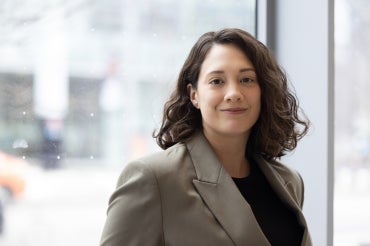
An assistant professor of philosophy, Karina Vold says debates about whether AI systems could be considered “conscious” are closely intertwined with how we treat such systems from an ethical and moral perspective (photo by Polina Teif)
Published: March 31, 2025
By
Adam Elliott Segal
When Karina Vold began her postdoctoral research at the Leverhulme Centre for the Future of Intelligence at the University of Cambridge in 2017, the idea of focusing on philosophy and the still emerging field of artificial intelligence drew quizzical looks.
"People were like, really? You're working on AI?" says Vold, who is now an assistant professor in the University of Toronto's department of philosophy and the Institute for the History and Philosophy of Science & Technology (IHPST) in the Faculty of Arts & Science.
These days, however, Vold’s choice appears prescient. Working at the intersection of philosophy, cognitive science, and AI ethics, Vold is taking part in an urgent global discussion about a fast-moving technology that some say will have a revolutionary impact on the economy, society – even what it means to be human.
She also finds herself back at an institution (she did her bachelor’s degree at U of T) that’s uniquely positioned to tackle these and other big AI questions. It’s the home of U of T University Professor Emeritus Geoffrey Hinton – who received the Nobel Prize in Physics last year for his fundamental work on deep learning, the technology that sparked today’s AI boom – and initiatives such as the Schwartz Reisman Institute for Technology and Society, which has a focus on AI safety and counts Vold as a research lead.
Vold says she’s particularly interested in AI’s impact on citizens, its role in modern society, as well as questions around its capacities.
The science of consciousness, for example is an area that philosophers have grappled with for decades that has now suddenly become a hot topic in AI circles because of rapid advances made by large language models such as ChatGPT.
“There's been a lot of work on other psychological terms like beliefs, desires, pain, creativity, curiosity – terms that are psychological in nature in the sense they tend to attribute a kind of mindedness to the system,” she says. “And there's a history of how careful we are at using these terms when we try to assess other biological systems.”
For example, Vold says, “in comparative psychology, it's a very high bar to make the claim that a lobster feels pain or that a raven is curious or creative. You have to be thoughtful about how you design experiments.
“[But] these very same terms are now getting used in computer science – in ways that are sometimes too fast and loose.”
Why is this important? Vold says terms such as “consciousness” are closely intertwined with how we treat these systems from an ethical and moral perspective.
“There's a new wave of people talking about AI systems as agents, for example, she says. “But if the public gets used to recognizing these systems as conscious, or agents, we might be quick to give them rights and protections that we don't give other biological species.”
Vold says interdisciplinary conversations, like the ones fostered at the Schwartz Reisman Institute, are critical to navigate these and other issues.
Yet, while Vold takes seriously warnings about AI’s potential to run amok with potentially damaging consequences, she generally counts herself as a techno optimist – and she says some of that hopefulness comes from the students who show up in her U of T classes.
“I'm in a unique department--the Institute for the History of Philosophy of Science and Technology,” she says. “We get students from the sciences – a mix of computer scientists, engineers [and] cognitive scientists … there's been some long philosophical discussions and questions such as: Can AI be creative? Can AI be curious? Can AI have consciousness? Do various AI really speak? Does it really understand?”
That kind of cross-pollination of ideas – one that mirrors Vold’s hybrid role in both the arts and sciences – are exactly the types of academic discussions she says are critical to realizing a future where AI lives up to its transformative potential, from curing diseases to addressing climate change.
“My sense is computer scientists are interested in these philosophical questions and want to do things responsibly as they build these technologies.”
Share this page
Topics
Tags

Subscribe to The Bulletin Brief
More U of T News



Main navigation repeated
Jump to menu repeated
Quick links
Quick links
Statement of Land Acknowledgement
We wish to acknowledge this land on which the University of Toronto operates. For thousands of years it has been the traditional land of the Huron-Wendat, the Seneca, and the Mississaugas of the Credit. Today, this meeting place is still the home to many Indigenous people from across Turtle Island and we are grateful to have the opportunity to work on this land. Read about U of T’s Statement of Land Acknowledgement.
UNIVERSITY OF TORONTO - SINCE 1827
相關文章
其他收藏 · 0