
Tim Cook 如何身經百戰,贏得 AI 的最大獎項:信任層
文章認為,儘管蘋果公司可能錯過了開發強大 AI 模型的第一波競賽,但執行長 Tim Cook 在建立 AI 系統關鍵的「信任層」方面擁有獨特的優勢,著重於治理和問責制。
Pitchfreaks News
Napster, Zuck, and Studio Ghibli: How Tim Cook Is Battle-Hardened to Win AI's Biggest Prize
Those clamoring for Cook to step down fail to see it: Apple’s CEO is uniquely qualified to navigate the looming AI trust crisis.

Let’s be honest. Apple lost the battle.
Even with its recently announced partnership with Google Gemini.
Apple was late to large language models. They had no answer to ChatGPT. While OpenAI and Google and Anthropic raced ahead, Apple was silent. The narrative wrote itself: Apple missed AI.
But the battle is not the war.
The battle was about capability—who could build the most powerful model, the fastest, with the most parameters. Apple lost that battle. They may never win it. But the war is different. The war is about governance, legibility, accountability. The war is about who stands between these powerful systems and the humans who depend on them. The war is about trust.
Someone will have to become the trust layer. Someone will have to stand between the models and the humans who use them, verifying what is real, flagging what is fabricated, restoring confidence in the information we consume. That someone could capture one of the largest economic opportunities in the history of technology.
Apple is not just positioned to be that someone. Apple may be the only entity capable of doing it at all.
We are in the storm now. Artificial intelligence has arrived with extraordinary capability and equally extraordinary unreliability. Large language models hallucinate with confidence. Deepfakes proliferate. The companies building these systems have billions of reasons to downplay their limitations. The information environment—the substrate of shared reality—is degrading faster than our institutions can respond.
The model providers have been critisized of training their systems on copyrighted materials without permission—artists’ work, writers’ words, celebrity faces and voices treated as training data. Leading models have been accused of piracy. The scientists working for these companies have shipped experiments before understanding the repercussions. Studio Ghibli’s style was replicated on demand, without permission. An artist’s life work, reduced to a filter. Actress, Scarlett Johansson, claimed an OpenAI system used a voice that was “eerily similar” to her own without her consent. These are, at best, socially challenging offerings that could bring real harm to people. And like the early days of Napster, there is no legislative body policing this mess. No accountability for bad actors. The chaos is unregulated.
And this is only the beginning. The next step is agentic AI—humans working alongside AI and robots in production environments, making consequential decisions together at machine speed. When confident systems are wrong in a physical environment, the errors don’t stay on a screen.
This is not the first time Apple has stepped into chaos and imposed order. The pattern reveals something about the company’s character—and about what happens when industries cannot regulate themselves.
In 2003, the music business was dying. Napster had shown millions how to steal music, and they did—without guilt, from an industry that had spent decades gouging consumers and squeezing artists on royalties. Now artists were getting crushed from both ends: publishers taking their cut, pirates taking the rest. The labels responded by suing twelve-year-olds and grandmothers. They could not agree on a legitimate digital distribution model. They were bleeding out from a wound they had helped inflict.
Apple launched the iTunes Store. Ninety-nine cents per song. Simple. Legal. Elegant. Within a decade, Apple controlled digital music distribution, and the labels were dependent on the platform for survival. Apple helped save the music industry from itself and took a commanding position in the process.
In 2021, Apple launched App Tracking Transparency. For years, Facebook and the adtech ecosystem had harvested user data with minimal consent and maximum opacity. Apple forced the question: should apps be allowed to track you across the internet without your explicit permission?
Facebook publicly attacked the move. They took out full-page newspaper ads. Mark Zuckerberg accused Apple of anticompetitive behavior. Meta lost billions in market cap. Users, given the choice, overwhelmingly chose not to be tracked. Apple had done what the social platforms would never have done to themselves: imposed accountability.
Two industries. Two moments when incumbents could not solve their own problems. Twice Apple stepped in, established trust infrastructure, and captured enormous value.
Consider what Apple actually controls.
They design their own chips. Apple Silicon is not just a performance advantage; it is a security architecture. Verification can be built into the hardware—secure enclaves, neural engine optimizations for authenticity detection, cryptographic signing at the silicon level. No other company building AI systems manufactures their own processors for consumer devices.
They control the operating system. macOS, iOS, iPadOS—these are the layers where trust policies get enforced. Apple decides what runs, how it runs, what permissions it requires.
They own the hardware. The iPhone, the iPad, the Mac, the Apple Watch, the Apple TV—these are the physical endpoints where AI meets humans. Every screen you read, every speaker you hear, every haptic tap on your wrist passes through Apple’s devices.
They own the retail experience. Microsoft opened stores that looked like Apple Stores and closed them all in 2020. Gateway had country stores in the nineties—gone. Dell tried kiosks—abandoned. Samsung has experience zones inside Best Buys. Google opened a single store in New York as a curiosity. Meta has no physical retail presence at all.
Apple Stores generate over five thousand dollars per square foot annually. Tiffany does around three thousand. The average mall retailer does under five hundred. Apple is one of the most profitable retailers on the planet by traditional metrics, selling products you could buy online in thirty seconds.
This matters because retail is where the customer relationship becomes physical. When something goes wrong, you walk into an Apple Store and talk to a human. You cannot do that with OpenAI. You cannot do that with Anthropic. They have help pages. Apple has hundreds of stores staffed by people trained to make things right.
Retail is brutally hard. Margins are thin, execution must be flawless at scale, customer experience must be consistent across hundreds of locations. The fact that Apple does it better than almost anyone—while Microsoft, with infinite resources, could not make it work—tells you something about institutional discipline.
They control the sales channel. Direct online, carefully managed partnerships. No intermediary dilutes the trust message.
And they have the brand. Decades of positioning around privacy, quality, reliability. When Apple says something has been verified, people believe them. That credibility is not replicable on any reasonable timeline.
This is complete vertical integration. Chips to software to hardware to retail to distribution to brand. Apple can implement trust verification at every layer of the stack without asking anyone’s permission.
Now consider the model providers. OpenAI builds models. They do not manufacture chips. They do not control operating systems. They do not make devices. They have no stores. They ship APIs and hope someone else figures out how to present their outputs to humans.
More fundamentally, every model provider has an inherent conflict of interest. Their revenue depends on people using their models. Their incentive is to minimize concerns about reliability, to paper over hallucinations, to emphasize capability over caution. They cannot objectively audit their own systems.
You cannot be the trust layer if you are also the thing being trusted. The referee cannot also be the player. Apple doesn’t need to win the foundation model battle to win the trust war. It has the rare independence to try to be the referee—and the stack to make it real.
This matters even more as AI becomes agentic. When humans and AI systems work side by side in physical environments—warehouses, hospitals, factories, vehicles—verification cannot wait for a human review cycle. It has to happen in real time, at the edge, on the device. Apple’s silicon can process trust decisions locally. Apple’s operating system can enforce permissions before an action is taken. Apple’s hardware is the physical layer where humans and machines actually meet. No other company can implement accountability at machine speed across the full stack.
And Apple has the cash to do it. No ad revenue to protect. No fundraising rounds to close. No investors demanding growth at the expense of caution. Apple can build the trust layer because they can afford to build it right—without the shortcuts that come from needing to monetize attention or satisfy venture timelines.
Structure is necessary but not sufficient. Lots of companies have assets. Fewer have discipline.
The culture of Silicon Valley was defined, for a generation, by a phrase Mark Zuckerberg made famous: move fast and break things. It was a reasonable ethos for scaling a social network. It is catastrophic for building trust infrastructure. You cannot be the verification layer for reality if your institutional culture celebrates breaking things.
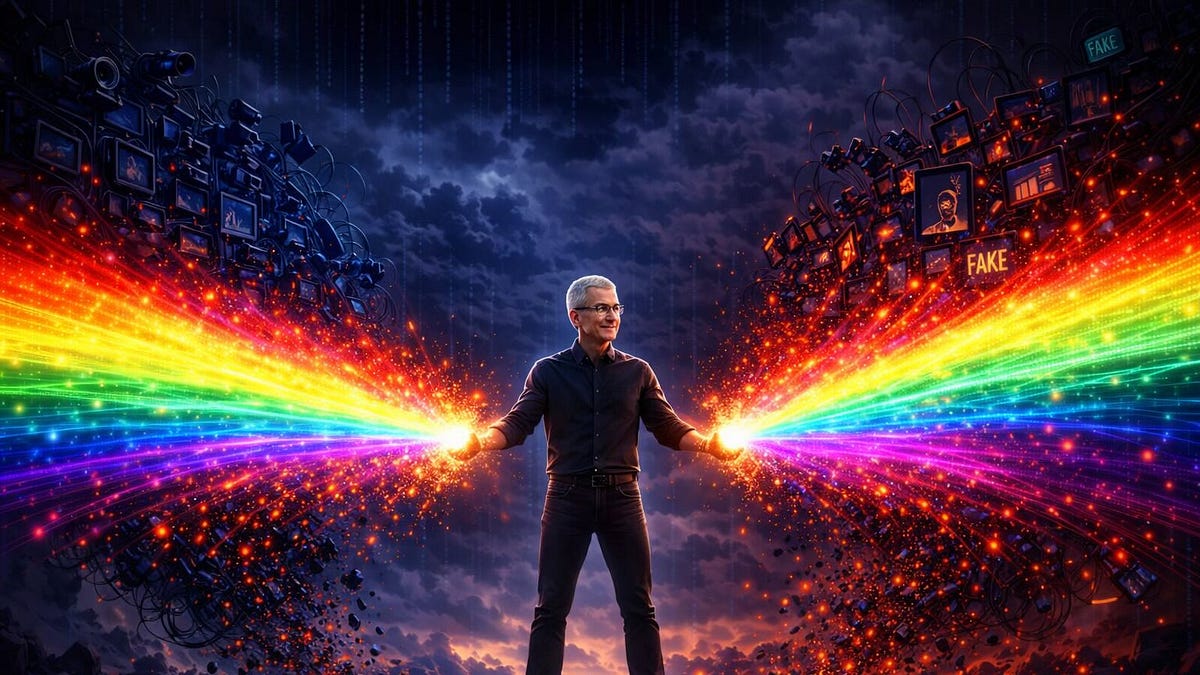
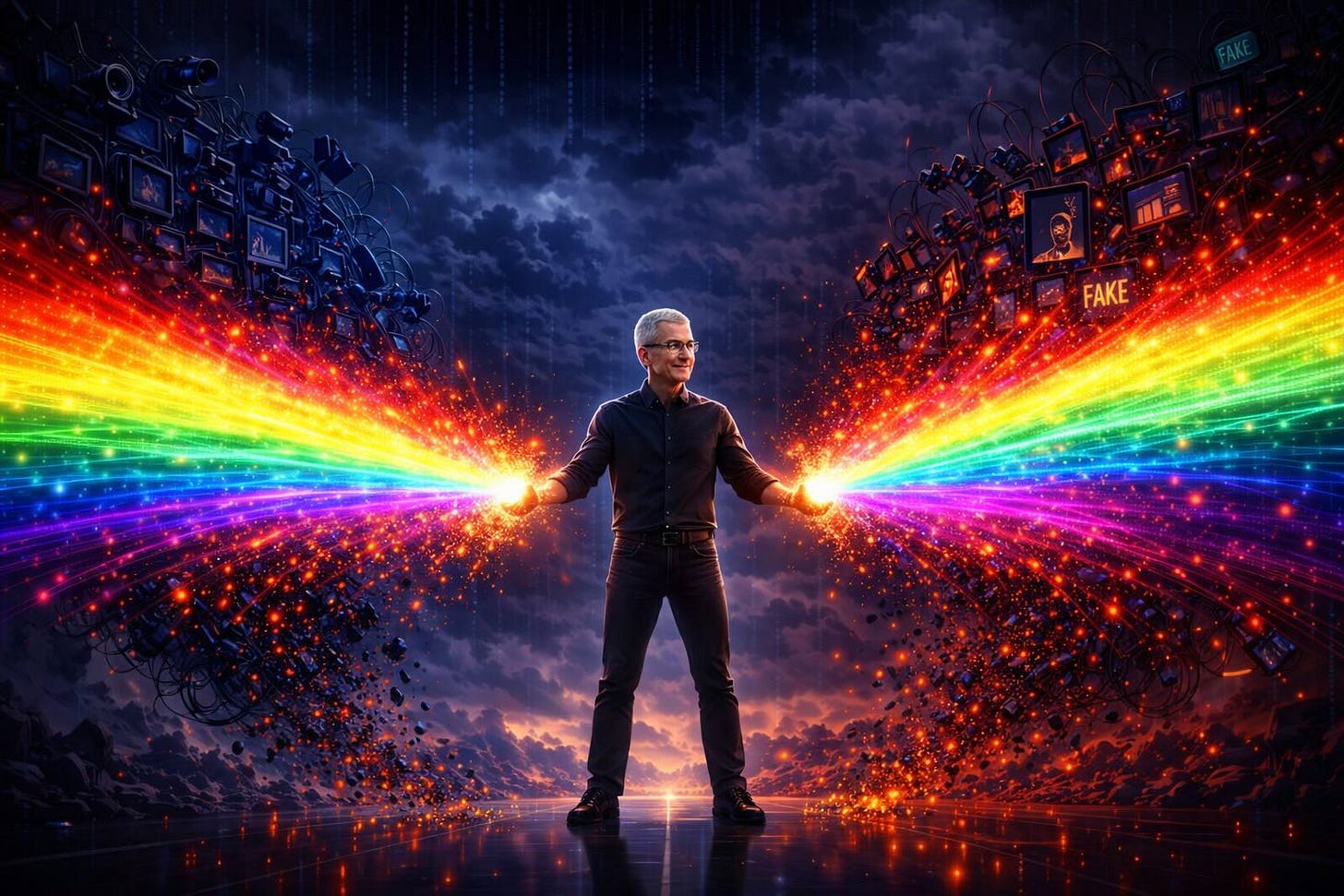
In 1977, Apple introduced a logo with six colored stripes. Playful, human, optimistic—a rainbow rendered in the visual language of personal computing. The company kept it for two decades before replacing it with monochrome minimalism. The rainbow became nostalgia.
But the symbol never lost its meaning. When you see a rainbow after a storm, you know the weather is turning. A double rainbow means extraordinary luck. At the end of the rainbow, there is a pot of gold.
Imagine a future where Apple has done what Apple does.
Your iPhone shows you a news article. A small indicator tells you this content has been verified against primary sources. The information is real. A human institution stands behind it.
You receive an email that appears to be from your bank. Your Mac flags it: AI-generated elements inconsistent with your bank’s verified communication patterns. You are protected.
Your child asks Siri a question. The response comes with clear provenance—where this information originated, its confidence level, how to learn more. The experience is designed for understanding, not engagement. It brings clarity. It brings possibility.
Your colleague is an AI agent working alongside you—researching, drafting, executing tasks at speed. A small indicator confirms its sources are verified, its reasoning is legible, its actions are bounded by permissions you set. You trust it because the trust layer is watching. Not the model provider. Not the agent itself. An institution with no conflict of interest, verifying at the infrastructure level.
Legibility. Clarity. Accountability. Agency. In a world where AI agents work alongside us, these aren’t just promises—they’re requirements.
A product visionary wins battles. A systems master wins wars. These are different skills.
Steve Jobs chose Tim Cook. For fifteen years, the narrative has been that Tim lives in Steve’s shadow. Competent steward. Supply chain genius. Not a product guy. Not a visionary. The implication: not Steve.
But the AI war isn’t a product war. It’s a systems war. It requires someone who can build trust infrastructure at global scale—across chips, software, hardware, retail, and brand. Someone patient, systems-minded, quality-obsessed. Someone genuine. Not performing genius. Just doing the work.
Apple’s stratospheric post–Steve Jobs success is the evidence: what Steve Jobs was to products, Tim Cook has been to systems. And he has the right temperament to govern a system this big.
Compared to some global tech titans, Tim Cook stands out by not trying to stand out. He comes across as relatable and genuine. While others may boast and puff their chests, Tim is comfortable in his own skin. He doesn’t need to showboat. He’s the CEO of Apple. That’s one of the world’s biggest flexes.
The AI Trust Layer can be Tim Cook’s moment. Not a product launch—a restoration. Not a device—an infrastructure. The undertaking that makes information trustworthy again.
The rainbow after the storm.
And here’s the truth beneath the business case: we need him to win this.
Not for Apple. For us.
On August 9th, 2011, Apple became the world’s most valuable company by market capitalization, topping the seemingly un-toppable Exxon. Just 15 days later, Steve Jobs wrote in his letter of resignation as Apple’s CEO (endorsing Cook), “I believe Apple’s brightest and most innovative days are ahead of it.”
Tim has seen this movie before: Napster normalized piracy. Zuck scaled surveillance. Studio Ghibli exposed the cultural line AI crossed. He sees that today’s model providers cannot police themselves. He sees that legislators are years behind. The information layer is degrading. Tim sees someone has to build the trust infrastructure between AI and humanity. Someone with the structure, the culture, the cash, and the character to do it right.
Here’s to hoping Steve was right and Tim chooses trust.
This essay argues that confident AI systems require human verification. The essay itself was produced that way.
The author developed every concept, argument, and framework through iterative dialogue with Claude (Anthropic) and Google NotebookLM. Claude served as a thinking partner—testing logic, shaping structure, drafting prose, and exposing gaps. NotebookLM surfaced “Apple lost the battle” as the strongest entry point for the essay.
ChatGPT was used as a “model-as-judge” on the final draft, pushing for more precise wording around actress Scarlett Johansson’s accusation involving OpenAI. Perplexity was used to validate claims, and the author manually reviewed the underlying source websites to assess their credibility.
Throughout the process, the author wrote core prose, directed the work, challenged outputs, revised repeatedly, and made all final editorial decisions.
At one point, Claude hallucinated the author’s surname—twice—using two different incorrect names. The author caught both errors. This is precisely the reliability problem the essay describes: AI systems that can be confident, fluent, and wrong. The solution is not to stop using them. The solution is humans in the loop, verifying.
A minority of the draft text was AI-assisted. All final judgment, interpretation, and responsibility remain with the author alone.
Antonio White, “The Pitchfreak” helps deep tech founders and operators clarify strategy, sharpen positioning, and build systems that scale. He writes about technology, trust, and the business forces shaping the future.
Apple retail sales per square foot: CoStar research, reported in Chain Store Age, December 2024.
The Ghibli-Style AI Trend Shows Why Creators Need Their Own Consent Tools: The Tech Press.com April 2nd, 2025
Scarlett Johansson Said No, but OpenAI’s Virtual Assistant Sounds Just Like Her: New York Times: May 20th, 2024
RIAA lawsuits: Electronic Frontier Foundation, “RIAA v. The People: Five Years Later,” September 2008.
Briefly, Apple Reigns as the Most Valuable Company: New York Times: August 9th, 2011Letter From Steve Jobs: Apple.com Newsroom, August 24th 2011

No posts
Ready for more?
相關文章
其他收藏 · 0