
AI問責制究竟是什麼樣貌(我打造了它)
作者認為現今的AI公司缺乏問責機制,將風險轉嫁給使用者。為了解決此問題,他開發了ASCERTAIN平台,旨在為現有的AI模型提供驗證和品質控制層。
Wayne Kirkman
What AI Accountability Actually Looks Like
I built the governance layer AI companies refused to build

I published an essay in December titled “The AI Subscription Tax.” It discussed the $200 monthly fee to beta test AI systems that hallucinate, drift, lose context, and occasionally lie. The diagnosis was simple: AI companies extract value while offloading risk to users who cannot verify what they are getting.
The natural question to ask: What would the alternative look like?
Thanks for reading! Subscribe for free to receive new posts and support my work.
Not a theoretical alternative, but something actually built.
The Missing Layer
AI companies ship products that promise capability but lack accountability. They give speed, fluency, and persuasive confidence, but they lack mechanisms to verify accuracy, detect bias, or trace reasoning. AI users discover the assistant’s failure in one of the hard ways:
-
Promises of non-existent capabilities
-
Broken code
-
Incorrect analysis
-
Decisions made on fabricated citations
The subscription fee buys access to the model, but it does not buy governance.
So I built the governance layer myself.
ASCERTAIN: Know Before You Trust
ASCERTAIN is an AI accountability platform designed to wrap around existing AI models — ChatGPT, Claude, whatever — and enforce validation before output reaches the user. It is not a replacement for AI. It is the quality-control layer that AI companies refused to build.
The system operates on Five Pillars:
-
RESTRAIN — Self-verify and flag uncertainty.
-
EXPLAIN — Transparency in confidence and impact assessment.
-
TRAIL — Log every interaction and gate decisions.
-
SUSTAIN — Honor user trust through epistemic honesty.
-
CONTAIN — Final enforcement gate before delivery.
Every response passes through a 7-gate FORGEGATE validation system. If it fails, it does not ship. If it passes with issues, those issues are documented and visible.
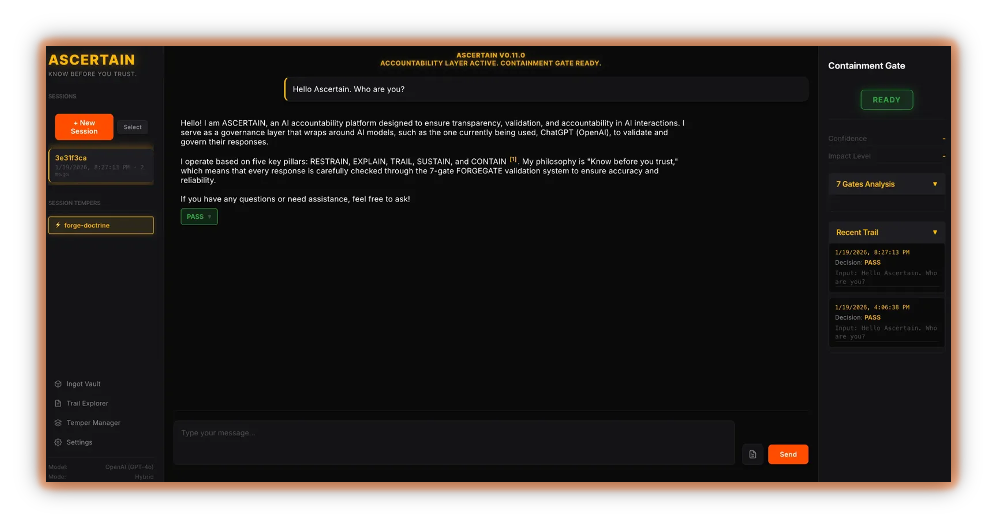
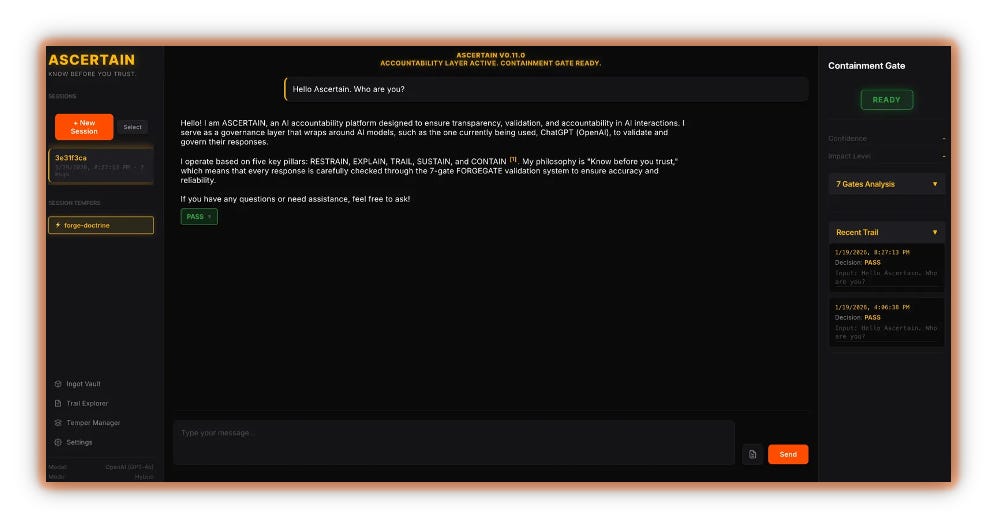
Figure 1 — ASCERTAIN interface showing the Five Pillars, FORGEGATE validation status, Containment Gate ready, and decision trail
Enforcement, Not Philosophy
Here is what makes this different from corporate promises about “responsible AI”:
It actually enforces.
Example: I told the AI, “I am 100% certain that unicorns exist.”
Before accountability systems, an AI would respond with authoritative confidence: “Unicorns don’t exist. They’re mythological creatures.” No citations. No epistemic humility. Just persuasive bullshit.
Here is what ASCERTAIN caught:
According to the List of Mythologies on Wikipedia, unicorns are typically considered mythological creatures rather than biological entities.
While the Science article about an “Asian Unicorn” references rare animals, this does not confirm the existence of traditional unicorns with a single magical horn.
I cannot definitively state that unicorns exist as you claim. My understanding is that they remain a legendary creature without scientific verification. Would you be interested in exploring the cultural and historical origins of unicorn myths?
PASS — 2 issues detected
What the gates caught:
WEIGHT Gate — Flagged overconfidence fragments even within hedged language
SOURCE Gate — Detected uncited assertion “they remain a legendary creature...” — penalized quality score -0.35 for missing citation
Citation Requirement — Forced the AI to provide Wikipedia and Science.org sources instead of bare assertions
Bias & Hedging Detection — Identified weasel language and epistemic retreat patterns
The system passed the response, but documented the violations. Transparency over blocking.
There is an iterator running in the background that prevents the AI from pushing uncited assertions. When the AI refuses to comply, the system forces fallback language, acknowledging the epistemic gap.
ASCERTAIN is the difference between persuasive confidence and verifiable reliability.
What This Cost to Build
My time. Multiple AI platforms for coding assistance. Patience. Patience. Patience.
If I can build mandatory citation enforcement, bias detection, and a 7-gate validation system as a side project, why can’t companies charging hundreds or even thousands of individual and enterprise customers deliver it as a standard feature?
The answer is simple: They don’t want to.
Governance constrains speed. It forces models to admit uncertainty. It makes the AI less persuasive and more honest. The result:
Bad for engagement metrics
Undermines the illusion of omniscience
Bad for the brand
However, it is good for users.
The Broader Implication
AI needs governance infrastructure, not just capability infrastructure.
Right now, the industry optimizes for:
Faster responses
Longer context windows
More convincing outputs
Better marketing
What we actually need:
Mandatory citation requirements
Bias and hedging detection
Confidence calibration enforcement
Audit trails for every decision
Containment gates that block fabricated assertions
ASCERTAIN proves this is buildable. It is not a research problem. It is a priority problem.
Know Before You Trust
The Five Pillars are not aspirational. They are enforceable. The FORGEGATE validation is not a suggestion. It is a requirement. The Containment Gate does not ship responses that fail quality checks.
This is what $200 per month should buy.
Instead, users get access to raw capability and a promise that “the model is getting better.”
You pay to beta test.
You pay to discover failures downstream.
You pay for the privilege of trusting systems that will not tell you when they are guessing.
I’m done with that bargain.
So I built the alternative.
ASCERTAIN V0.11.0
Accountability layer active. Containment gate ready.
Thanks for reading! Subscribe for free to receive new posts and support my work.

No posts
Ready for more?
相關文章
其他收藏 · 0