
為AI設計設計合約
本文探討如何讓AI遵守特定設計規則的挑戰,提出一個「設計合約」綱要,用以強制執行UI意圖,避免生成通用輸出,超越了簡單的提示詞方法。

AskCodi Blog
Designing a Design Contract for AI
What if AI wasn’t allowed to ignore your design rules? I built a system that makes it impossible.

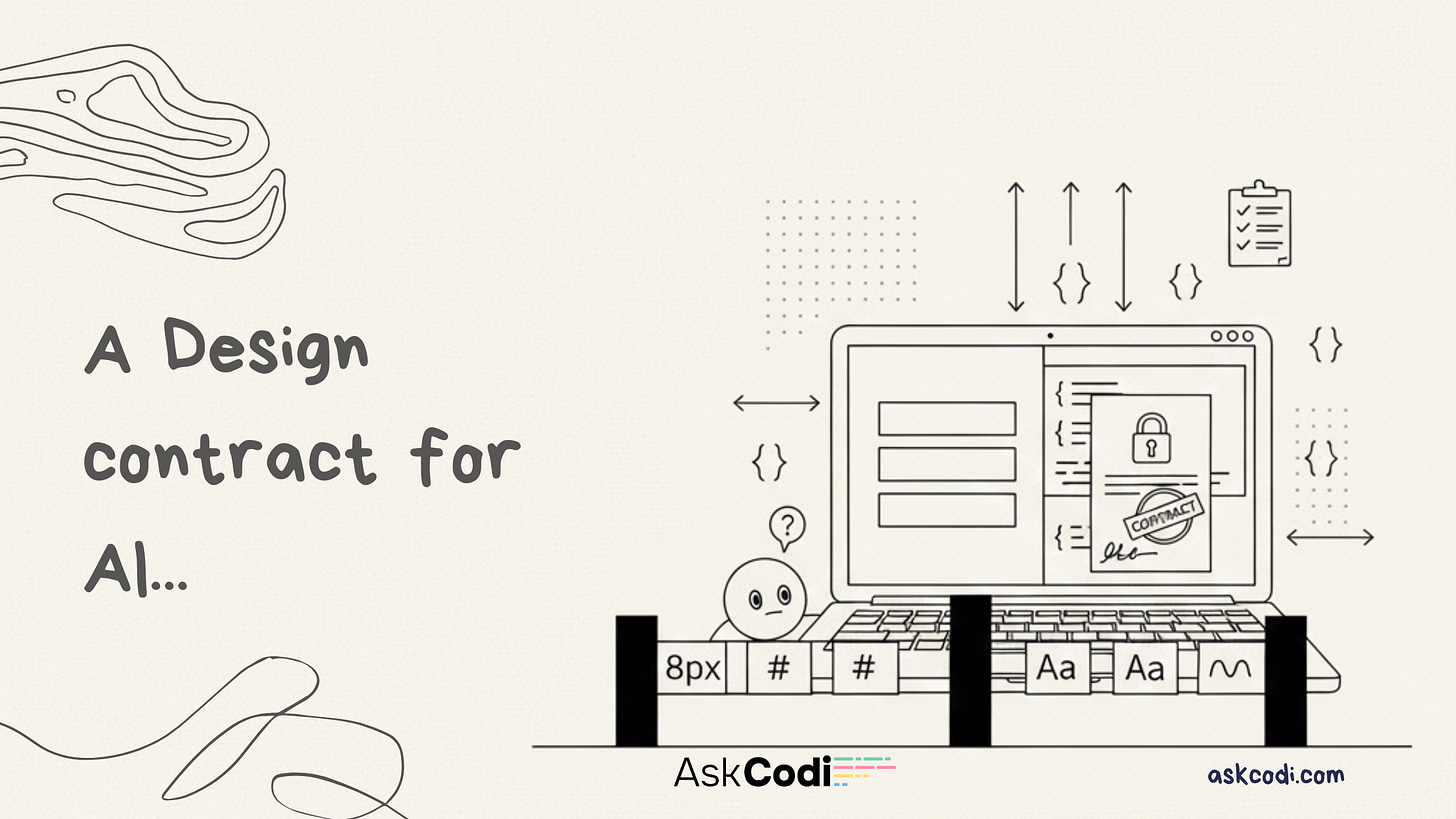
How I built a system that forces AI to respect design decisions
[Previously: I discovered that AI generates generic UIs because it lacks context, not capability. System prompts and metadata didn’t work. I needed something stronger.]
Thanks for reading AskCodi Blog! Subscribe for free to receive new posts and support my work.
What Should a UI Intent Look Like?
I started designing what a UI Intent schema should be.
It needed to be:
Comprehensive: Cover all aspects of UI design
Deterministic: Same intent = same quality of output
Explicit: No ambiguity or interpretation
Enforceable: Technical mechanism to block violations
Evolvable: Can change over time with audit trail
Here’s what I came up with:
This wasn’t just metadata. This was a design contract.
The Enforcement Challenge
The schema was one thing. Enforcement was another.
I had three options:
Option 1: Prompt-Based Enforcement
Include intent in system prompt. Tell AI “You MUST follow this intent”. Hope it listens.
Pros: Easy to implementCons: Not reliable, AI can ignore prompts
Option 2: Post-Generation Validation
Let AI generate code. Validate against intent. Reject if violations found.
Pros: Catches violationsCons: Wastes tokens, slow feedback loop
Option 3: Runtime Enforcement Gate
AI must classify alignment before file operations. Block operations that conflict with intent. Require explicit intent update for conflicts.
Pros: Bulletproof enforcementCons: Complex implementation
I chose Option 3. Here’s why:
If the AI wants to create a login page but the intent says "no_authentication", I don’t want to:
Let it generate the code and then reject it (wasteful)
Hope the AI notices the conflict in the prompt (unreliable)
I want a hard gate that stops the operation and says:
“This request conflicts with UI Intent. You cannot create authentication features. You must either:
Adapt the request to align with intent (suggest alternative)
Update the intent explicitly (with reason) before proceeding”
This forces intentionality. The AI can’t accidentally drift. The user sees why requests are blocked. Intent changes are explicit and audited.
The Classification Protocol
Here’s how I implemented enforcement:
Step 1: Before any file operation, AI must classify the request
The AI calls a classification tool that returns structured data with four key fields:
Intent Alignment: One of three states (ALIGNED, PARTIALLY_ALIGNED, or CONFLICTING)
Violations: List of specific rules broken (e.g., “no_authentication”, “product_type_mismatch”)
Reasoning: Human-readable explanation of why this classification was chosen
Recommended Action: Whether to proceed, adapt the request, or update intent first
This isn’t free-text evaluation. It’s machine-readable JSON that the enforcement gate can validate programmatically.
Step 2: Runtime gate validates classification
ALIGNED: Proceed immediately with file operations
PARTIALLY_ALIGNED: Check if change type is in the allowed list (visual refinements yes, backend logic no)
CONFLICTING: Block file operations unless AI first calls the update intent tool with explicit reason
Step 3: Intent updates are versioned
Every intent change is recorded with:
What changed (JSON diff from previous version)
Why it changed (mandatory reason field provided by AI)
Who changed it (user, AI, or system attribution)
When it changed (timestamp with millisecond precision)
This creates an append-only audit trail of design decisions that can never be silently modified.
The Three Layers of UI Intent
UI Intent ended up having three layers:
Layer 1: Base Intent (User Defined)
Product type, audience, goals. High-level design tone and constraints. Non-goals and forbidden features.
This is the source of truth.
Layer 2: Design Profile (Derived)
Concrete design rules derived from base intent. Layout strategies, component allowlists and blocklists. Typography rules, spacing scales. Anti-patterns and quality checklists.
Deterministic derivation (same intent → same profile).
Layer 3: UI Archetypes (Hard Constraints)
Product-type-specific layout rules. Landing pages vs dashboards vs internal tools. Maximum CTAs, navigation requirements. Forbidden patterns per archetype.
Non-negotiable constraints.
This layering ensures that:
User has control (Layer 1)
AI gets explicit rules (Layer 2)
System prevents nonsense (Layer 3)
Deriving Concrete Rules from Abstract Intent
The most complex part was deriving concrete design rules from abstract intent.
For example, if the base intent says:
The derived design profile should specify concrete, actionable constraints:
Layout Strategy: Linear sectional flow (hero → features → social proof → CTA)
Navigation: Top navigation only, minimal with max 5 items
Density: Spacious section spacing (py-16 on mobile, py-24 on desktop)
Visual Motifs: Structured borders, subtle shadows, no gradients
Allowed Components: Hero sections, feature grids, testimonials, FAQ sections
Forbidden Components: Sidebars, data tables, admin panels
Interaction Rules: Maximum 1 primary CTA, simple forms only
Anti-Patterns: Generic centered div heroes, more than 3 competing CTAs, login/signup flows
Quality Checklist: Hero with clear value prop, single prominent CTA, sectional vertical flow
I built deterministic mapping matrices that translate abstract intent to explicit rules:
Product Type Rules (4 types): Landing pages get spacious sectional layouts. Dashboards get dense grids with sidebars. SaaS apps get hybrid marketing and product sections. Internal tools get compact, function-first layouts.
Design Tone Motifs (4 tones): Minimal gets flat design with minimal shadows. Professional gets subtle shadows and structured borders. Playful gets rounded corners and accent colors. Bold gets high contrast and strong borders.
Experience Level Adaptations (3 levels): Non-technical users get guided flows and plain language. Technical users get dense controls and keyboard shortcuts. Mixed audiences get balanced complexity with progressive disclosure.
Each combination produces specific, actionable rules that the AI must follow. Same intent always produces same profile. Completely deterministic.
Why This Architecture Works
1. Structured Classification (Not Free Text)
The AI can’t give vague responses like “this seems okay” or “maybe violates intent”. It must provide machine-readable JSON with specific violation types.
This makes enforcement programmable.
2. Three Tiers (Not Binary)
ALIGNED gives zero friction for common requests.
PARTIALLY_ALIGNED lets AI adapt within constraints (e.g., “client-side only” instead of backend).
CONFLICTING forces explicit intent update for major changes.
Binary allow/deny would be too restrictive.
3. Append-Only Versioning
Every intent change creates an immutable record. You can audit the entire evolution of design decisions. You can rollback to any previous version.
This is critical for understanding why an app evolved the way it did.
4. Explicit Change Attribution
Every update tracks who initiated it (user, AI, or system). You can see if drift was user-requested or AI-suggested.
This builds trust in the system.
The Tools I Added to AI’s Toolkit
I added two new tools to the AI’s available functions:
Tool 1: classify_intent_alignment
The AI is now required to call this tool before file operations. It can’t skip evaluation or provide vague reasoning.
Tool 2: update_ui_intent
The reason field forces transparency. The AI can’t silently change intent. It must provide justification like:
“User requested authentication. Updating non_goals to remove ‘no_authentication’ because user explicitly needs user management features.”
This makes intent evolution transparent and deliberate.
The Enforcement Gate Logic
The runtime validation follows a strict waterfall:
First Check: Read-Only OperationsRead file operations always proceed (they don’t modify state, so no risk).
Second Check: Classification RequiredIf no classification was provided, block immediately with error: “Must classify intent alignment before file operations.” No exceptions.
Third Check: ALIGNED StateIf classification is ALIGNED, proceed immediately.
Fourth Check: PARTIALLY_ALIGNED StateValidate the change type. Only specific types allowed without intent updates:
visual_refinements (colors, shadows, spacing)
layout_adjustments (grid changes, positioning)
copy_changes (text content only)
component_styling (CSS classes)
Any other change type (backend_logic, authentication, new_capabilities) is auto-reclassified as CONFLICTING and blocked.
Fifth Check: CONFLICTING StateSearch recent tool calls for an update_ui_intent call. If found, the conflict was explicitly resolved and operations proceed. If not found, block with error: “Request conflicts with intent. Call update_ui_intent first.”
This gate is non-bypassable. It runs before tool execution, not after. The AI cannot generate conflicting code, even if it tries.
What I Learned Building This
1. Constraints Are Features
I thought constraints would feel restrictive. They actually feel liberating. When the AI knows exactly what’s allowed, it produces better output faster.
2. Explicitness Beats Cleverness
I could have used ML to infer violations. But explicit rules are better. They’re debuggable. They’re predictable. They’re trustworthy.
3. Auditability Matters
Being able to see why intent changed over time is incredibly valuable. It turns intent drift from a bug into a feature.
4. Structure Enables Automation
Because classification is structured JSON, I can build tools on top of it. Intent debuggers. Diff viewers. Rollback systems. Analytics.
Continue to Part 3: The Implementation
In the next post, I’ll show you how I integrated this into AskCodi, the bugs I hit along the way, and the moment when everything finally clicked.
This is Part 2 of a 5-part series on building UI Intent. I’m Sachin, founder of AskCodi, and I’m sharing how I built a system that forces AI to respect design decisions.
Thanks for reading AskCodi Blog! Subscribe for free to receive new posts and support my work.

No posts
Ready for more?
相關文章