

當所有AI產品都承諾相同魔法時,如何脫穎而出
本文探討了當大多數AI產品都提供相似的「魔法」承諾時,創始人如何讓自己的產品脫穎而出。文章提出了一個行銷策略,建議創始人採取「之」字形策略,從商品化內容轉向建立聲譽資本。

Tools For Tech Founders
How to Stand Out When Every AI Product Promises the Same Magic
The Marketing Playbook for Founders Ready to Zig While Everyone Else Zags


Every AI product now promises the same thing: “Create X in seconds.”
Your homepage probably says something similar.
But your technical buyers have pattern-matched this promise already. They’ve tried tools that “eliminate the hard parts” and have realized that “easy” is usually code for “easy to start, hard to finish.”
We’ve seen this movie before…
In the 90s, banner ads worked because they were novel. Then people learned where ads lived on the page. “Banner blindness” became a thing. The first banner ad had a click-through rate of ~40%. Now you’d be lucky to get 0.04%.
Blindness towards AI content is heading for the same fate, only faster. People have learned the patterns and tuned it out.
So if everyone else is pushing magic promises, here’s how to Zig when everyone else is Zagging:
Part 1: Content Marketing
Moving from commodity content to reputational capital.
Because technical buyers have built new antibodies towards generic AI writing, if you want attention, stop publishing what anyone could generate. Instead…
1. Start Sharing Proprietary Insight (stuff only you can know)
Your advantage is everything not included on a common crawl.
AI can’t write about the weird bug you fixed last week. Or the insight you learned from chatting with a customer. Those stories are differentiated by default because they are real and unique to you.
The Zag: Generating hundreds of generic “How-to” guides and AI-synthesized articles.
The Zig: Share specific stories from your life or your product.
Example 1: Peter Walker, Head of Insights @ Carta
Amassed 159,221 followers on Linkedin from sharing data from the Carta Platform and converting it into compelling narratives that are useful to their target audience: Startup founders.
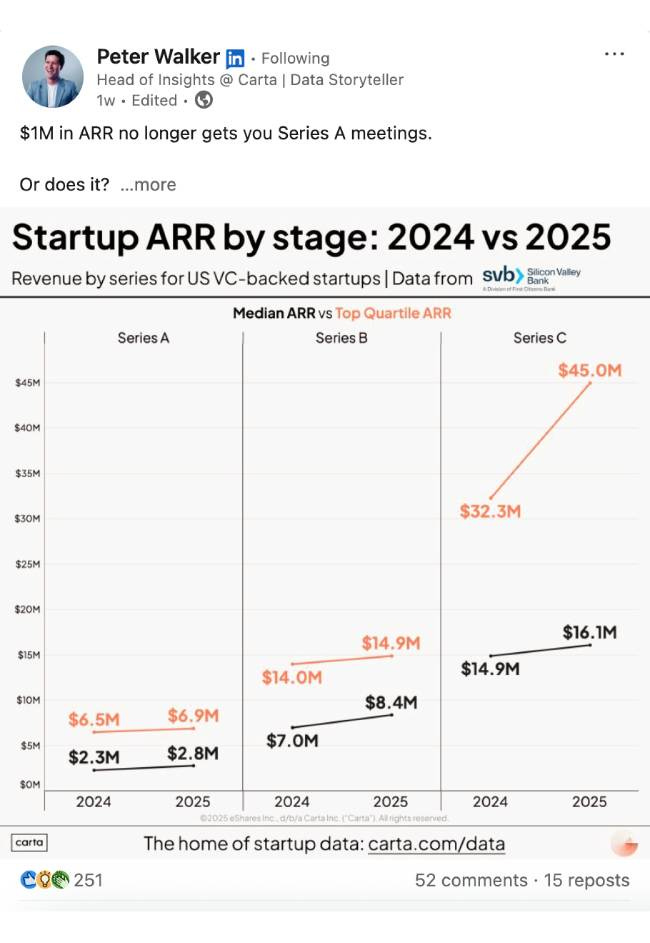
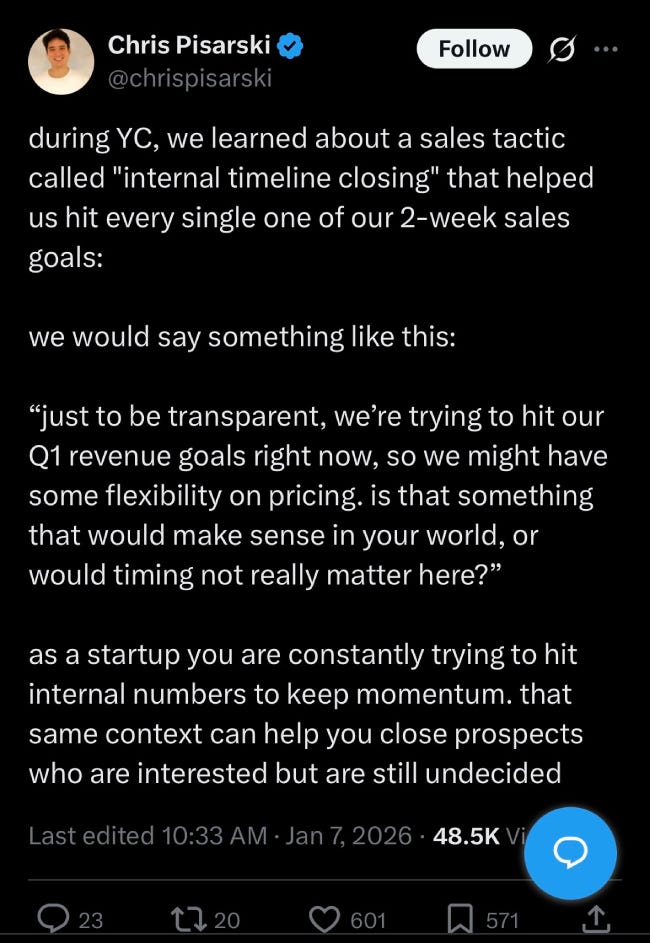
Example 2: Chris Pisarski, Co-founder @ Crustdata (YC F24).
Shows that your content doesn’t even have to be your own. You can share advice from other organizations like YC. Again, interesting to his target audience of technical founders, who may even aspire to join YC one day.
2. Trade Articles for Artifacts (tools beat posts)
If something looks hard to make, people treat it as more valuable.
Plus, vibe coding a useful tool is a great way to capture lead info like email/company. Creating real usage and value vs forgettable article skimming.
The Zag: Flooding the internet with “thought leadership” pieces that offer no utility.
The Zig: Releasing open-source CLI tools, spreadsheet calculators, or configuration generators that help your prospects and capture their info.
Example: Ahrefs’ (Free SEO Tools)
Ahrefs offers a library of free SEO mini-tools (Backlink Checker, Keyword Generator, Website Authority Checker). Unlike an article you just read, these tools require you to input your website URL, analyze the metrics, and give you a checklist of how to improve.
By the time you’ve used their free tools to diagnose your site, you trust their data engine so much that paying $99/month for the full suite feels like the only logical next step.
3. Show the Messy Middle (with real trade-offs)
When everyone else is posting picture-perfect polished posts. Move to the messy middle.
Share what didn’t work. Explain why you rebuilt your onboarding flow three times. Document the customer feedback that changed your roadmap.
The Zag: Presenting a perfectly polished, corporate-sanitized article that feels artificial.
The Zig: Publishing failed experiments and “unfiltered” technical post-mortems.
In a world of AI perfection, admitting human imperfection signals authentic technical rigor and transparency.
Word of Warning: It’s not about being “messy” for the sake of it. It’s about showing the technical trade-offs. “We chose PostgreSQL over NoSQL for this specific reason, even though it made our initial build harder.” This signals rigor, not just “imperfection.”
Example: Honeycomb.io (Public Incident Reviews)
When their system goes down, Charity Majors, CTO and her team don’t just send a polished PR statement. They publish deep, technical, and often “messy” post-mortems that show exactly where they messed up and how they fixed it. This vulnerability builds more trust with engineers than 100% uptime ever could.
With content you’ve on your prospects radar. But here’s the problem, you’ve just earned attention you can’t convert.
The next Zig isn’t about what you publish. It’s about how you position the product itself.
Part 2: Positioning
1. Position for “The High Ceiling,” not “The Low Floor”
Everything is now easy to try, cheap to start, and promises instant value (the low floor). That same ease of use drives high churn: when switching costs are near zero and differentiation is thin,
Users leave as soon as the novelty fades or a slightly better option appears.
Instead, brag about how far a user can go once they’ve mastered it (the high ceiling). Your marketing should show what the tool looks like in Year 2 of usage, not Minute 1.
The Zag: “Anyone can use this in seconds.”
The Zig: “This is a professional instrument. It takes 20 minutes to configure, but it will save you 20 hours every week for the next three years.”
By changing your positioning, you signal that your tool has functional density. It appeals to the “Craftsman” mindset rather than the “Lazy” mindset. The “Lazy” prospect is probably more likely to churn anyway.
Example: Obsidian (The “IDE for Thought”)
Most note-taking AI tools brag about how they “write for you.” Obsidian does the opposite. It starts as a blank slate with a “high ceiling” of plugins, CSS customization, and local-first file management. It positions itself as a tool you master over years, not something you use instantly.
2. Embrace the Friction (Precision over Ease)
You aren’t saying it is hard to use. You’re making it impossible to misuse. Appealing to the “Professional Grade” persona.
If your tool requires data mapping, API keys, or specific schema definitions, don’t hide that in the documentation, feature it in the marketing.
The Zag: Promising “magical” one-click solutions that work instantly but offer zero transparency.
The Zig: Marketing your tool as a “professional instrument” that requires intentional setup for superior results.
Experts distrust “magic” because it usually implies a lack of reliability and customizability. When you admit something requires effort, the prospect believes your claims about the results much more readily.
Example: Linear (The “Linear Way”)
While Jira and Trello try to be “easy for everyone,” Linear forces a specific, opinionated workflow and a steep learning curve for keyboard shortcuts. They market this friction as a feature: “Built for high-performance teams.” They don’t want the casual user; they want the “Pro” who is willing to learn their system.
3. Use “Negative Positioning” (eliminate non-ideal users)
It can be counter-intuitive for tech founders to alienate some of their TAM.
But being “violently specific” about who you are not for helps your message actually resonate with your prospects.
No one reads “this tool can do anything for anyone” and thinks “wow! They know me so well!”
The Zag: Trying to appeal to every potential user to maximize lead volume and TAM.
The Zig: Boldly defining the specific use cases and user types you serve best.
When you’re honest about who you aren’t for, prospects believe you much more when you say who you are for. This is the ultimate zig because AI products try to sell to everyone with a pulse.
Example: Basecamp (The “We are not for everyone” Philosophy)
Basecamp explicitly lists features they will never build and types of customers they don’t want. By saying “We are not a project management tool for 5,000-person enterprises,” they become the hero for the 10-person agency.
Sharp positioning helps you stand out. But what happens when the page is buried under a flood of AI-generated slop?
The final Zig: stop broadcasting and start building rooms worth being invited into.
Part 3: Community (Focus: Trust over Reach)
In 2026, the internet has reached a “saturation point” where the volume of AI-generated content is flooding every platform and has effectively broken the traditional marketing funnel.
This is creating a migration to “Dark Social“. As public social feeds (X, LinkedIn, Threads) become flooded with AI-generated “engagement bait,” high-value users are retreating into private, gated spaces.
Information is no longer a commodity, trust is. And community marketing moves from broadcasting to connecting.
1. Build in Private, not Public
“Building in Public” has become a performance art. Building in “Semi-Private” (a gated group) feels like a conspiracy. Make your customers feel like insiders.
When people feel like insiders, they pay closer attention. A public Twitter thread can’t create that.
The Zag: Posting on public feeds hoping to “go viral” in an algorithm that prioritizes rage-bait noise.
The Zig: Building or deeply participating in Slack, Discord, or Telegram groups where the barrier to entry is high.
Influence has moved from the Timeline to the DMs. If people are talking about your tool in a private group where you aren’t even present, you’ve won.
Word of Warning: If you have no public presence whatsoever you have no Top-of-Funnel. You cannot have a private community if no one knows you exist to apply. Use a “Hybrid Funnel.” Publicly share the artifacts (Point #2) to build awareness, but keep the discussion and roadmap private to build the community.
Example: SurferSEO (Private Facebook Community)
SurferSEO created a private Facebook group back in 2017, which has since grown to thousands of members. Their gated community offers exclusive access to live training sessions and peer support, helping them build a loyal customer base and generate leads through recommendations within the group.
2. Become a Peer, not a Vendor.
Engineers hate being sold but they love learning.
In a “spray and pray” world, marketing feels like an intrusion. In a community, marketing is indistinguishable from support and development.
Bonus points if you solve a user’s problem with a competitor’s tool or a generic script. Congrats, you’ve just won that user’s trust forever.
The Zag: Feature updates from the company Linkedin page.
The Zig: Founder responding to feedback on Hackernews.
Example: Kelsey Hightower (at Google/Kubernetes)
Though he worked for Google, Kelsey became a legend by acting as a peer to the community. He would often show how to solve problems using any tool, not just Google’s. He was a teacher first, a developer second, and a “marketing asset” last. People bought GCP because they trusted Kelsey, not because of the ads.
The playbook isn’t complicated. But it is counterintuitive. While everyone else embraces “effortless”, lean into effort.
Share what only you know.
Build helpful tools, not posts.
Position for mastery, not magic.
And when you do build community, make it feel like a private club, not a megaphone.
The founders who win in 2026 won’t be the ones who shout the loudest, they’ll be the ones whispering inside jokes with a community that actually gets them.

No posts
Ready for more?
相關文章