

數據顯示AI採用普遍失敗,2026年如何補救
本文分析了178家公司的數據,揭示了AI採用過程中普遍存在的陷阱,並結合作者經營兩家AI公司的獨特見解,提供了在2026年前進行改進的可行策略。


The Data Says You're Likely Screwing Up AI Adoption. Here's How to Fix It in 2026.

Before we start, I need to come clean: I’m cheating a little compared to everyone else making “2026 AI predictions.”
I run 2 AI companies: AI Academy and Epiphany. These 2 lead me inside dozens of organizations simultaneously. I get to see what’s working, what’s not, and what keeps leaders up at night, so making predictions for me looks less like random guessing and more like connecting the dots.
Thanks for reading What Matters! Subscribe for free to receive new posts and support my work.
It’s like insider trading, but legal.
Helin Yontar recently pointed out I’ve used my unfair advantage in my companies, but rarely shared it publicly. A shame, isn’t it?
In this article I will:
Start from an assessment of where we are, backed by data from 178 companies ranging from SMEs to large enterprises, from the AI Academy’s AI adoption survey (btw, you can still contribute here).
Interpret this data, and provide my predictions for 2026 and recommendations on what you should do if you want to be proud of your work in a year from now.
Buckle up: reality is different from what you might have read on LinkedIn.
Executive summary:
If you only have 1 minute, here’s what you should know:
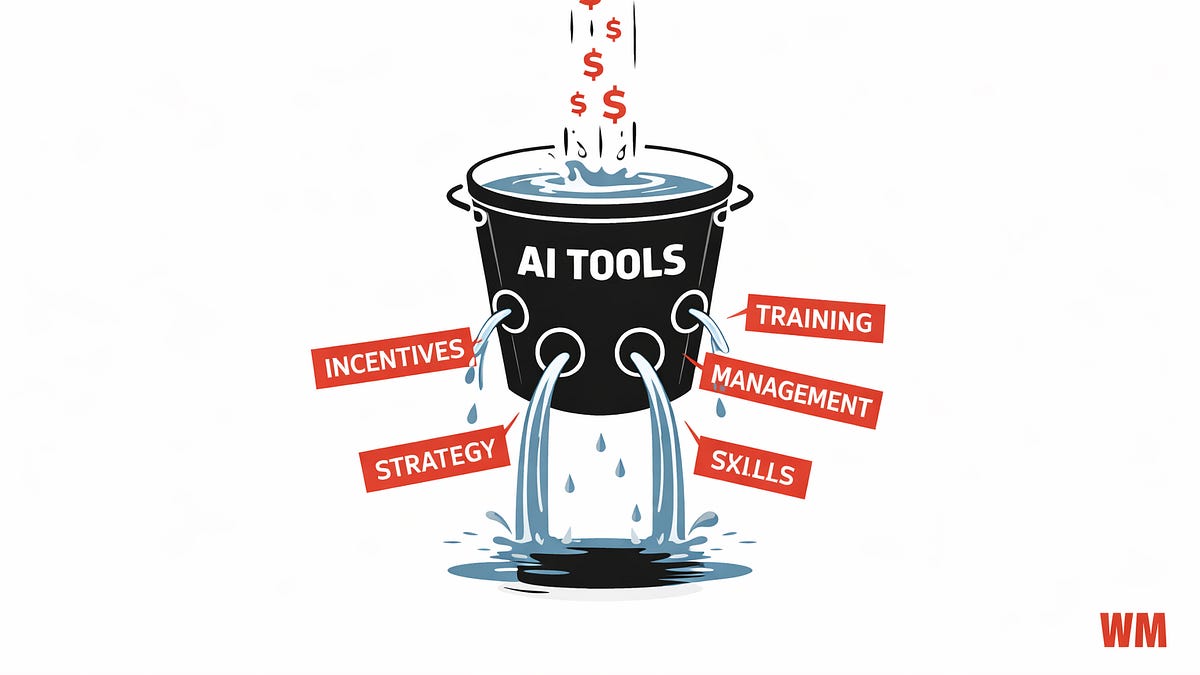
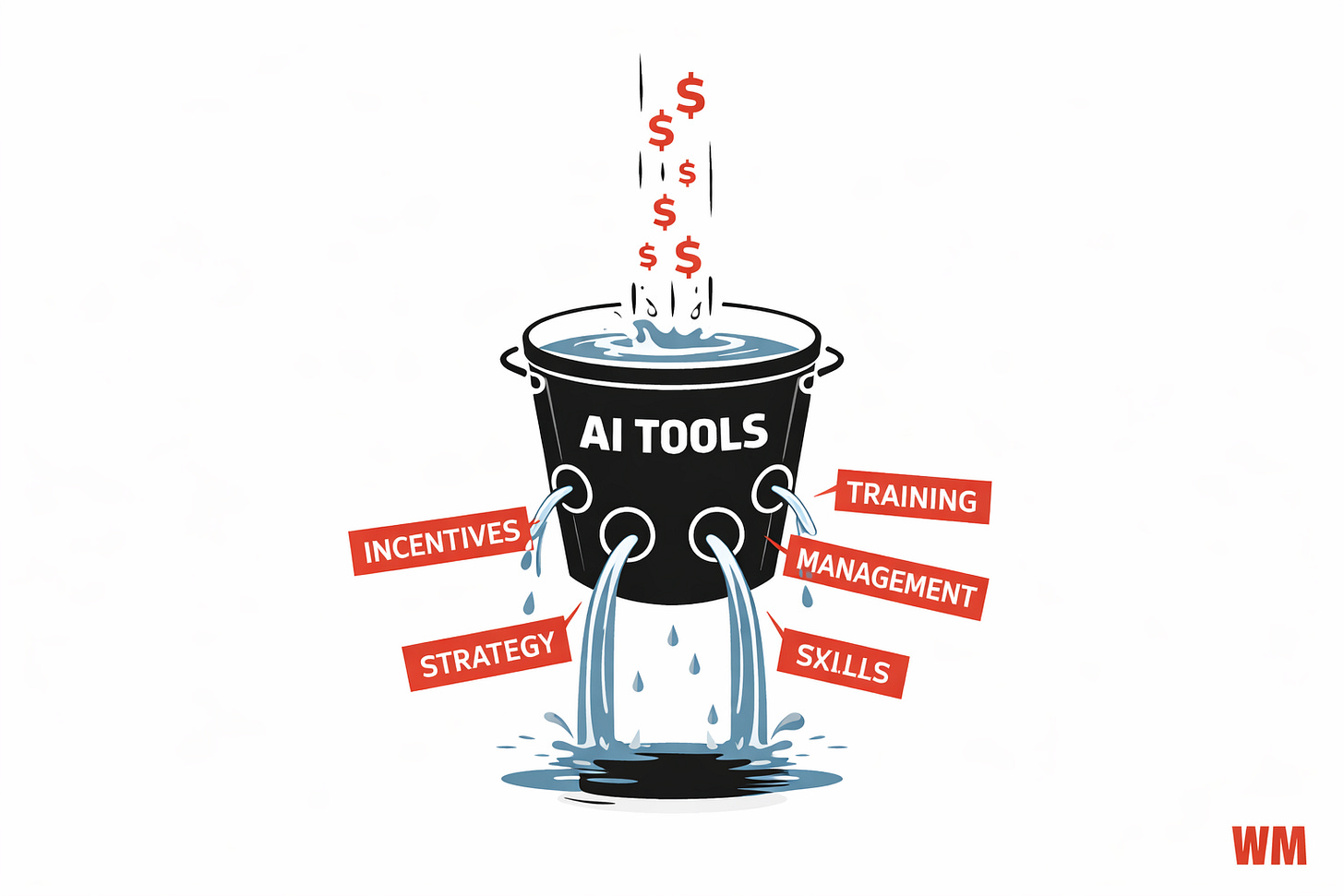
Companies are investing in AI tools, but massively underinvesting in strategy, people and change management. This creates a “leaky bucket” situation: you’re paying for AI tools that could deliver dramatic ROI, but you won’t get it because your people don’t have the direction, skills, or incentives to actually change how they work.
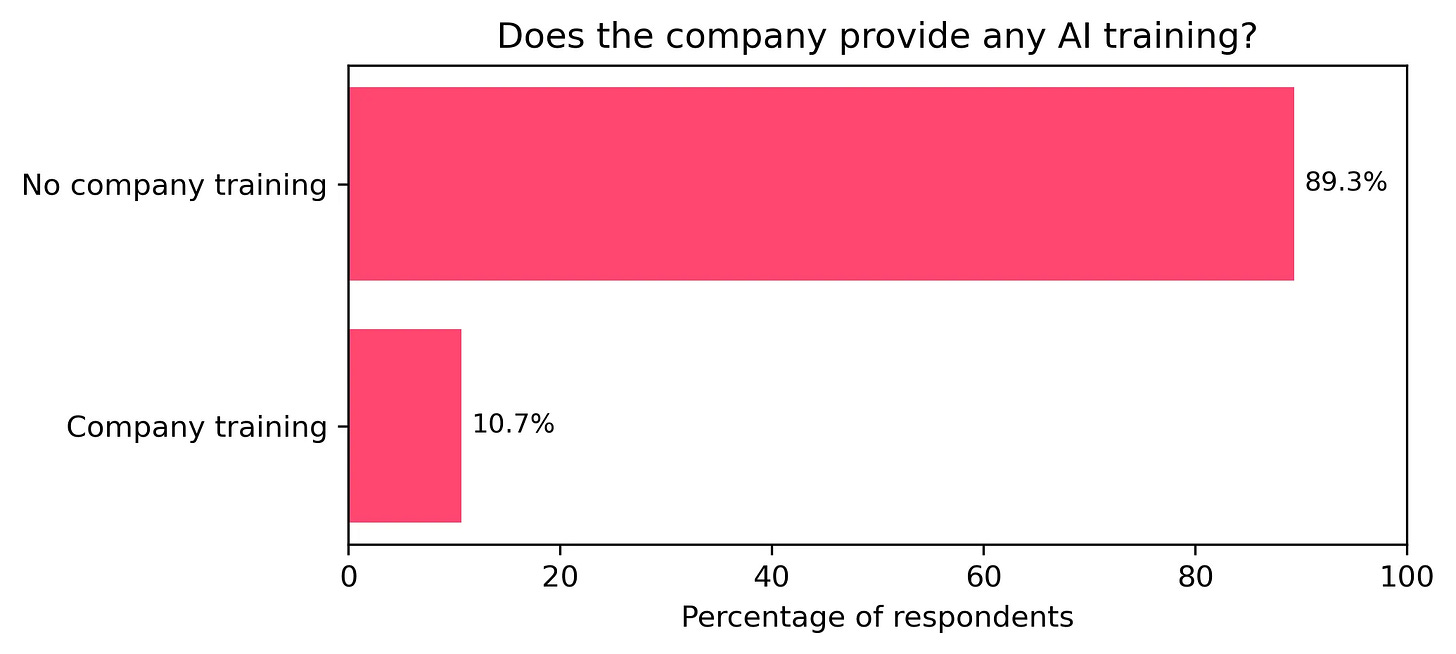
A telling example: 75% of people say they need training support to use AI well, but only 10.7% of organizations who bought AI tools also trained their teams.
To fix this, leadership should stop treating this as an IT or procurement problem. AI is a business and leadership problem. The tools work, now you need to lead the change required to reshape what your people can do and what your company can become.
A personal comment: isn’t it ironic that many worry AI will take our jobs, but then AI adoption fails when there’s not enough focus on people? People are what matters, my friend.
A reality check - how we’re starting 2026
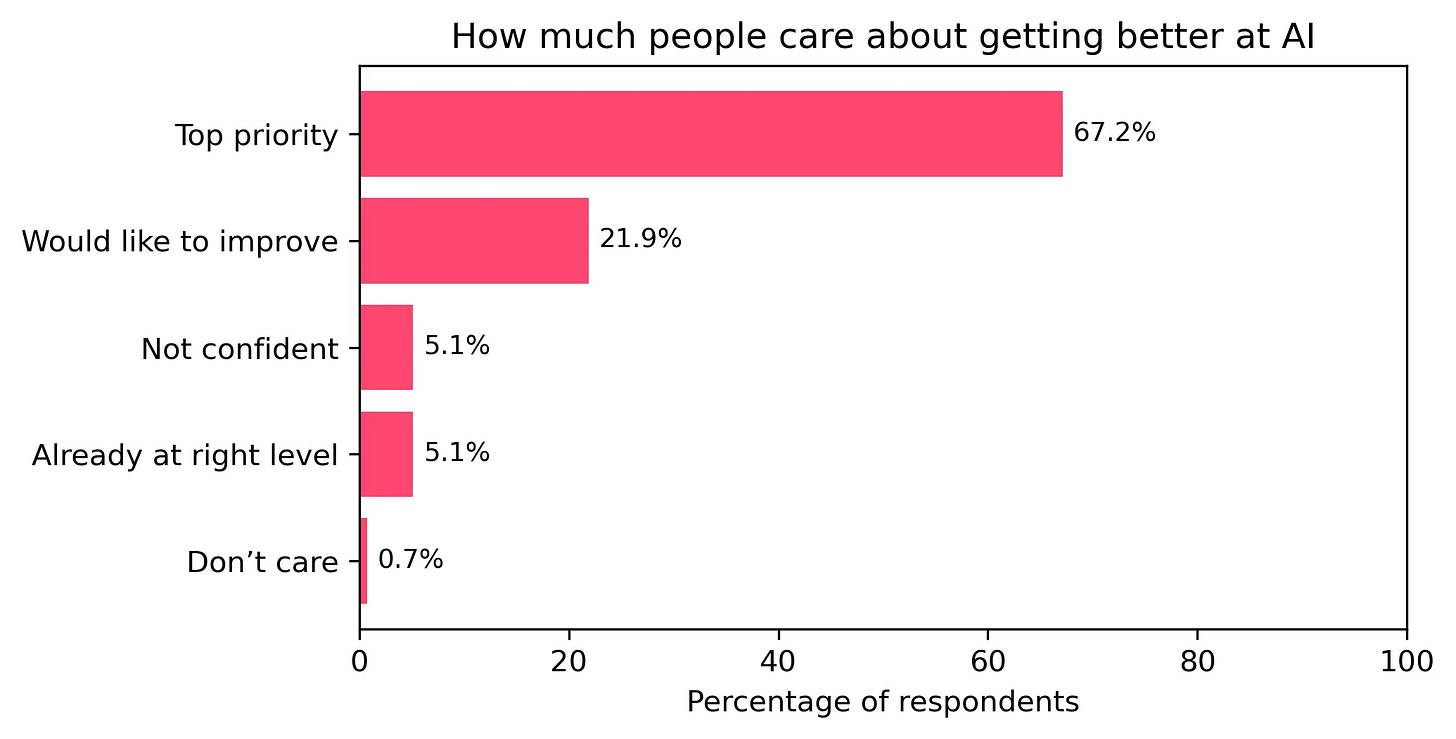
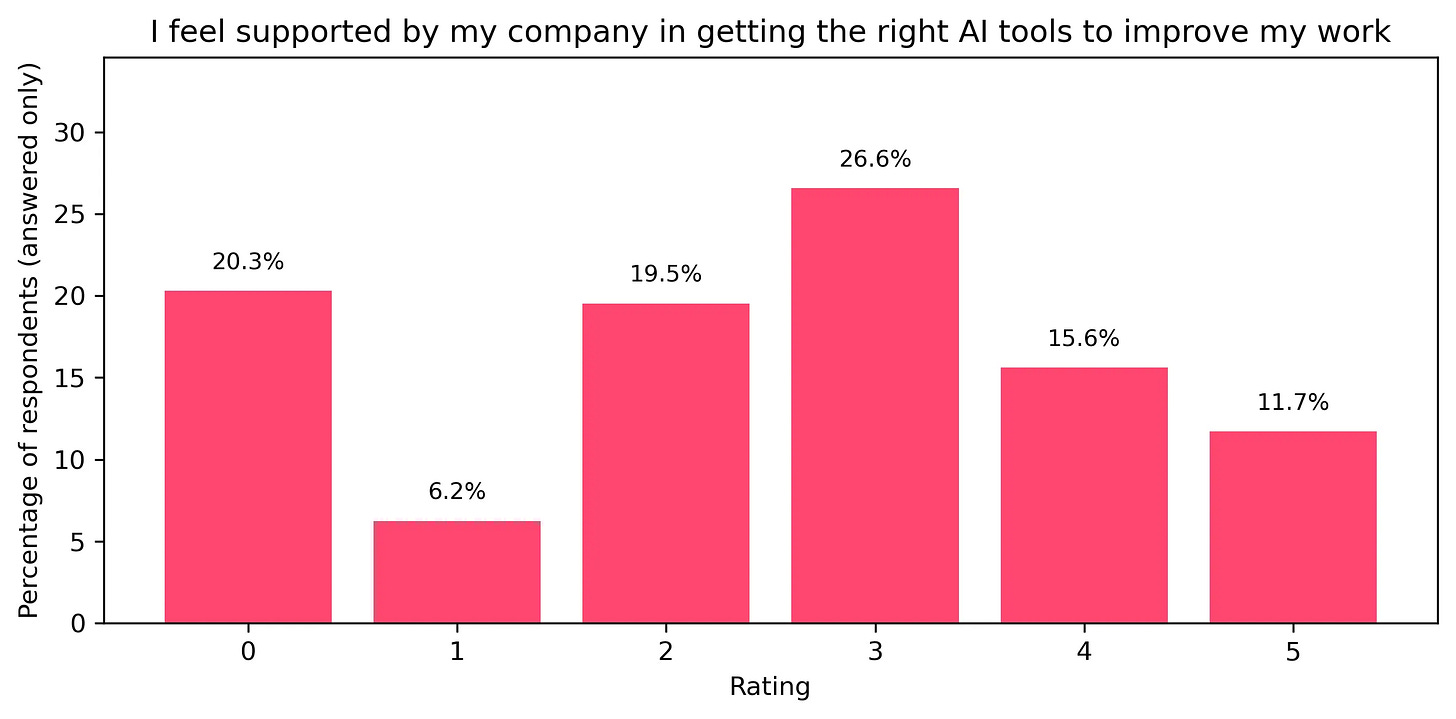
Here’s the problem in one number: ~70% of people see using AI better as a top priority, but only 1 in 4 employees feel significantly supported by their company in achieving that goal.
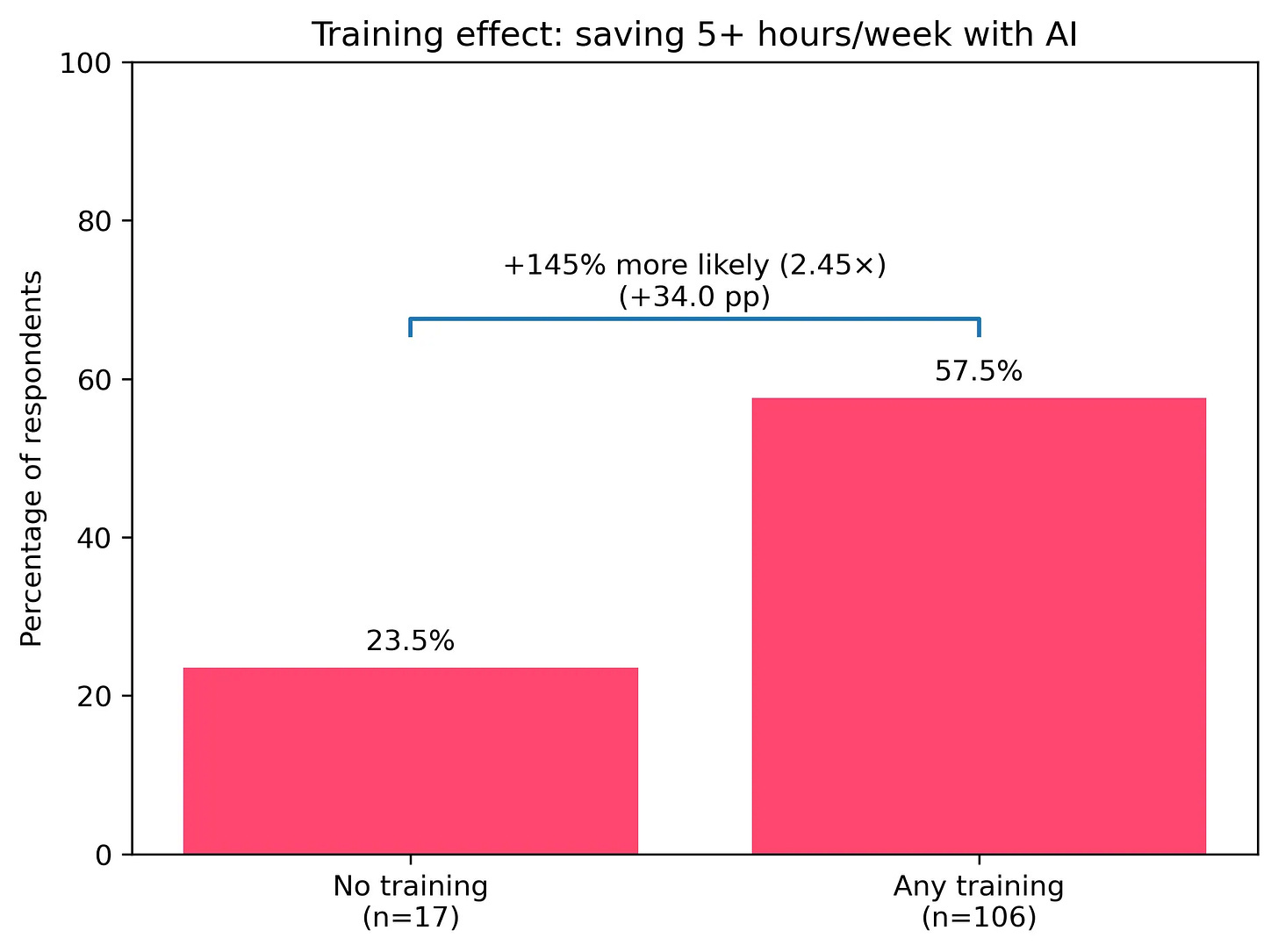
A tangible example: 75% of employees say they need training to use AI effectively. Yet, only 10.7% of companies have provided it, even though those who got training are 2.45x more likely to save 5+ hours per week.
You’re paying for tools your people really want to use but can’t figure out how, because you’re offloading AI transformation to the tools themselves instead of stepping in and giving employees what they need.
Now let’s get into the details:
Tool investments - spending is happening:
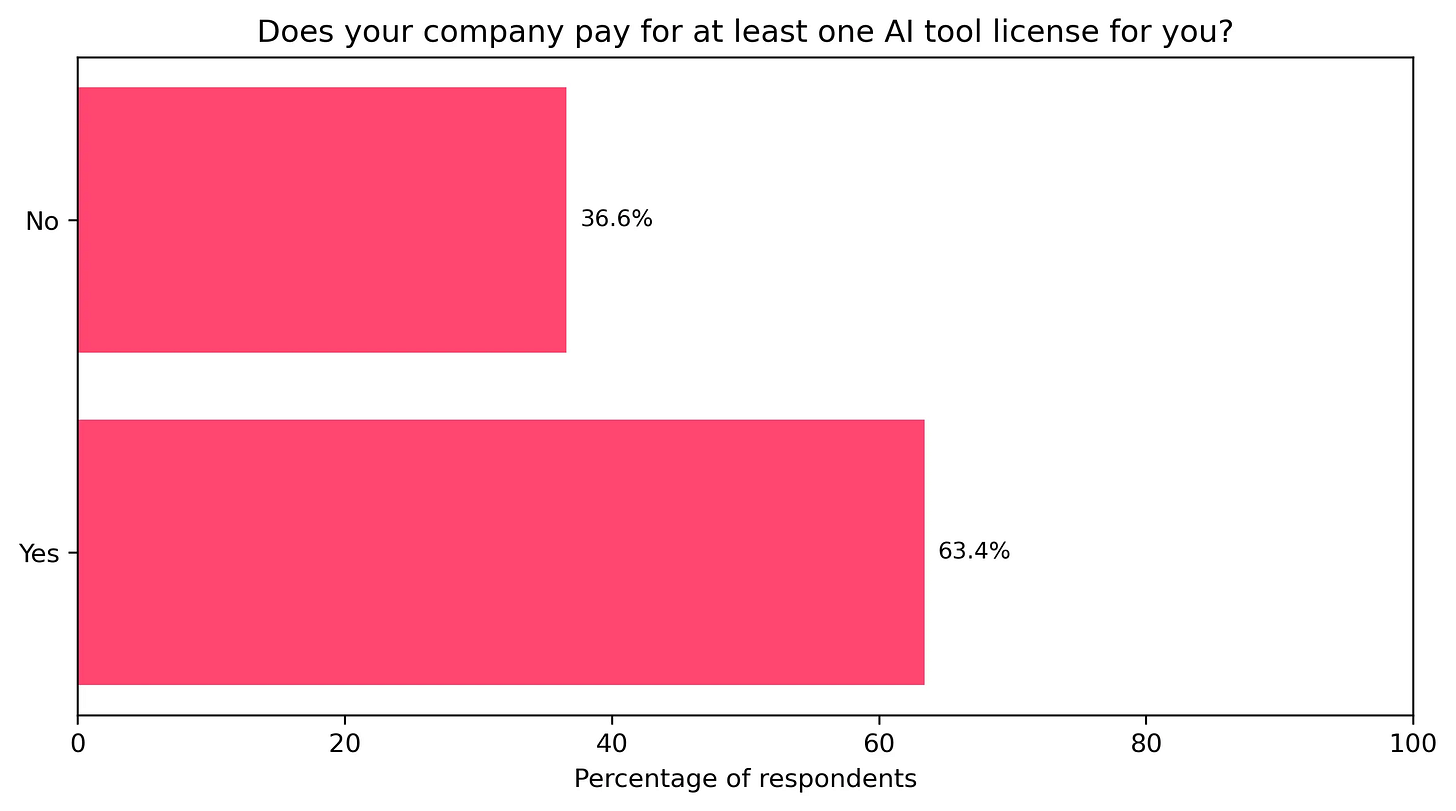
63.4% of companies provided a general-purpose AI tool to their employees (Copilot is #1, followed by ChatGPT and Gemini), and 1/3 provided also some specialized AI tool (like Epiphany for capability building or Legora for law). Basically, money is being spent.
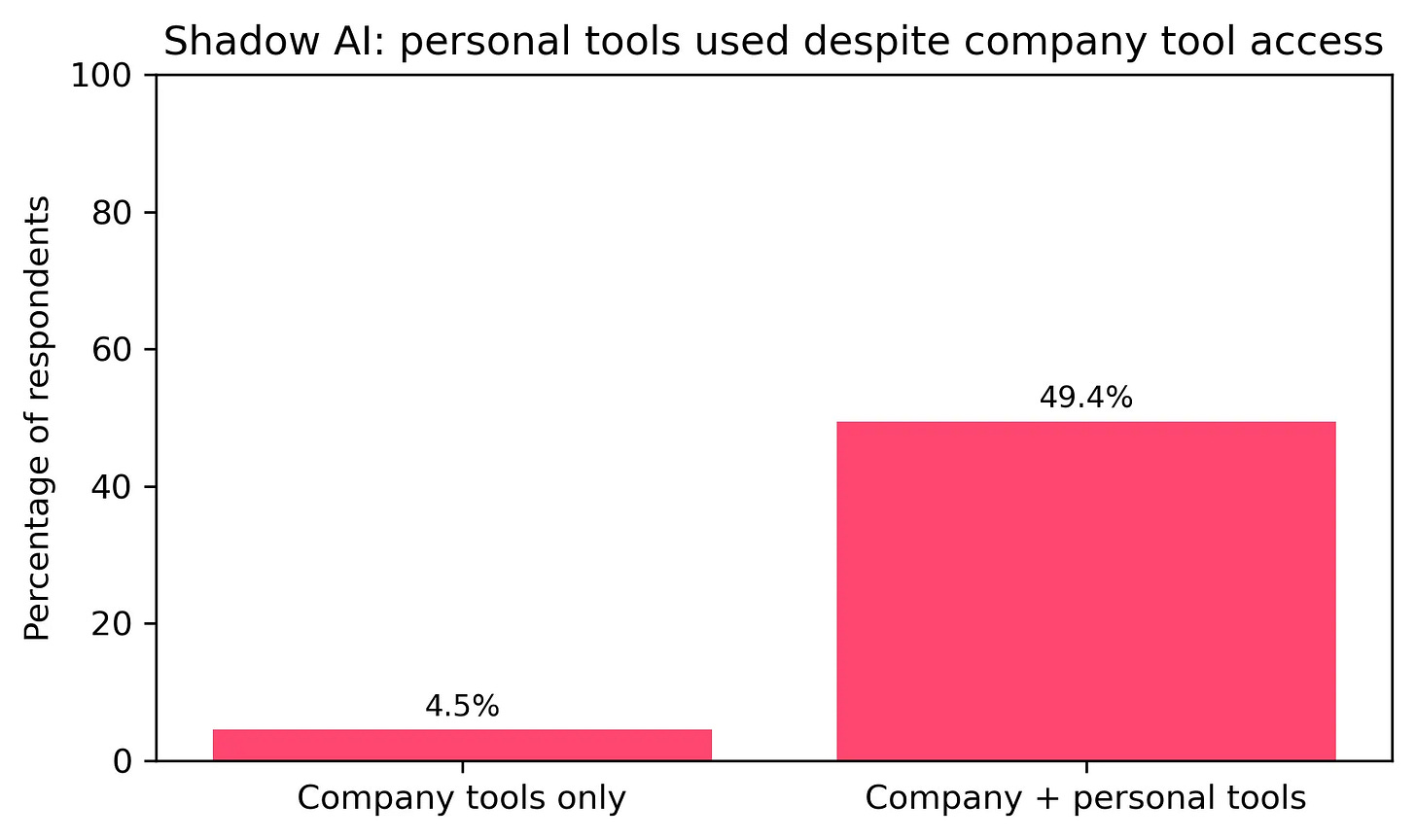
However, half of respondents who got an AI tool from their company also uses other unapproved tools they pay for personally (we refer to this as “shadow AI”). This indicates a mismatch between what people need and what companies put resources towards.
Note: I suspect this mismatch started because people didn’t like the tools their companies gave them, but as these tools improve the mismatch is now driven mostly by habit and lack of skills rather than a tool gap.
Tool ROI - (spoiler: AI works, but not for everyone).
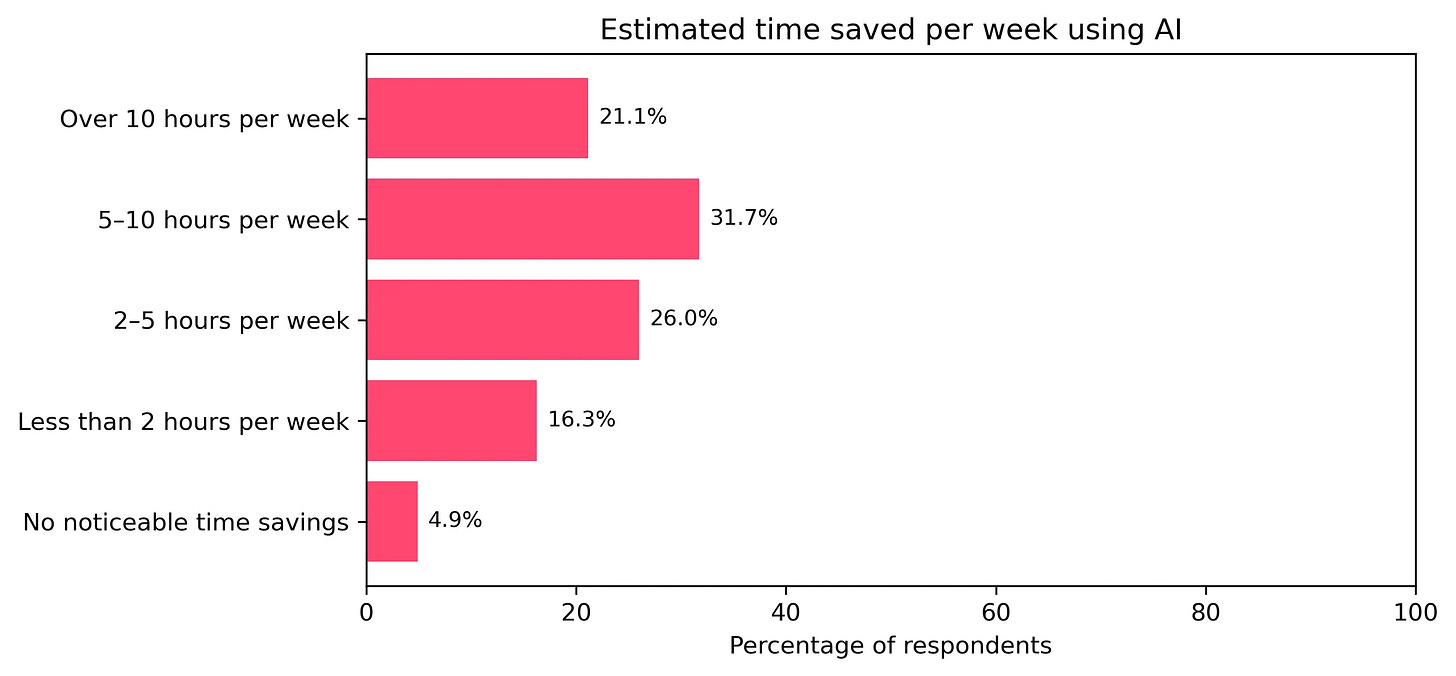
Over half reported more than 5hrs per week of time saving, with a solid group of power users (21%) reporting over 10hrs of time saved.
Over 70% reported significant improvement to the quality of their work.
However, many are lagging behind: 20-25% of people report absent or very limited gains
Yet, most tools cost between $20 and $200 a month, so I’d say ROI is unquestionable.
Perception and barriers - people want support:
2 out of 3 respondents said that getting better at using AI is a “Top priority”
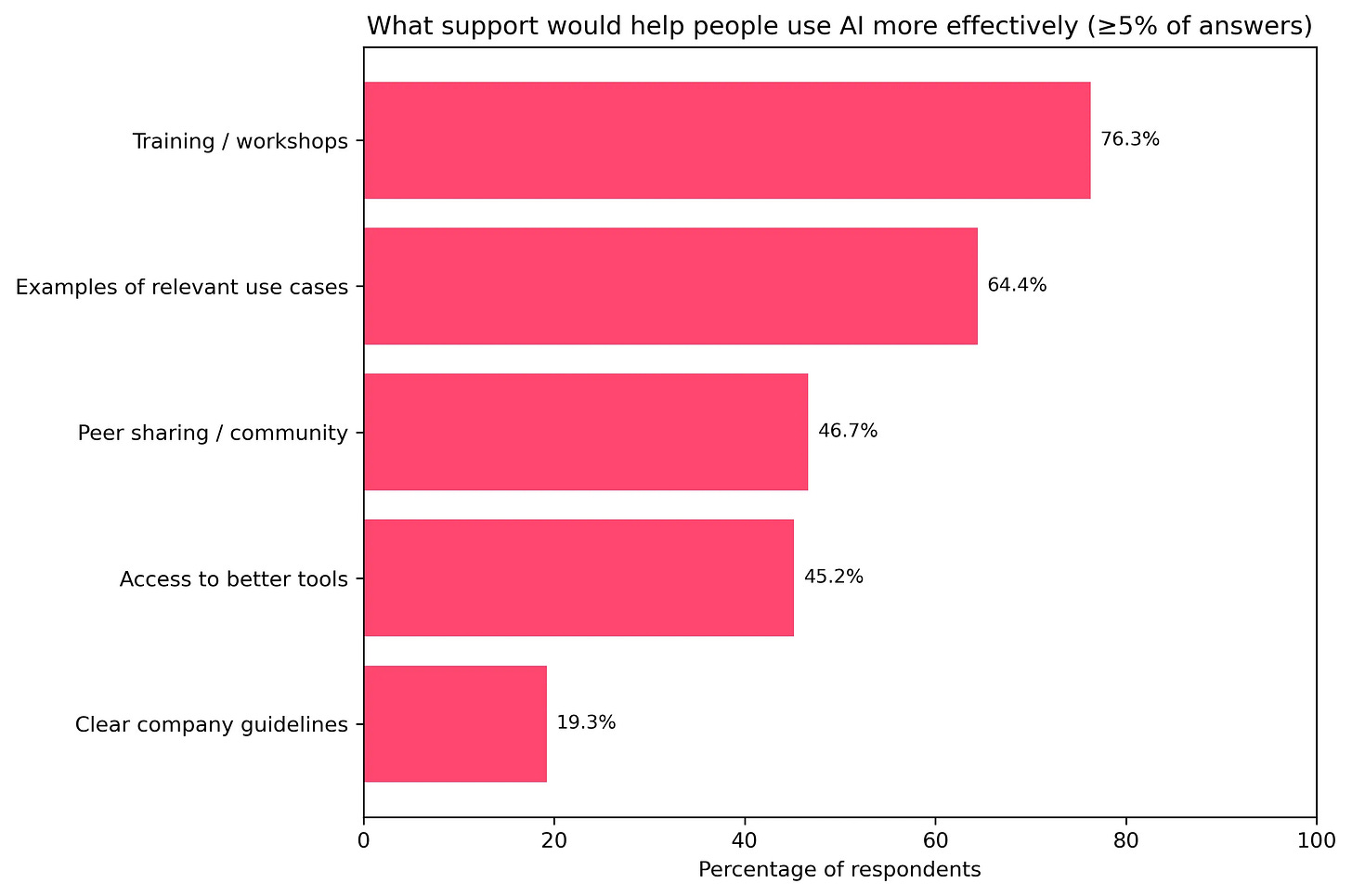
75% report they need support in the form of trainings and workshops to use AI more effectively.
Only roughly 1 out of 4 respondents feel significantly supported by their company in getting the right tools, and learning how to use them best
Lack of time to learn is the #1 constraint to growth (mentioned by 45% of respondents), followed by cost of tools (40%) and lack of integrations into workflows (35%)
The gap between what companies do, and what their teams want them to do:
Only 10.7% of companies provided any training, even though:
the vast majority of employees wants it and needs it (read above)
training is highly correlated with better outcomes - people who took any sort of training are 2.45x more likely to report 5hrs+ of time saving per week.
Quick side note RE agents:
We didn’t ask anything about agents because we knew they are beyond the level of maturity of most companies (despite what you read on LinkedIn). But since you might be wondering, here’s some data from McKinsey and a research paper on successful agent deployments:
In any business function, less than 10% of companies are scaling/have scaled agents. We’re still in the phase of curiosity (62% of respondents are at least experimenting)
Successful agents are very simple: 68% make less than 10 steps, and the successful ones have low autonomy and high degrees of human intervention
Note: this doesn’t mean that agents are a fad, but that it’s early for most organizations
Now that we know where we are, here’s what actually matters for 2026 based on where your company is.
The strategies companies should embrace to kick ass in 2026.
Not every organization is at the same level, so let me give you specific recommendations based on where you are.
If you haven’t invested in AI yet
AI will get so ubiquitous and the value so obvious you’ll have to stop ignoring it and start investing in it. The good news is that while you’re a bit late to the party, you can learn from the experiments and mistakes everyone else did so you can start in a thoughtful, “best-practice” sort of way.
Here’s what you should do:
Executive alignment first. If you haven’t invested in AI yet (or invested very little in an unstructured way), my bet is that there’s not enough clarity and buy-in at the executive level. Start fixing it (I can help, reach out).
Clear implementation strategy: you can avoid the 2025 classic mistake of “buying tools and hope they get adopted”, and start with a complete view of the business from day one. The TAP framework (Technology, Aspiration, and People) is how I like to structure direction.
Communicate your newfound vision to your team, give them the right technological tools, and adopt the right change management initiatives to ensure these get accepted and used productively and responsibly. These include:
Invest in a training that doesn’t only focus on tools but on change management too
Identify clear responsibilities for your AI transformation (e.g. finding an “AI catalyst” sort of role, identifying champions, etc.)
Start measuring well, so “buying AI” isn’t a “check the box” exercise (e.g. add it in performance reviews, measure how closer you’re moving to your Aspiration, etc.).
I’ll cover how to set your Technology, Aspiration and People strategy and how to set the right governance in future articles, so make sure you’re subscribed.
If you have invested in tools but haven’t been proactive in leading your AI transformation
If you’re in this category you’re guilty of the “AI as an uncoordinated procurement exercise” approach. Don’t worry though, you’re in good company as most organizations are here and they typically look like this:
~20% of employees are power users, they adapted how they work to fully benefit from AI and use it in their core work tasks (e.g. the stuff they get measured on)
~20% are skeptical and don’t even want to open these tools
~60% use AI sporadically and for low value-added use cases like summarizing meeting notes or crafting emails
If this is you, it’s crucial you now put the right strategies in place to turn your investments into real change. You can use my TAP framework to simplify your understand of what this entails:
Tools: what tools does your team need, and do they have easy access to them?
Aspiration: do you have a clear idea on why you want your team to embed AI, and have you articulated that to your company? Spoiler: “because it’s the future” or “to work better” without explaining what “better” looks like won’t motivate anyone
People: the most important one. This means:
invest in training, so people know how to use the tools you paid for and are supported in changing their workflows
have an adoption strategy, e.g. identifying AI champions and enabling them to support their peers and having people with a clear mandate to drive adoption
if you’re serious about AI, include something related to its usage in performance reviews
If you invested in tools and have a clear strategy
If you’ve actually done the foundational work—executive alignment, clear aspiration, training programs, performance reviews that measure AI adoption—you’re in a very small group.
By the way, I have found only small organizations in this group, and no large enterprise. The most advanced enterprises I met typically have done 2 things:
Bought a generic AI tool (Copilot, ChatGPT or Gemini) for the entire organization
Invested heavily in training and change management (this looks like training everyone with hands-on practice, and having separate deeper tracks for AI champions and executives).
These are 2 important pillars. What is missing? Here are 3 moves that I start seeing in the industry, and that will be pivotal in 2026 especially for these few AI leaders
- Specialized tools for specialized work: generic AI tools like Copilot are great for generic tasks like summarizing meeting notes. These are also typically low-value tasks. Some business units will hugely benefit from compounding these generic tools with specialized ones that are specifically built for their most important tasks. Using Copilot for everything is like using an excel sheet as your CRM - technically it works, but…come on. Some examples for the AI world:
Embed a tool like Legora in the legal team to cut contract review time by X%
Embed Epiphany in the L&D team to reduce time to market and increase impact of training by Y%
Embed Jasper in the marketing team to reduce agency budgets by Z% keeping quality
- Start building, not only buying. Some processes are so unique to you that they can’t be tackled with off-the shelf solutions - top AI leaders build their own leveraging no-code tools make.com, n8n, Cassidy, crew.ai (and some vibe-coding) to democratize agent creation. Examples:
a marketer building an agent that creates custom ads spending reports weekly
an AI champion in HR creating an onboarding Q&A agent
a financial analyst creating an agent to turn financial reports into simple executive summaries
Caveat: this requires the right processes and governance, which leads me to point 3.
-
Add structure to the transformation: the best companies I’ve met create new teams and structures to manage their AI efforts. This includes having people responsible for AI adoption, reporting structures, and ideally adding AI-specific objectives in performance review. More on this in future articles—it deserves its own deep dive (so…subscribe if you haven’t yet)
-
Start thinking about more fundamental disruption, not only incremental change. This includes changing current processes completely rather than just adding AI to old ones, and/or building new product or services.
Final outlook and what’s coming next
I have bad news for you.
Now that you’ve read this article, you have both data about the problem and ideas for solutions, so you really have no excuse to keep treating AI like a tech problem. You have to step in now.
But there are also some good news.
Everything I’ve mentioned that separates solid from sloppy AI adoption is human: strategy, training, incentives, leadership. Which means you have control. You don’t need to wait for Silicon Valley to build something new, you can start today.
Some practical next steps for you:
Look honestly at what your organization has done in 2025 - where are you in the 3 buckets described above? What fallacies have you fallen into?
If you agree with my vision, what barriers do you envision you’ll have to face to convince others in your organization?
If you found this article useful, subscribe and think about who else should read it (suggestion: think both about people who agree with this so they can get data and ideas to support their vision, and people who might not so you can start a conversation)
If you need help implementing all of this, reach out.
Appendix - survey graphs
Tools ROI
Perceptions
The gap
Thanks for reading What Matters! Subscribe for free to receive new posts and support my work.

No posts
Ready for more?
相關文章