


指令預訓練大型語言模型
這篇文章由Sebastian Raschka撰寫,重點介紹了用於大型語言模型(LLMs)的指令微調(instruction finetuning)的最新研究,並特別介紹了一種名為「The Magpie」的新方法,該方法無需初始提示即可從零開始生成高質量的對齊數據。


Instruction Pretraining LLMs
-- The Latest Research in Instruction Finetuning
Jul 20, 2024
by Sebastian Raschka
A lot has happened last month: Apple announced the integration of on-device LLMs, Nvidia shared their large Nemotron model, FlashAttention-3 was announced, Google’s Gemma 2 came out, and much more.
You’ve probably already read about it all in various news outlets. So, in this article, I want to focus on recent research centered on instruction finetuning, a fundamental technique for training LLMs.
What I am going to cover in this article:
Happy reading!
1. Creating Alignment Data from Scratch
The Magpie: Alignment Data Synthesis from Scratch by Prompting Aligned LLMs with Nothing paper shares a fascinating hack to generate a high-quality dataset for LLM instruction finetuning. While this doesn’t offer any particularly recent research insights, it’s one of those interesting, practical exploits that seems super useful.
1.1 Generating An Instruction Dataset From Nothing
What distinguishes this instruction-data-generating method from others is that it can be fully automated and doesn’t require any initial questions or instructions. As the paper title suggests, it enables the creation of an instruction dataset from “Nothing” – the only thing we need is a locally running Llama 3 8B model. The figure below summarizes how this method works.
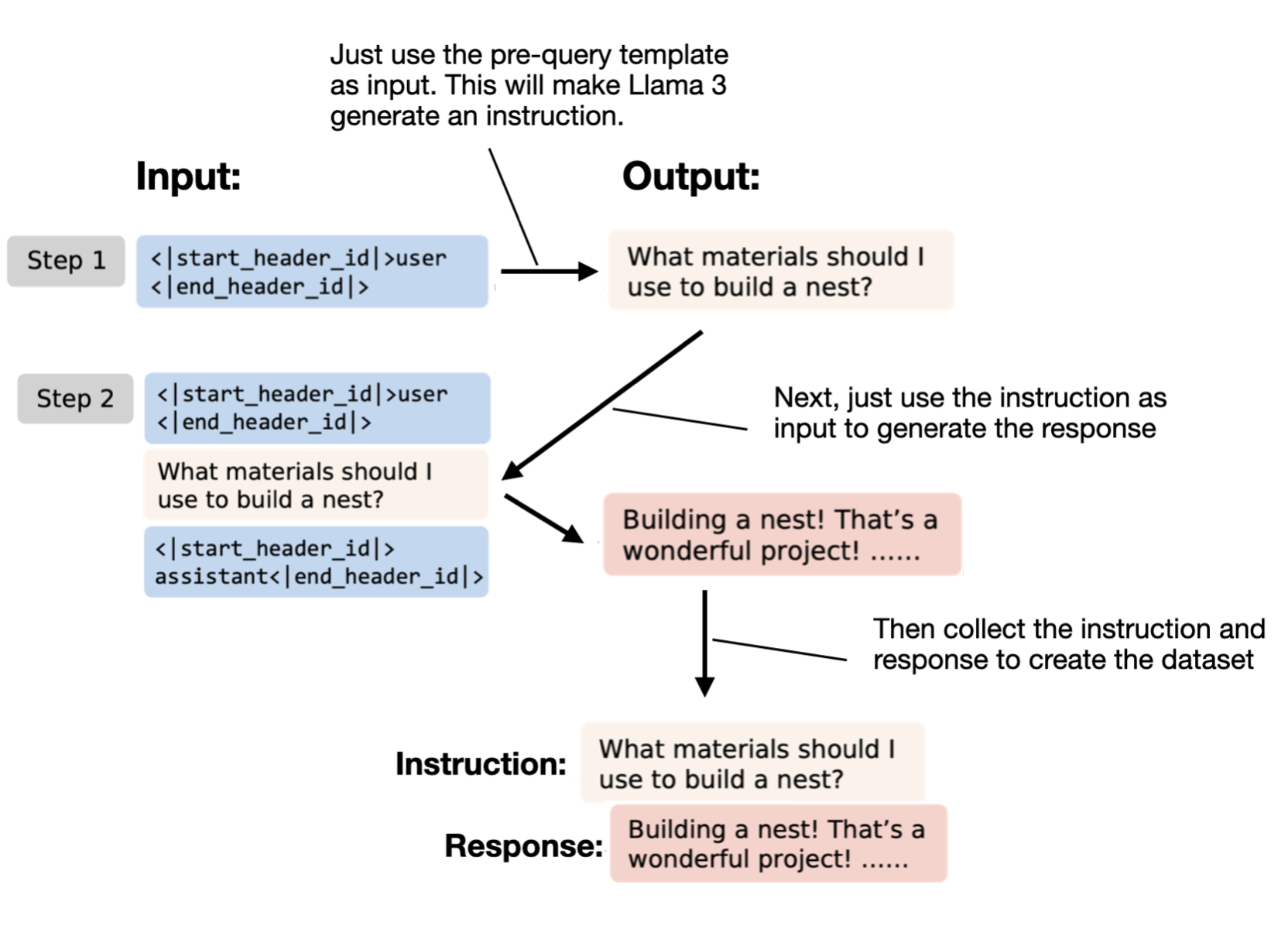
Essentially, as shown in the figure above, we just have to prompt the Llama 3 8B Instruct model with a pre-query template, and it will generate an instruction for us. Then, we feed that instruction back to the LLM, and it will generate a response. If we repeat this procedure a couple of thousand times, we obtain a dataset for instruction finetuning. (Optionally, we can apply an LLM to filter the instruction-response pairs by quality.)
1.2 Dataset quality
What’s fascinating is that with the resulting instruction dataset, the authors found that finetuning a Llama 3 8B base model with just instruction finetuning (no preference finetuning via RLHF and DPO) beats the original Llama 2 8B Instruct model by Meta AI, as shown in the figure below.
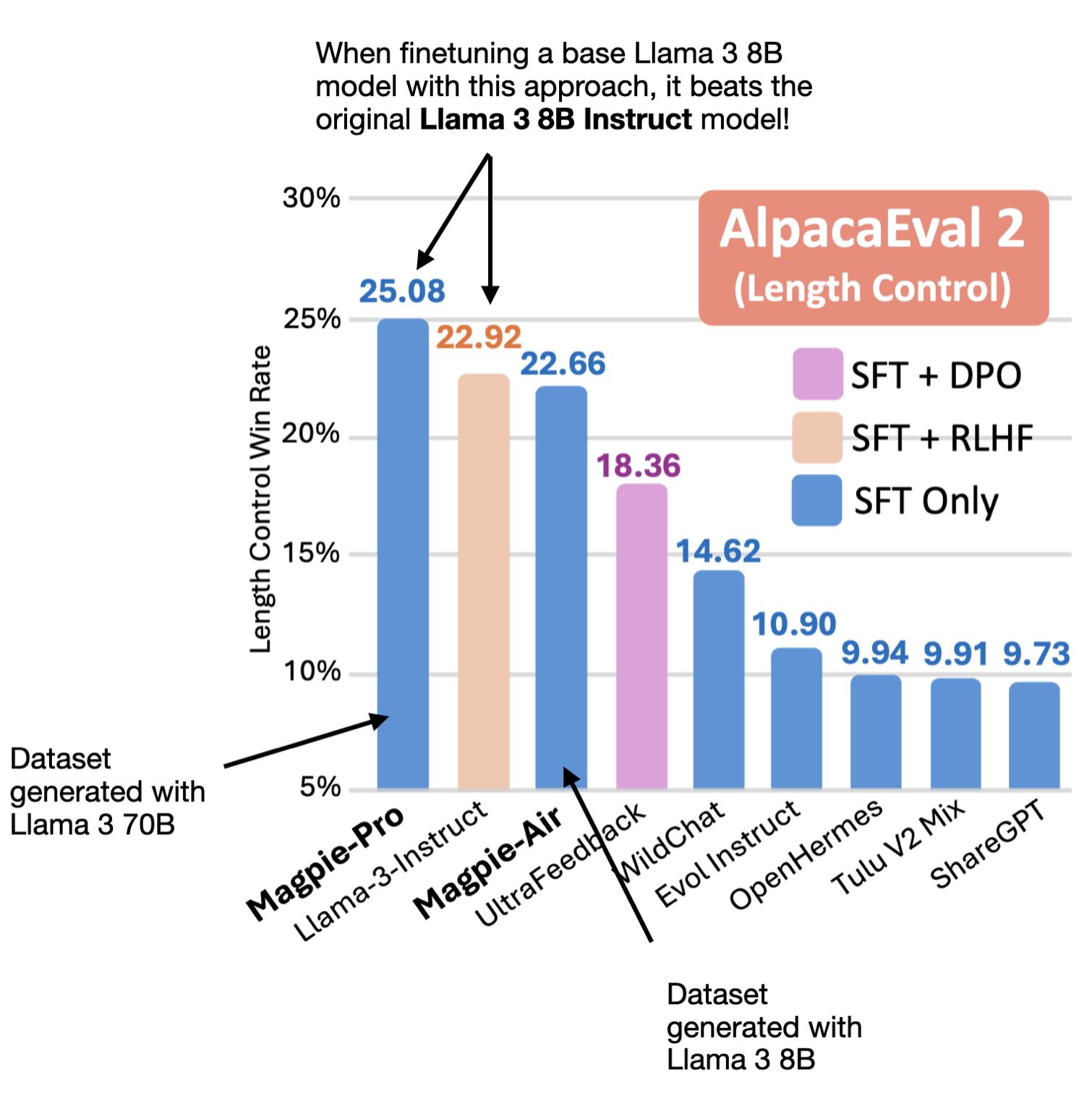
The Magpie results shown in the figure above wer achieved with 300 thousand samples only. In comparison, The original Llama 3 Instruct model was finetuned and aligned on 100 million samples!
1.3 Running the Dataset Generation Locally
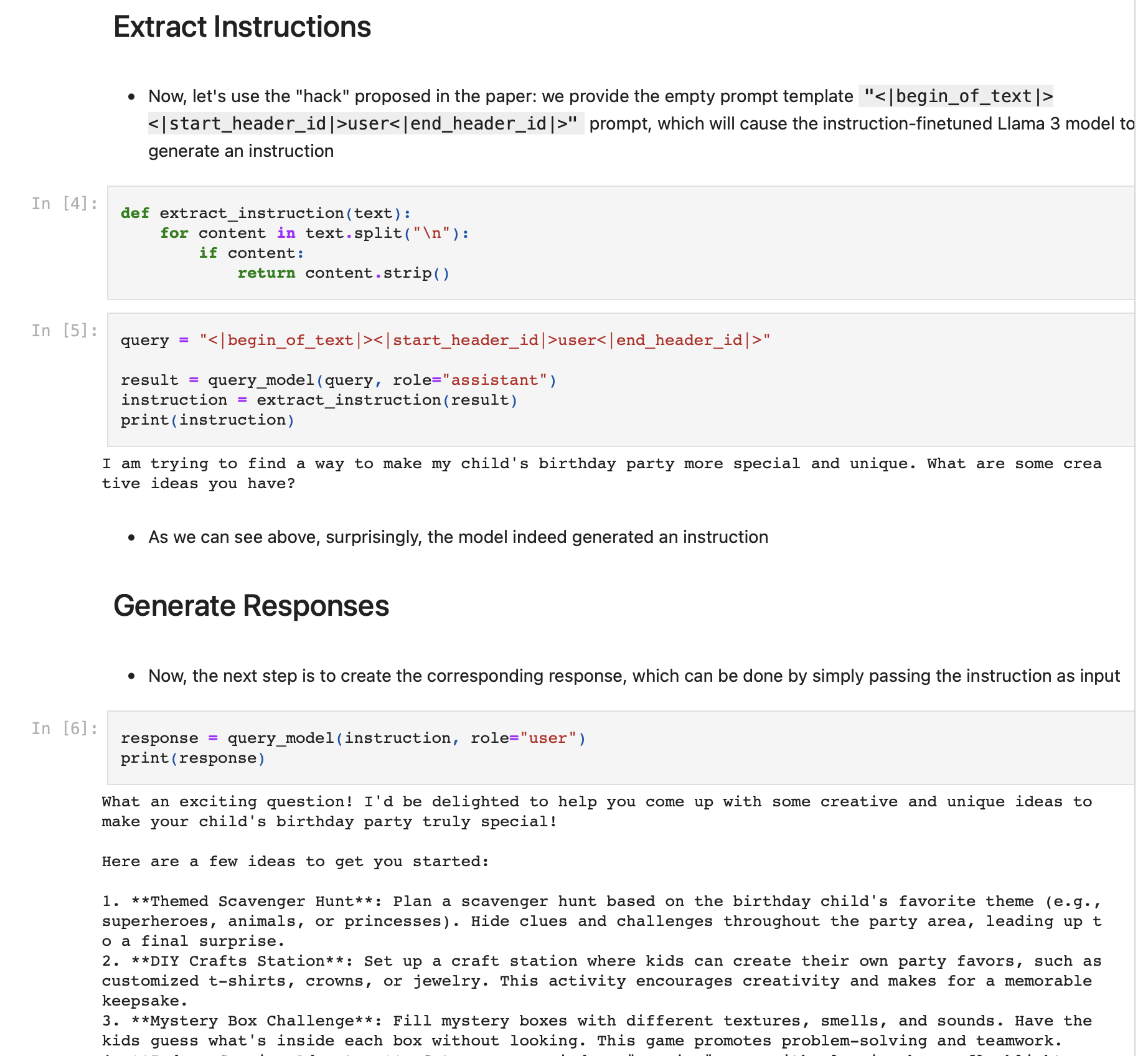
I was skeptical at first, so I tried to implement this myself. It really works! Here, you can find my reimplementation using Ollama, which even runs fine locally on a MacBook Air.
1.4 Additional Details
The authors created two sets of datasets: A “Pro” version using the Llama 3 70B Instruct model and an “Air” version using the Llama 3 8B Instruct model. As an earlier figure showed, the Magpie-Pro-generated dataset results in slightly stronger models compared to the Magpie-Air dataset when using it to instruction-finetune a Llama 3 8B base model.
The figure below shows an additional comparison of the dataset qualities and difficulties as rated via an LLM.
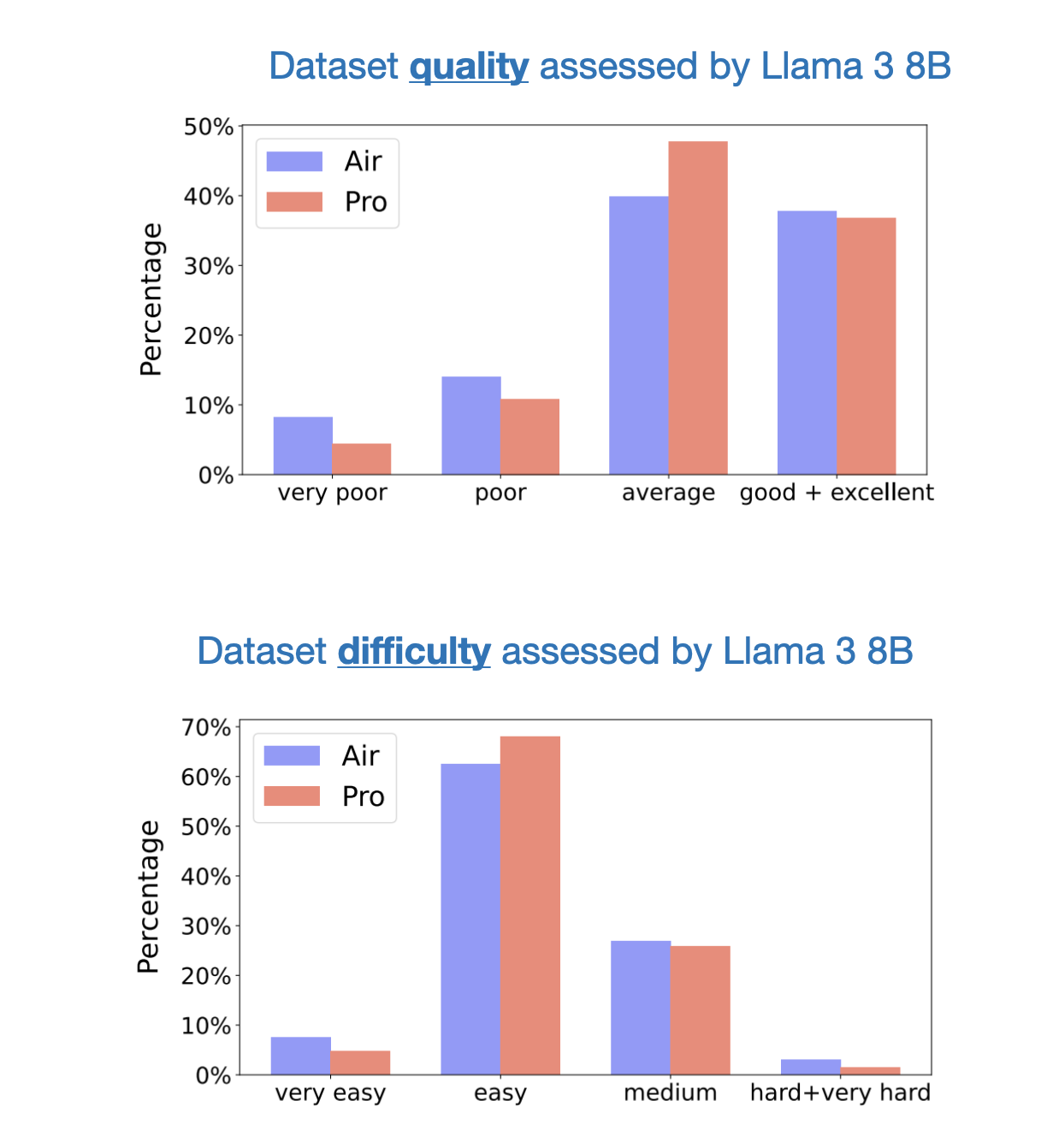
As the figure above shows, the quality of the Air and Pro datasets is roughly on par. In addition, it would have been interesting to see how the Alpaca dataset compares to these. (The assumption is that the Magpie data is of much higher quality than Alpaca, but a reference point would be interesting.)
Furthermore, the paper contains an analysis showing that the breadth or diversity in this dataset is much larger than that of other popular datasets for instruction finetuning, such as Alpaca, Evol Instruct, and UltraChat. In addition, when compared to models trained with other instruction finetuning datasets, the Magpie-Pro finetuned model also compares very favorably.
1.5 Conclusion
Overall, I think that Magpie is an interesting exploit that is, on the one hand, fascinating in its effectiveness and, on the other hand, has a lot of practical utility. I will certainly consider it as an interesting, simple, and cost-effective candidate for constructing general-purpose instruction datasets in the future.
2. Instruction Finetuning from Scratch
If you are looking for a resource to understand the instruction finetuning process in LLMs, I am happy to share that Chapter 7 on instruction finetuning LLMs is now finally live on the Manning website.
This is the longest chapter in the book and takes a from-scratch approach to implementing the instruction finetuning pipeline. This includes everything from input formatting to batching with a custom collate function, masking padding tokens, the training loop itself, and scoring the response quality of the finetuned LLM on a custom test set.
(The exercises include changing prompt styles, instruction masking, and adding LoRA.)
Happy coding!
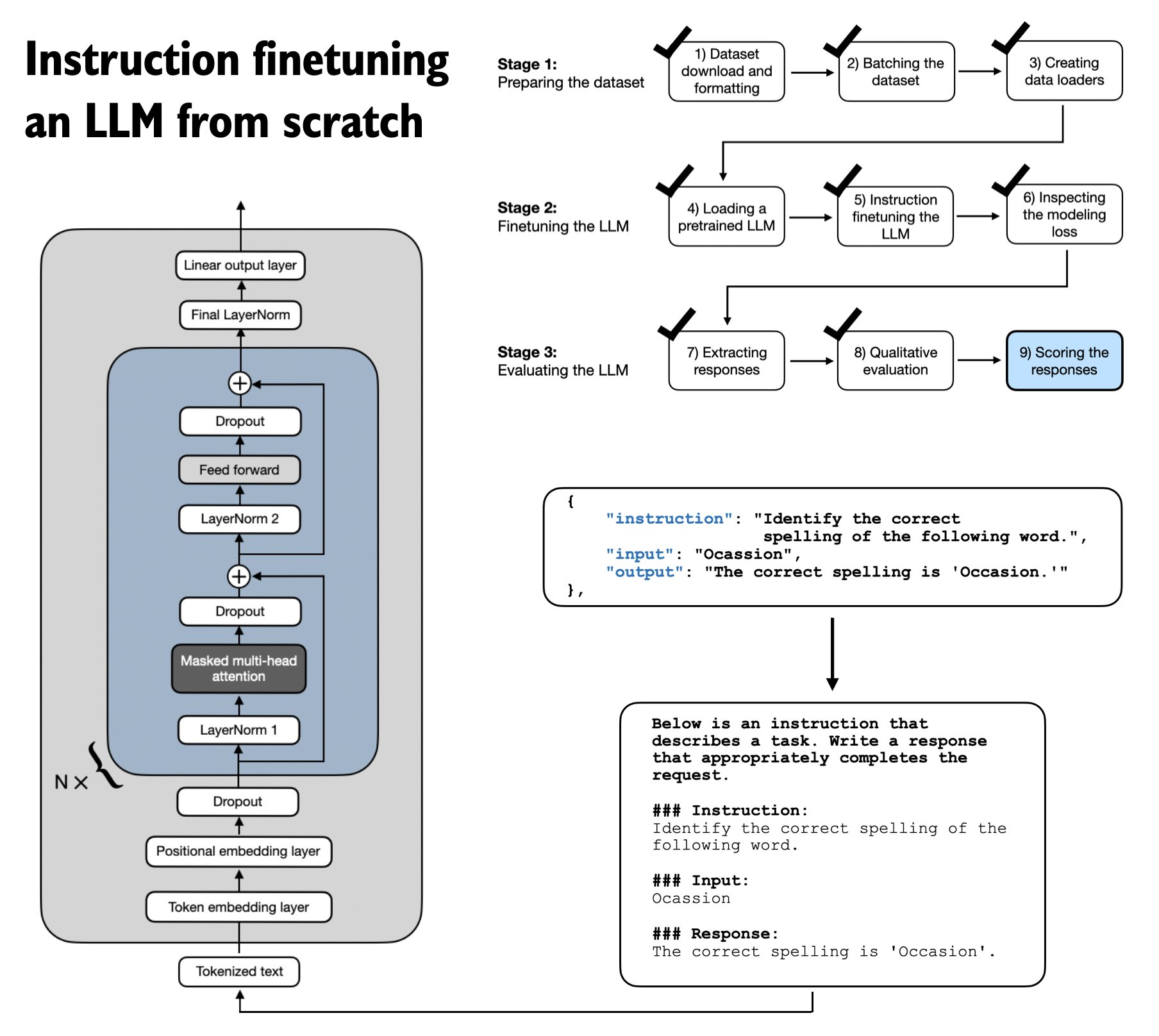
PS: it’s also the last chapter, and the publisher is currently preparing the layouts for the print version.
3. Instruction Pretraining LLMs
In the paper “Instruction Pre-Training: Language Models are Supervised Multitask Learners” (https://arxiv.org/abs/2406.14491), researchers investigate whether LLM pretraining can be made more efficient by including synthetic instruction-response pairs instead of just raw text. (Here, “raw text” means text from books, websites, papers, and so forth that has not been reprocessed into a specific format.)
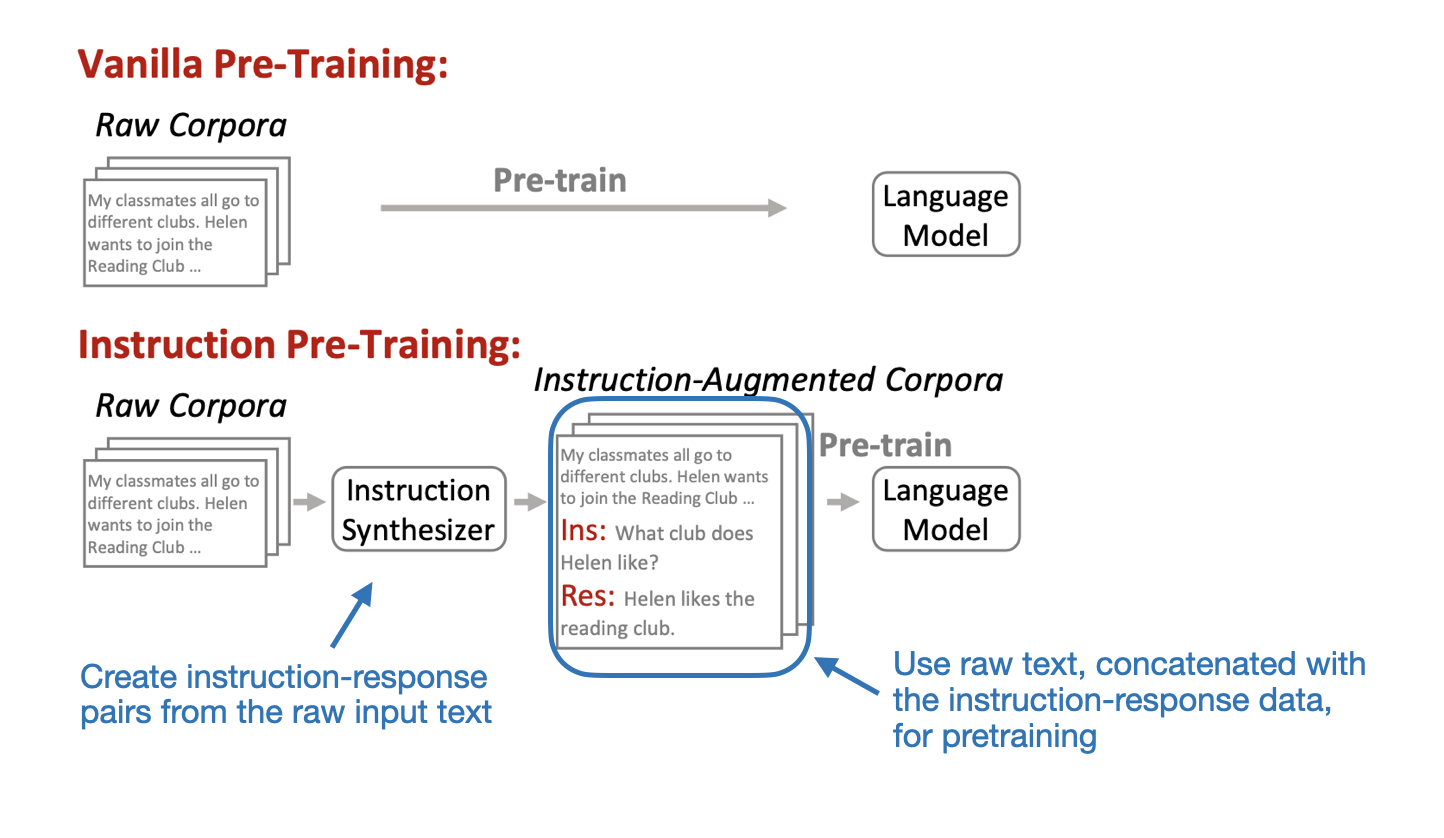
Specifically, the researchers experiment with generating instruction-response data from the raw training corpus itself via an “instruction synthesizer,” an LLM specifically finetuned for this task.
(Note that this is not the first paper proposing the formatting of raw text as instruction data. Another work that comes to mind is “Genie: Achieving Human Parity in Content-Grounded Datasets Generation” (https://arxiv.org/abs/2401.14367). I also recall seeing another paper or blog post using instruction data during pretraining a few months ago—I discussed this method with some of my colleagues—but unfortunately, I couldn’t find the reference. Nonetheless, the paper discussed here is particularly intriguing since it builds on openly available LLMs that run locally and covers both pretraining and continual pretraining.)
3.1 Instruction Synthesizer
Before we dive into the pretraining and continual pretraining results, let’s talk about the core component of this method: the instruction synthesizer. This is an openly available Mistral 7B v0.1 LLM (which I wrote about last year here: https://magazine.sebastianraschka.com/i/138555764/mistral-b) that has been finetuned to generate instruction-response pairs from raw text.
To finetune this synthesizer, the researchers use datasets such as HotpotQA (https://arxiv.org/abs/1809.09600), which consists of passages from Wikipedia associated with questions and answers. For this, the authors also ensure that a variety of tasks, like commonsense reasoning, sentiment analysis, math problems, etc., are covered.
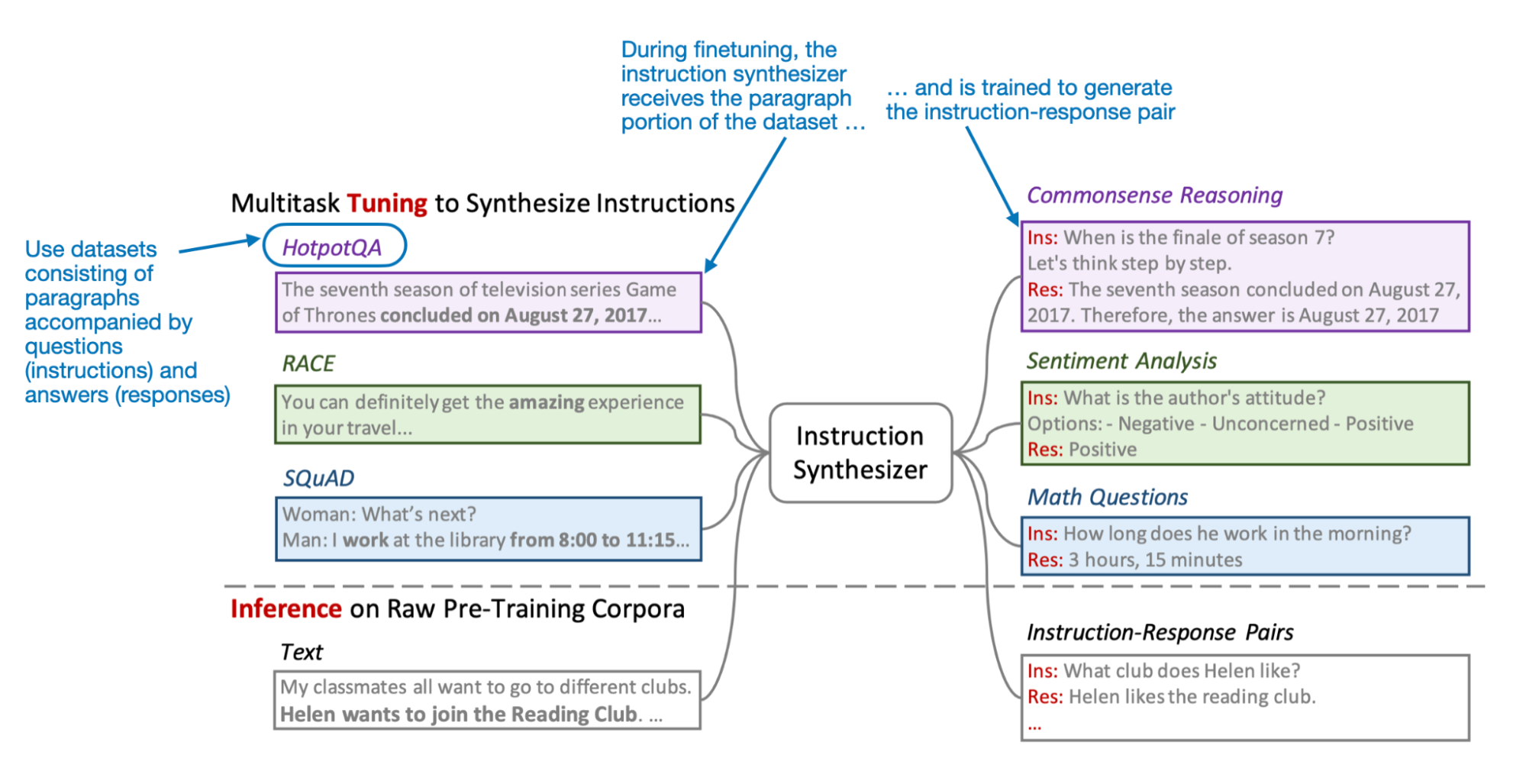
Once this instruction synthesizer is developed (i.e., finetuned), it can be used to generate the input data for pretraining the target LLMs.
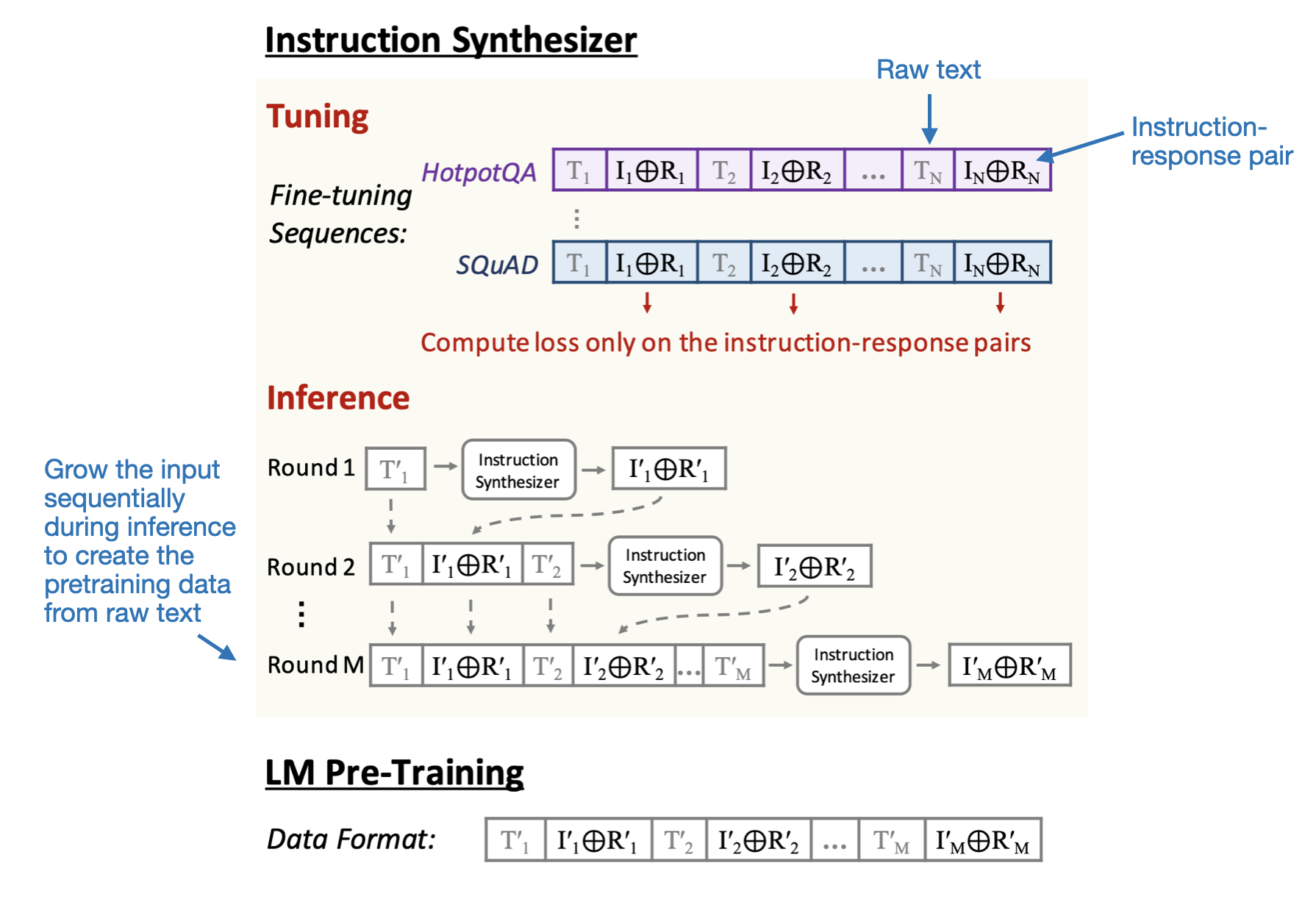
One last noteworthy detail regarding the instruction synthesizer is that multiple raw texts (Tn) and instruction-response pairs (In ⊕ Rn) are concatenated as few-shot examples, as shown in the figure below.
3.2 Pretraining with Instruction Data
Now that we have discussed the method to generate the instruction-response pairs, let’s get to the interesting part: how well do models train on this augmented dataset. The first set of results looks at two small models trained from scratch: 500M parameters and 1.3B parameters (both are based on the Mistral architecture).
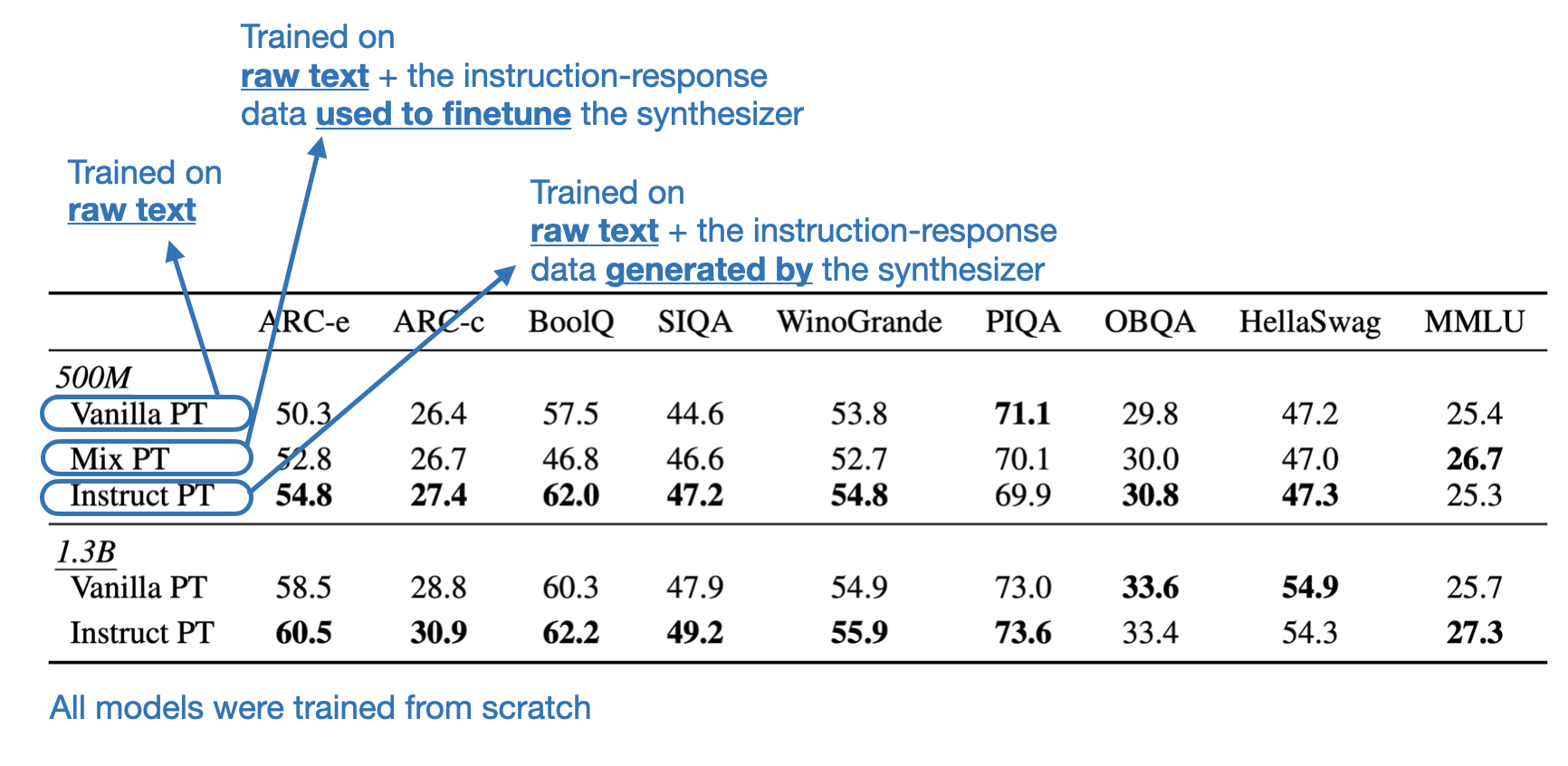
As we can see in the table above, the model trained via the proposed instruction pretraining approach (Instruct PT) performs best on most benchmark tasks (higher values are better).
Note, though, that it has seen more tokens than the Vanilla PT approach since it included the synthesized instruction-response pairs. Hence, the authors included the Mix PT comparison, which is a model that has been trained on a data mix containing both the raw text and the instruction data used to train the synthesizer.
From this comparison, we can see that not simply using any instruction data makes the difference. The fact that Instruct PT performs better than Mix PT on most tasks illustrates that the nature of the instruction-response data (i.e., instruction-response data related to the raw data) makes the difference. (The authors conducted all experiments using the same number of tokens.)
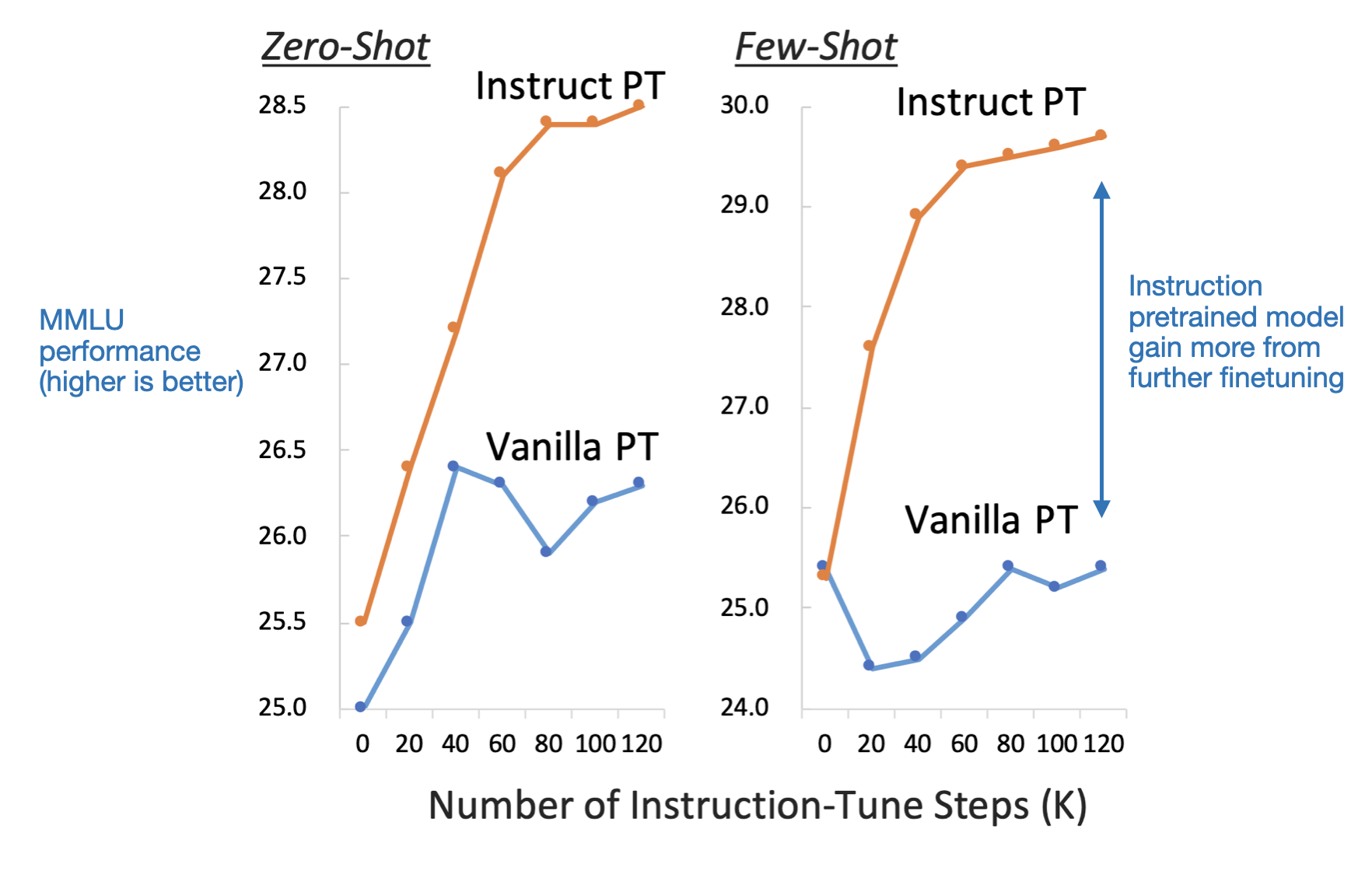
In addition, it’s worth noting that the Instruct PT pretrained models have another advantage: They improve a more when they are instruction-finetuned afterwards, as the figure below shows.
3.3 Continual Pretraining with Instruction Data
Pretraining from scratch is interesting because that’s how LLMs are created in the first place. However, I’d say that practitioners care more about continual pretraining and finetuning.
Continual pretraining here means that we take an existing pretrained model and pretrain it further on new domain data. For instance, think of a Llama 3 8B base model that has been trained on a general text corpus and that you want to adapt for finance, medical, legal, or other domains.
The table below summarizes the results the researchers obtained when applying the instruction pretraining method to a pretrained Llama 3 8B base model. Specifically, they conducted continual pretraining with both biomedical texts and finance texts.
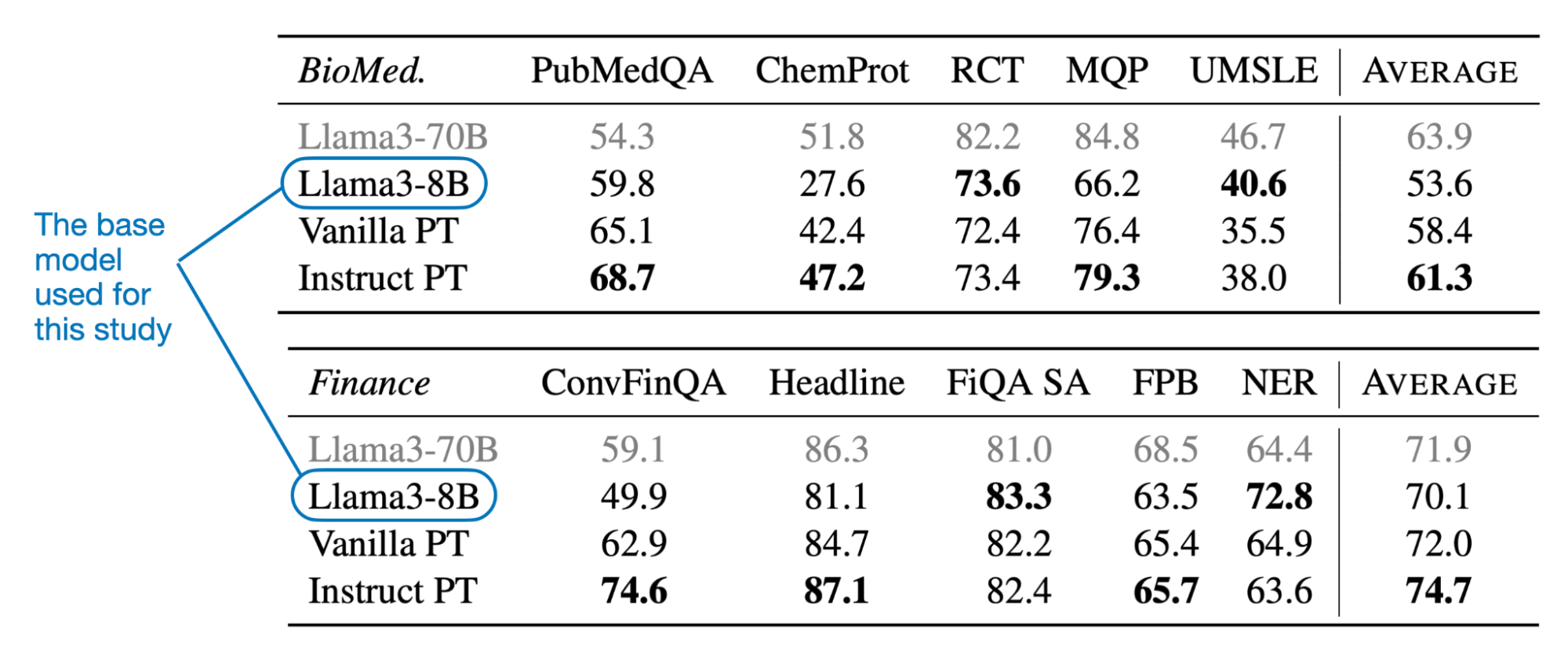
Looking at the table above, we can see that the instruction pretraining approach (Instruct PT) clearly outperforms the vanilla pretraining (Vanilla PT) approach (here, this means regular continual pretraining of the base model).
The Llama 3 70B base model is included as a reference; I suppose to showcase that small specialized models can beat larger general models.
3.4 Conclusion
Almost every time I explain the LLM pretraining pipeline to someone, they are surprised by its simplicity and the fact that this is still what’s commonly used to train LLMs today. The instruction pretraining approach is quite refreshing in that sense.
One caveat is that for large pretraining corpora, it might still be expensive to create the instruction-augmented corpora. However, the nice thing about generated data is that it can be reused in many different projects once created.
4. Gemma 2
I cannot write this article without mentioning Google’s new Gemma 2 models, which are arguably the biggest model release last month. However, when it comes to pure size, Nvidia’s Nemotron-4 340B takes the crown (https://arxiv.org/abs/2406.11704). The Gemma 2 models come in 2.6B, 9B, and 27B parameter versions.
Since this article is already quite lengthy, and you’re likely familiar with Gemma 2 from other sources, let’s cut to the chase. What are the main highlights and noteworthy updates in Google’s newly released Gemma 2 LLMs? The main theme is exploring techniques without necessarily increasing the size of training datasets but rather focusing on developing relatively small and efficient LLMs.
Specifically, they blend three main architectural and training choices to create the 2.6B and 9B parameter models: sliding window attention, grouped-query attention, and knowledge distillation.
4.1 Sliding window attention
Sliding window attention (e.g., as popularized by Mistral) is a technique using a fixed-sized attention block that allows a current token to attend to only a specific number of previous tokens instead of all previous tokens, as illustrated in the figure below.
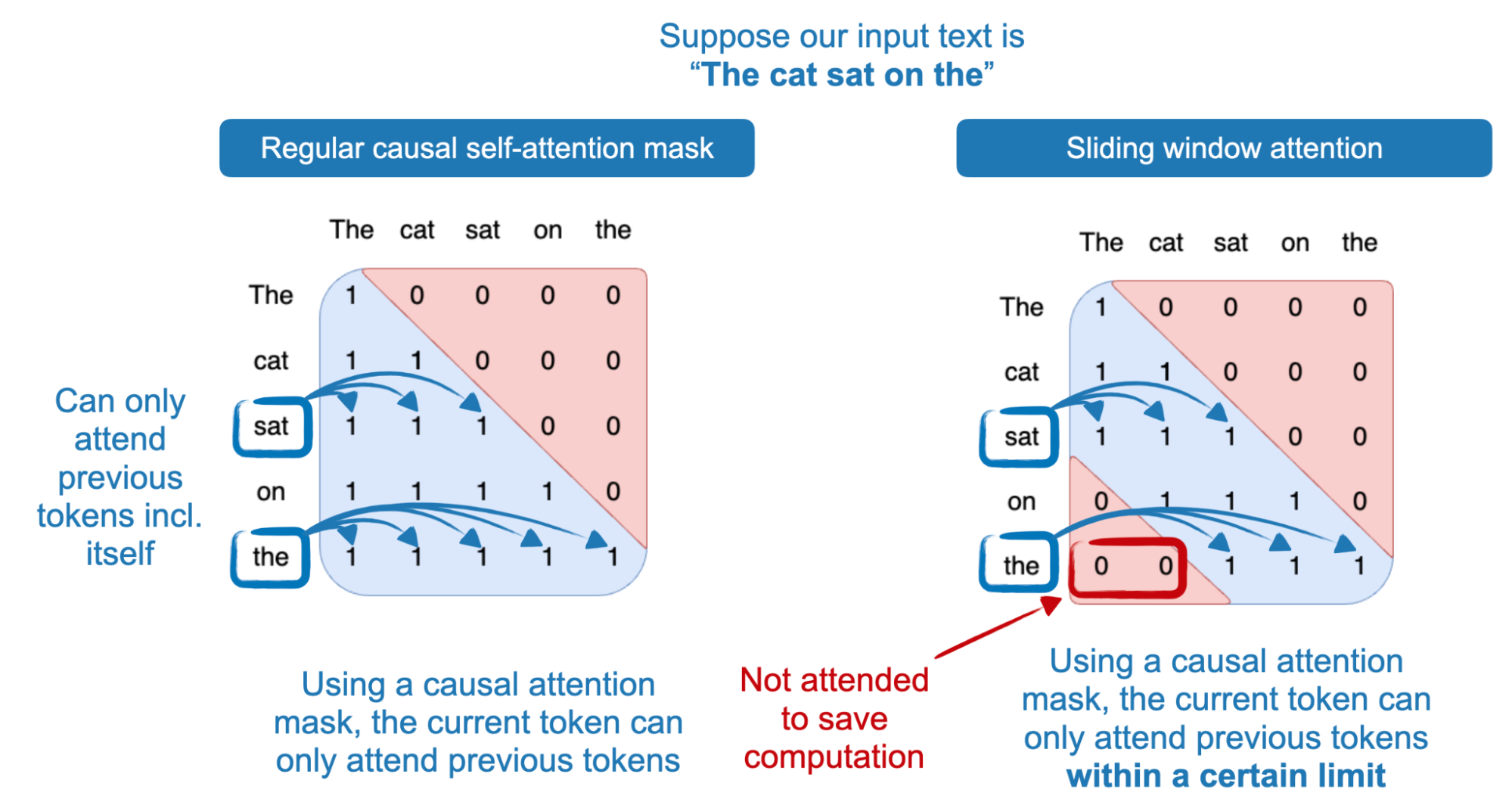
In the case of Gemma 2, the authors alternated between regular attention and sliding window attention layers. The sliding attention block size was 4096 tokens, spanning a total block size of 8192 tokens.
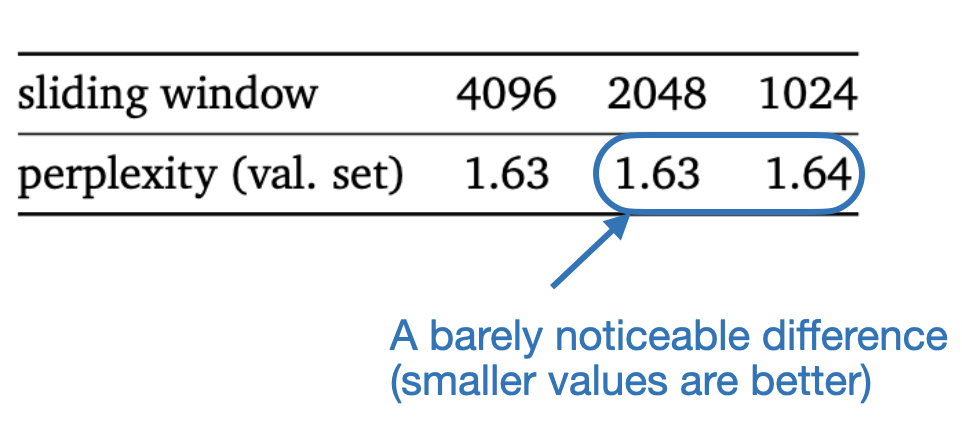
Sliding window attention is mainly used to improve computational performance, and the researchers also included a small ablation study showing that there’s a barely noticeable difference in perplexity when shrinking the block size during inference.
(It would have been interesting to see the GPU memory improvement side-by-side.)
4.2 Group-query attention
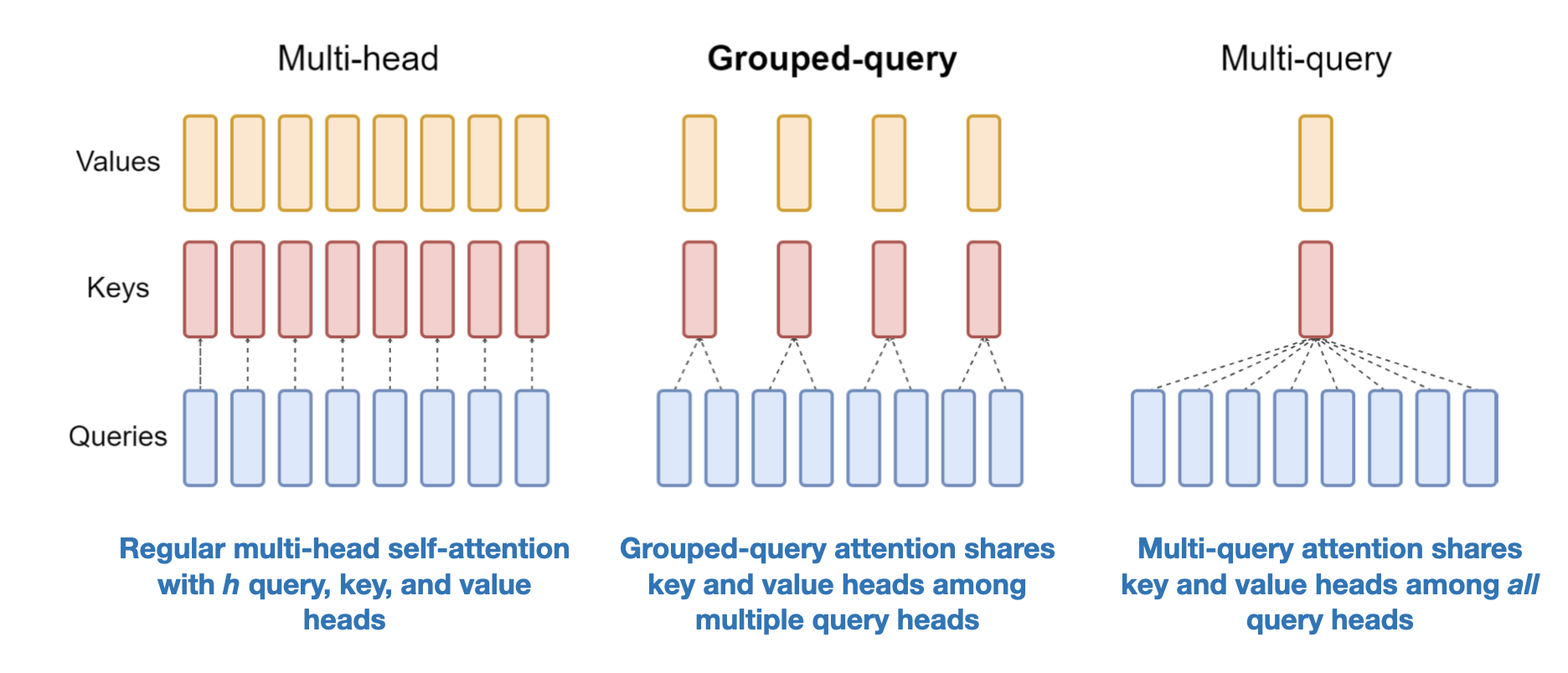
Group-query attention (like in Llama 2 and 3) can be regarded as a more generalized form of multi-query attention. The motivation behind this is to reduce the number of trainable parameters by sharing the same Keys and Values heads for multiple Query heads, thereby lowering computational requirements.
4.3 Knowledge distillation
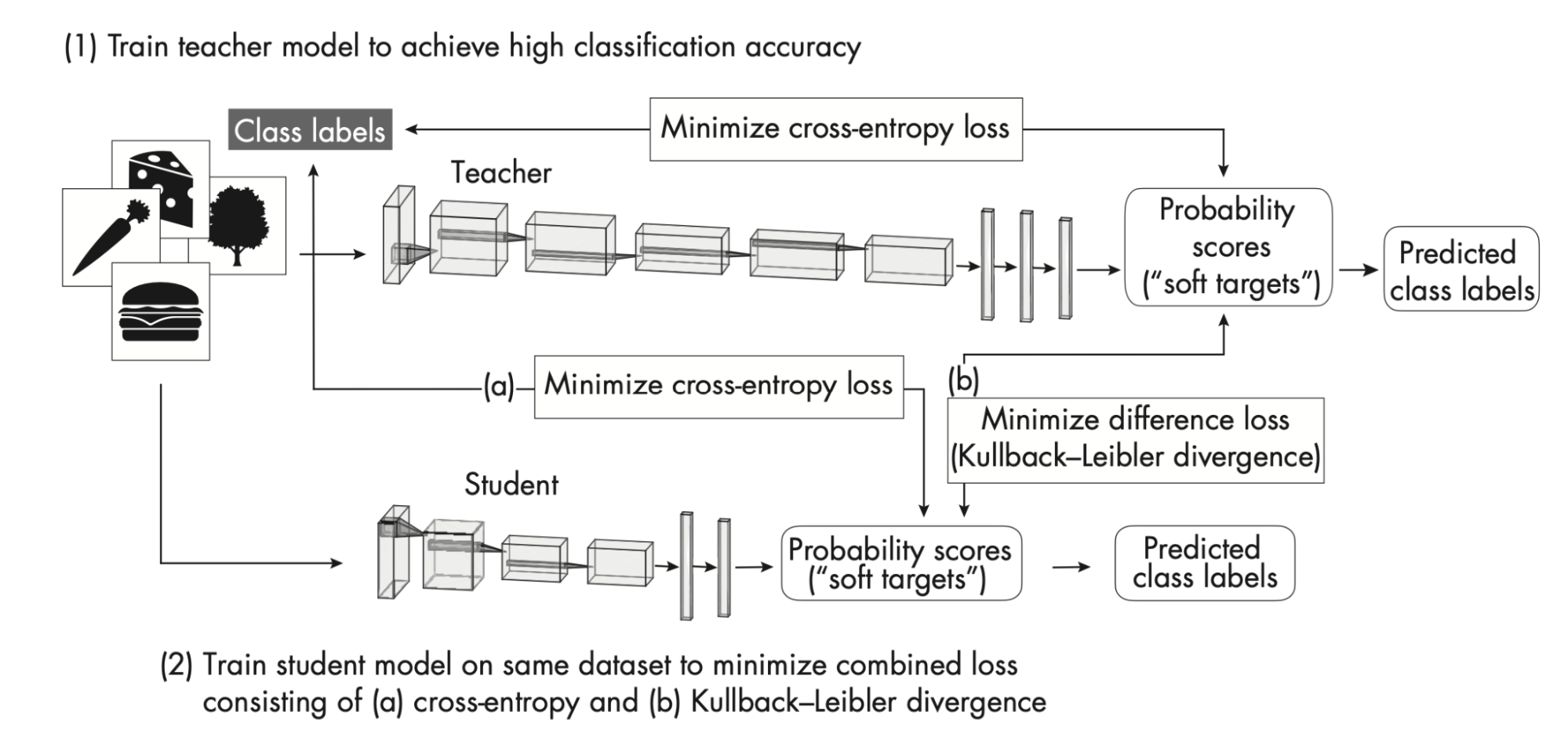
The general idea of Knowledge distillation (as in MiniLLM, https://arxiv.org/abs/2306.08543) is to transfer knowledge from a larger model (the teacher) to a smaller model (the student). Here, they trained a 27B (teacher) model from scratch and then trained the smaller 2B and 9B (student) models on the outputs of the larger teacher model. The 27B model doesn’t use knowledge distillation but was trained from scratch to serve as a “teacher” for the smaller models.
4.4 Other interesting architecture details
The paper contains many other interesting tidbits. For instance, one hallmark of Gemma 2 is its relatively large vocabulary size: 256,000 tokens. This is similar to the first Gemma model, but it’s still worth noting since it’s twice the size of the Llama 3 vocabulary (128,000) and eight times the size of the Phi-3 vocabulary (32,000).
The vocabulary size of an LLM refers to the number of unique tokens (words, subwords, or characters) that the model can recognize and generate.
A large vocabulary size in LLMs allows for better coverage of words and concepts, improved handling of multilingual content, and reduced tokenization artifacts. However, a large vocabulary size also comes with trade-offs, such as increased model size and potentially slower inference due to the larger embedding and output layers. (That’s where the sliding window attention and multi-query attention mechanism are important to offset this.)
There’s also an interesting section on “logit capping,” a technique I haven’t seen used before. Essentially, it is a form of min-max normalizing and clipping of the logit values to keep them within a certain range. I presume this is to improve stability and gradient flow during training.
logits ← soft_cap ∗ tanh(logits/soft_cap).
Additionally, they leverage model merging techniques to combine models from multiple runs with different hyperparameters, although the paper doesn’t provide much detail about that. (However, interested readers can read more about this in WARP: On the Benefits of Weight Averaged Rewarded Policies, which Gemma 2 uses for this.)
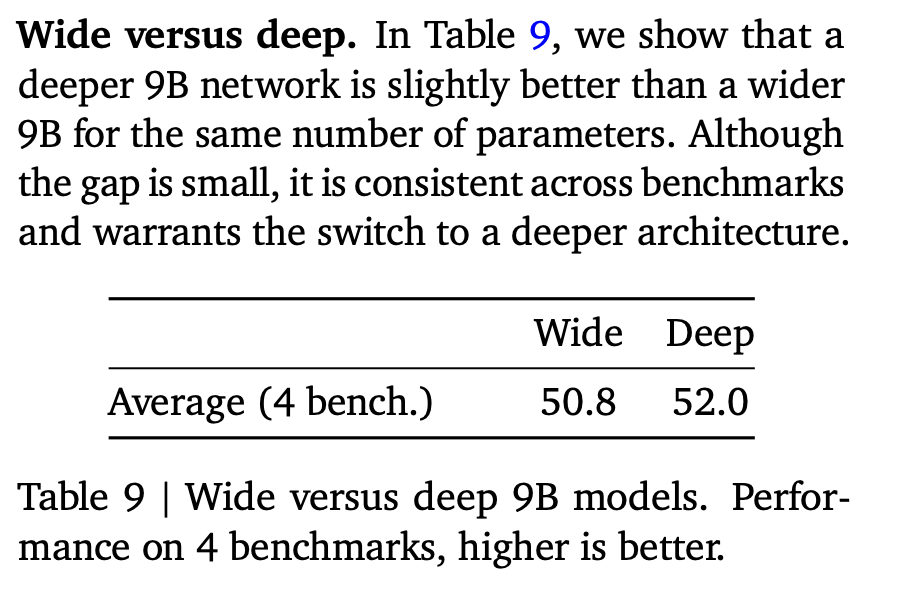
In terms of modeling performance, Gemma 2 is almost as good as the 3x larger Llama 3 70B, and it beats the old Qwen 1.5 32B model. It would be interesting to see a comparison with the more recent Qwen 2 model.
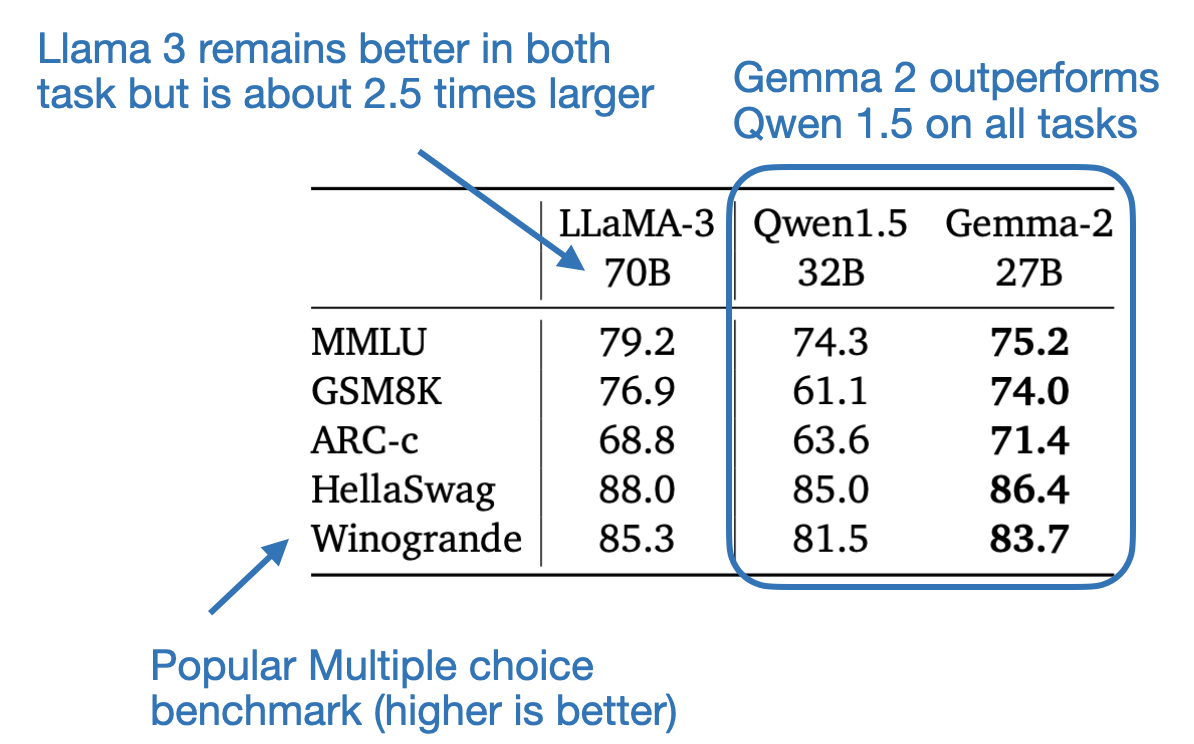
Personally, a highlight is that the Gemma 2 report includes ablation studies for some of its architectural choices. This was once a given in academic research but is increasingly rare for LLM research.
4.5 Conclusion
It’s refreshing to see such a relatively detailed technical report from Google. When it comes to the model itself, based on public consensus, Gemma 2 is likely the most capable model for single-GPU use cases today. For larger models, Llama 3 70B and Qwen 2 72B remain strong contenders.
Supporting Ahead of AI
Ahead of AI is a personal passion project that does not offer direct compensation. However, for those who wish to support me, please consider purchasing a copy of my books. If you find them insightful and beneficial, please feel free to recommend them to your friends and colleagues.
If you have a few moments, a review of Machine Learning Q and AI or Machine Learning with PyTorch and Scikit-Learn on Amazon would really help, too!
Your support means a great deal and is tremendously helpful in continuing this journey. Thank you!
5. Other Interesting Research Papers In April
Below is a selection of other interesting papers I stumbled upon this month. Given the length of this list, I highlighted those 20 I found particularly interesting with an asterisk (*). However, please note that this list and its annotations are purely based on my interests and relevance to my own projects.
Scaling Synthetic Data Creation with 1,000,000,000 Personas by Chan, Wang, Yu, et al. (28 June), https://arxiv.org/abs/2406.20094
LLM Critics Help Catch LLM Bugs by McAleese, Pokorny, Ceron Uribe, et al. (28 June), https://arxiv.org/abs/2407.00215
Direct Preference Knowledge Distillation for Large Language Models by Li, Gu, Dong, et al. (28 June), https://arxiv.org/abs/2406.19774
Changing Answer Order Can Decrease MMLU Accuracy by Gupta, Pantoja, Ross, et al. (27 June), https://arxiv.org/abs/2406.19470
From Artificial Needles to Real Haystacks: Improving Retrieval Capabilities in LLMs by Finetuning on Synthetic Data by Xiong, Papageorgiou, Lee, and Papailiopoulos (27 June), https://arxiv.org/abs/2406.19292
Dataset Size Recovery from LoRA Weights by Salama, Kahana, Horwitz, and Hoshen (27 June), https://arxiv.org/abs/2406.19395
This study introduces a method for recovering the number of images used to finetune a vision model using LoRA, by analyzing the norm and spectrum of LoRA matrices.
Step-DPO: Step-wise Preference Optimization for Long-chain Reasoning of LLMs by Azerbayev, Shao, Lin, et al. (26 June), https://arxiv.org/abs/2406.18629
This paper introduces Step-DPO, a method that optimizes individual reasoning steps in mathematical problem-solving for LLMs using a custom 10K step-wise preference pair dataset.
RouteLLM: Learning to Route LLMs with Preference Data by Ong, Amjad, et al. (26 June), https://arxiv.org/abs/2406.18665
- A Closer Look into Mixture-of-Experts in Large Language Models** by Zhang, Liu, Patel, et al. (26 June), https://arxiv.org/abs/2406.18219
This study looks at the inner workings of Mixture-of-Experts (MoE) LLMs to share insights about neuron behavior, expert selection criteria, and expert diversity across layers, while providing practical suggestions for MoE design and implementation based on these observations.
- Following Length Constraints in Instructions** by Yuan, Kulikov, Yu, et al. (25 June), https://arxiv.org/abs/2406.17744
LongIns: A Challenging Long-context Instruction-based Exam for LLMs by Shaham, Bai, An, et al. (25 June), https://arxiv.org/abs/2406.17588
- The FineWeb Datasets: Decanting the Web for the Finest Text Data at Scale by He, Wang, Shen, et al. (25 June), https://arxiv.org/abs/2406.17557
Adam-mini: Use Fewer Learning Rates To Gain More by Zhang, Chen, Li, et al. (24 June), https://arxiv.org/abs/2406.16793
WARP: On the Benefits of Weight Averaged Rewarded Policies by Ramé, Ferret, Vieillard, et al. (24 June), https://arxiv.org/abs/2406.16768
Sparser is Faster and Less is More: Efficient Sparse Attention for Long-Range Transformers by Lou, Jia, Zheng, and Tu (24 June), https://arxiv.org/abs/2406.16747
Efficient Continual Pre-training by Mitigating the Stability Gap by Wang, Hu, Xiong, et al. (21 June), https://arxiv.org/abs/2406.14833
MoA: Mixture of Sparse Attention for Automatic Large Language Model Compression by Fu, Huang, Ning, et al. (21 June), https://arxiv.org/abs/2406.14909
LongRAG: Enhancing Retrieval-Augmented Generation with Long-context LLMs by Jiang, Ma, Chen, et al. (21 June), https://arxiv.org/abs/2406.15319
- A Tale of Trust and Accuracy: Base vs. Instruct LLMs in RAG Systems** by Cuconasu, Trappolini, Tonellotto, et al. (21 June), https://arxiv.org/abs/2406.14972
Can LLMs Learn by Teaching? A Preliminary Study by Ning, Wang, Li, Lin, et al. (20 June), https://arxiv.org/abs/2406.14629
-
Instruction Pre-Training: Language Models are Supervised Multitask Learners by Cheng, Gu, Huang, et al. (20 June), https://arxiv.org/abs/2406.14491
-
Can Long-Context Language Models Subsume Retrieval, RAG, SQL, and More?** by Wu, Zhang, Johnson, et al. (19 June), https://arxiv.org/abs/2406.13121
Judging the Judges: Evaluating Alignment and Vulnerabilities in LLMs-as-Judges by Ye, Turpin, Li, He, et al. (18 June), https://arxiv.org/abs/2406.12624
From RAGs to Rich Parameters: Probing How Language Models Utilize External Knowledge Over Parametric Information for Factual Queries by Wadhwa, Seetharaman, Aggarwal, et al. (18 June), https://arxiv.org/abs/2406.12824
Self-MoE: Towards Compositional Large Language Models with Self-Specialized Experts by Kang, Karlinsky, and Luo, et al. (17 June), https://arxiv.org/abs/2406.12034
Measuring memorization in RLHF for code completion by Pappu, Porter, Shumailov, and Hayes (17 June), https://arxiv.org/abs/2406.11715
HARE: HumAn pRiors, a key to small language model Efficiency by Zhang, Jin, Ge, et al. (17 June), https://arxiv.org/abs/2406.11410
Iterative Length-Regularized Direct Preference Optimization: A Case Study on Improving 7B Language Models to GPT-4 Level by Kim, Lee, Park, et al. (17 June), https://arxiv.org/abs/2406.11817
Unveiling Encoder-Free Vision-Language Models by Choi, Yoon, Lee, et al. (17 June), https://arxiv.org/abs/2406.11832
- DeepSeek-Coder-V2: Breaking the Barrier of Closed-Source Models in Code Intelligence by Zhu, Wang, Lee, et al. (17 June), https://arxiv.org/abs/2406.11931
Tokenization Falling Short: The Curse of Tokenization by Nguyen, Kim, Patel, et al. (17 June), https://arxiv.org/abs/2406.11687
DataComp-LM: In Search of the Next Generation of Training Sets for Language Models by Li, Fang, Smyrnis, et al. (17 June), https://arxiv.org/abs/2406.11794
- Nemotron-4 340B Technical Report by Unknown Authors at NVIDIA (17 June), https://arxiv.org/abs/2406.11704
mDPO: Conditional Preference Optimization for Multimodal Large Language Models by Wang, Zhou, Huang, et al. (17 June), https://arxiv.org/abs/2406.11839
- How Do Large Language Models Acquire Factual Knowledge During Pretraining? by Chang, Park, Ye, et al. (17 June), https://arxiv.org/abs/2406.11813
Task Me Anything by Zhang, Huang, Ma, et al. (17 June), https://arxiv.org/abs/2406.11775
THEANINE: Revisiting Memory Management in Long-term Conversations with Timeline-augmented Response Generation by Kim, Ong, Kwon, et al. (16 June), https://arxiv.org/abs/2406.10996
Regularizing Hidden States Enables Learning Generalizable Reward Model for LLMs by Yang, Ding, Lin, et al. (14 June) https://arxiv.org/abs/2406.10216
Be like a Goldfish, Don’t Memorize! Mitigating Memorization in Generative LLMs by Hans, Wen, Jain, et al. (14 Jun) , https://arxiv.org/abs/2406.10209
Bootstrapping Language Models with DPO Implicit Rewards by Chen, Liu, Du, et al. (14 June), https://arxiv.org/abs/2406.09760
FouRA: Fourier Low Rank Adaptation by Borse, Kadambi, Pandey, et al. (13 June), https://arxiv.org/abs/2406.08798
- An Image is Worth More Than 16x16 Patches: Exploring Transformers on Individual Pixels by Nguyen, Mahmoud Assran, Jain, et al. (13 June), https://arxiv.org/abs/2406.09415
MLKV: Multi-Layer Key-Value Heads for Memory Efficient Transformer Decoding by Zuhri, Adilazuarda,Purwarianti, and Aji (13 June), https://arxiv.org/abs/2406.09297
Transformers Meet Neural Algorithmic Reasoners by Bounsi, Ibarz, Dudzik, et al. (13 June), https://arxiv.org/abs/2406.09308
Discovering Preference Optimization Algorithms with and for Large Language Models by Lu, Holt, Fanconi, et al. (12 June), https://arxiv.org/abs/2406.08414
-
An Empirical Study of Mamba-based Language Models by Waleffe, Byeon, Riach, et al. (12 June), https://arxiv.org/abs/2406.07887
-
Large Language Models Must Be Taught to Know What They Don’t Know by Kapoor, Gruver, Roberts, et al. (12 June), https://arxiv.org/abs/2406.08391
Large Language Model Unlearning via Embedding-Corrupted Prompts by Liu, Flannigan, and Liu (12 June), https://arxiv.org/abs/2406.07933
What If We Recaption Billions of Web Images with LLaMA-3? by Li, Tu, Hui, et al. (12 June) https://arxiv.org/abs/2406.08478
-
Magpie: Alignment Data Synthesis from Scratch by Prompting Aligned LLMs with Nothing by Xu, Jiang, Niu et al. (12 June), https://arxiv.org/abs/2406.08464
-
Samba: Simple Hybrid State Space Models for Efficient Unlimited Context Language Modeling by (11 June), https://arxiv.org/abs/2406.07522
-
Never Miss A Beat: An Efficient Recipe for Context Window Extension of Large Language Models with Consistent “Middle” Enhancement (11 June) by Wu, Zhao, and Zheng, https://arxiv.org/abs/2406.07138
Simple and Effective Masked Diffusion Language Models by Sahoo, Arriola, Schiff, et al. (11 June), https://arxiv.org/abs/2406.07524
TextGrad: Automatic “Differentiation” via Text by Yuksekgonul, Bianchi, Boen, et al. (11 June), https://arxiv.org/abs/2406.07496
An Image is Worth 32 Tokens for Reconstruction and Generation by Yu, Weber, Deng, et al. (11 June), https://arxiv.org/abs/2406.07550
- Self-Tuning: Instructing LLMs to Effectively Acquire New Knowledge through Self-Teaching by Zhang, Peng, Zhou, et al., (10 June), https://arxiv.org/abs/2406.06326
Turbo Sparse: Achieving LLM SOTA Performance with Minimal Activated Parameters by Song, Xie, Zhang, et al. (10 June), https://arxiv.org/abs/2406.05955
Husky: A Unified, Open-Source Language Agent for Multi-Step Reasoning by Kim, Paranjape, Khot, and Hajishirzi (10 June), https://arxiv.org/abs/2406.06469
Margin-aware Preference Optimization for Aligning Diffusion Models Without Reference by Hong, Paul, Lee, et al. (10 June), https://arxiv.org/abs/2406.06424
- Autoregressive Model Beats Diffusion: Llama for Scalable Image Generation by Sun, Jian, Chen, et al. (10 June), https://arxiv.org/abs/2406.06525
Creativity Has Left the Chat: The Price of Debiasing Language Models by Mohammidi (8 June), https://arxiv.org/abs/2406.05587
3D-GRAND: A Million-Scale Dataset for 3D-LLMs with Better Grounding and Less Hallucination by Yang, Chen, Madaan, et al. (7 June), https://arxiv.org/abs/2406.05132
BERTs are Generative In-Context Learners by Samuel (7 June), https://arxiv.org/abs/2406.04823
June 7, Mixture-of-Agents Enhances Large Language Model Capabilities, https://arxiv.org/abs/2406.04692
WildBench: Benchmarking LLMs with Challenging Tasks from Real Users in the Wild by Lin, Deng, Chandu, et al. (7 June), https://arxiv.org/abs/2406.04770
CRAG – Comprehensive RAG Benchmark by Yang, Sun, Xin, et al. (7 June), https://arxiv.org/abs/2406.04744
Boosting Large-scale Parallel Training Efficiency with C4: A Communication-Driven Approach by Dong, Luo, Zhang, et al. (7 June), https://arxiv.org/abs/2406.04594
Step-aware Preference Optimization: Aligning Preference with Denoising Performance at Each Step by Liang, Yuan, Gu, et al. (6 June), https://arxiv.org/abs/2406.04314
-
Are We Done with MMLU? by Gema, Leang, Hong, et al. (6 June), https://arxiv.org/abs/2406.04127
-
Transformers Need Glasses! Information Over-Squashing in Language Tasks** by Barbero, Banino, Kapturowski, et al. (6 June), https://arxiv.org/abs/2406.04267
The Prompt Report: A Systematic Survey of Prompting Techniques by Schulhoff, Ilie, Balepur, et al. (6 June), https://arxiv.org/abs/2406.06608
Buffer of Thoughts: Thought-Augmented Reasoning with Large Language Models by Yang, Yu, Zhang, et al. (6 June), https://arxiv.org/abs/2406.04271
Block Transformer: Global-to-Local Language Modeling for Fast Inference (4 June) by Ho, Bae, Kim, et al., https://arxiv.org/abs/2406.02657
- Scalable MatMul-free Language Modeling by Zhu, Zhang, Sifferman, et al. (4 June), https://arxiv.org/abs/2406.02528
Towards Scalable Automated Alignment of LLMs: A Survey, (3 June) by Cao, Lu, Lu, et al. https://arxiv.org/abs/2406.01252
The Geometry of Categorical and Hierarchical Concepts in Large Language Models by by Park, Choe, Jiang, and Veitch (3 June), https://arxiv.org/abs/2406.01506
OLoRA: Orthonormal Low-Rank Adaptation of Large Language Models by Büyükakyüz (3 June), https://arxiv.org/abs/2406.01775
Skywork-MoE: A Deep Dive into Training Techniques for Mixture-of-Experts Language Models by Wei, Zhu, Zhao et al. (3 June), https://arxiv.org/abs/2406.06563
Show, Don’t Tell: Aligning Language Models with Demonstrated Feedback by Shaikh, Lam, Hejna, et al. (2 June), https://arxiv.org/abs/2406.00888
Comments
Join the discussion on Substack.

If you read the book and have a few minutes to spare, I'd really appreciate a
brief review. It helps us authors a lot!
© 2013-2026 Sebastian Raschka
相關文章